Basic 5 · English Language
Speaking Clearly, Two-Syllable Words, Subject-Verb Agreement, Main and Minor Ideas, and Adverbs of Manner
In this topic you will present ideas using features of spoken language, blend sounds into two-syllable words, make subjects and verbs agree, identify main and minor ideas in a paragraph and use adverbs of manner.
By the end of these notes you should be able to:
- Give a short talk using appropriate spoken language
- Blend sounds to produce two-syllable words
- Use correct subject-verb agreement
- Identify main and minor ideas in a paragraph
- Use adverbs to show manner
What you already know
- Parallel Stories, Main Ideas in Sequence, Types of Verbs, Plot and Superlatives
Copy everything that has a blue line on its left into your notebook. The other parts are for reading.
Lesson 1
- Strand
- Oral Language
- Sub-strand
- Presentation
- Indicator
- B5.1.10.1.2 – Demonstrate awareness of the features of spoken language
Introduction
When you speak to a group, you need to be clear, polite and organised. Now you will give a short talk.
Giving a Short Talk
| Feature | How to do it |
|---|---|
| greeting | "Good morning, Madam, and fellow pupils." |
| clear topic | "Today I will talk about my hometown, Ho." |
| order | first, next, finally |
| volume and pace | loud enough, not too fast |
| eye contact | look at different parts of the audience |
| body language | stand straight, use natural gestures |
| closing | "Thank you for listening." |
Sample talk: "Good morning, Madam, and fellow pupils. Today I will talk about my hometown, Ho. First, Ho is the capital of the Volta Region. Next, it is surrounded by beautiful hills, such as Adaklu. Finally, the people are friendly and love Agbadza music. Thank you for listening."
New words
- presentation
- A talk given to an audience.
- eye contact
- Looking at the people you speak to.
- cue card
- A small card with notes for a talk.
Summary
- A good talk has a greeting, clear topic, ordered points and a closing.
- Speak clearly with eye contact and good posture.
Exercises
Answer in your exercise book first, then check your answers.
1. How should a talk end?
- A. "Thank you for listening."
- B. By running away
- C. With silence
- D. With shouting
Show answer
Answer: "Thank you for listening."A polite closing.2. Eye contact helps you connect with the audience.
- A. True
- B. False
Show answer
Answer: TrueIt shows confidence.3. A small card with notes for a talk is a ______ card.
Show answer
Answer: cueIt helps you remember.4. Give three tips for speaking to a group.
Show answer
Answer: Greet the audience, speak loudly and clearly, make eye contact (or use order words).Any three.
Lesson 2
- Strand
- Reading
- Sub-strand
- Blends and Consonant Clusters
- Indicator
- B5.2.5.1.1 – Orally produce two-syllable words by blending sounds
Introduction
Blending means joining sounds together to read a word. Two-syllable words have two beats.
Blending Two-Syllable Words
| Syllables | Word |
|---|---|
| gar + den | garden |
| mar + ket | market |
| pen + cil | pencil |
| ba + sket | basket |
| win + dow | window |
| tra + ffic | traffic |
| ri + ver | river |
Steps
- say each sound in the first syllable and blend it: g-ar → gar
- do the same for the second syllable: d-e-n → den
- join the syllables smoothly: gar-den → garden
- clap once for each syllable to check
Passage with two-syllable words: "After lunch, Esi took a basket to the market near the river. She bought a pencil, some sugar and a mango. On the way home, the traffic was heavy, so she waited at the window of her aunt's shop."
New words
- blend
- To join sounds together smoothly.
- syllable
- A part of a word with one vowel sound.
- consonant cluster
- Two or more consonants together, like "tr" or "sk".
Summary
- Blend the sounds of each syllable, then join the syllables.
- Clap to count syllables.
Exercises
Answer in your exercise book first, then check your answers.
1. How many syllables in "market"?
- A. two
- B. one
- C. three
- D. four
Show answer
Answer: twomar-ket.2. "Garden" is made of "gar" + "den".
- A. True
- B. False
Show answer
Answer: TrueTwo syllables.3. pen + cil = ______
Show answer
Answer: pencilBlend the syllables.4. Split into syllables: basket, river, window.
Show answer
Answer: bas-ket, ri-ver, win-dowTwo syllables each.
Lesson 3
- Strand
- Grammar
- Sub-strand
- VERBS
- Indicator
- B5.3.5.1.2 – Use appropriate subject-verb agreement
Introduction
The subject and verb in a sentence must agree. A singular subject takes a singular verb, and a plural subject takes a plural verb.
Subject-Verb Agreement
| Rule | Example |
|---|---|
| singular subject + singular verb | The boy plays football. |
| plural subject + plural verb | The boys play football. |
| two subjects joined by "and" take a plural verb | Ama and Kofi are friends. |
| "each", "every", "everyone" take a singular verb | Everyone likes jollof. |
| with "either … or", the verb agrees with the nearer subject | Either the teacher or the pupils are coming. |
| words between the subject and verb do not change agreement | The box of mangoes is heavy. |
Common mistake: "The box of mangoes are heavy" is wrong. The subject is "box" (singular), so we say "is".
Passage: "Every morning, the market women arrive early. Each of them carries a large basin. The smell of fried fish fills the air. Kofi and his sister help their mother, who sells kenkey. Either the children or their mother collects the money."
New words
- subject
- The person or thing a sentence is about.
- agreement
- Matching in number.
- singular
- Only one.
Summary
- Singular subjects take singular verbs; plural subjects take plural verbs.
- Find the true subject before choosing the verb.
Exercises
Answer in your exercise book first, then check your answers.
1. Choose: The dogs ___ barking.
- A. are
- B. is
- C. was
- D. has
Show answer
Answer: arePlural subject.2. "Everyone like jollof" is correct.
- A. True
- B. False
Show answer
Answer: False"Everyone likes jollof."3. The box of mangoes ______ (is/are) heavy.
Show answer
Answer: isThe subject is "box".4. Correct: "Ama and Kofi is going to school."
Show answer
Answer: Ama and Kofi are going to school.Two subjects.
Lesson 4
- Strand
- Writing
- Sub-strand
- Paragraph Development
- Indicator
- B5.4.3.1.2 – Identify the main idea and minor ideas in a paragraph
Introduction
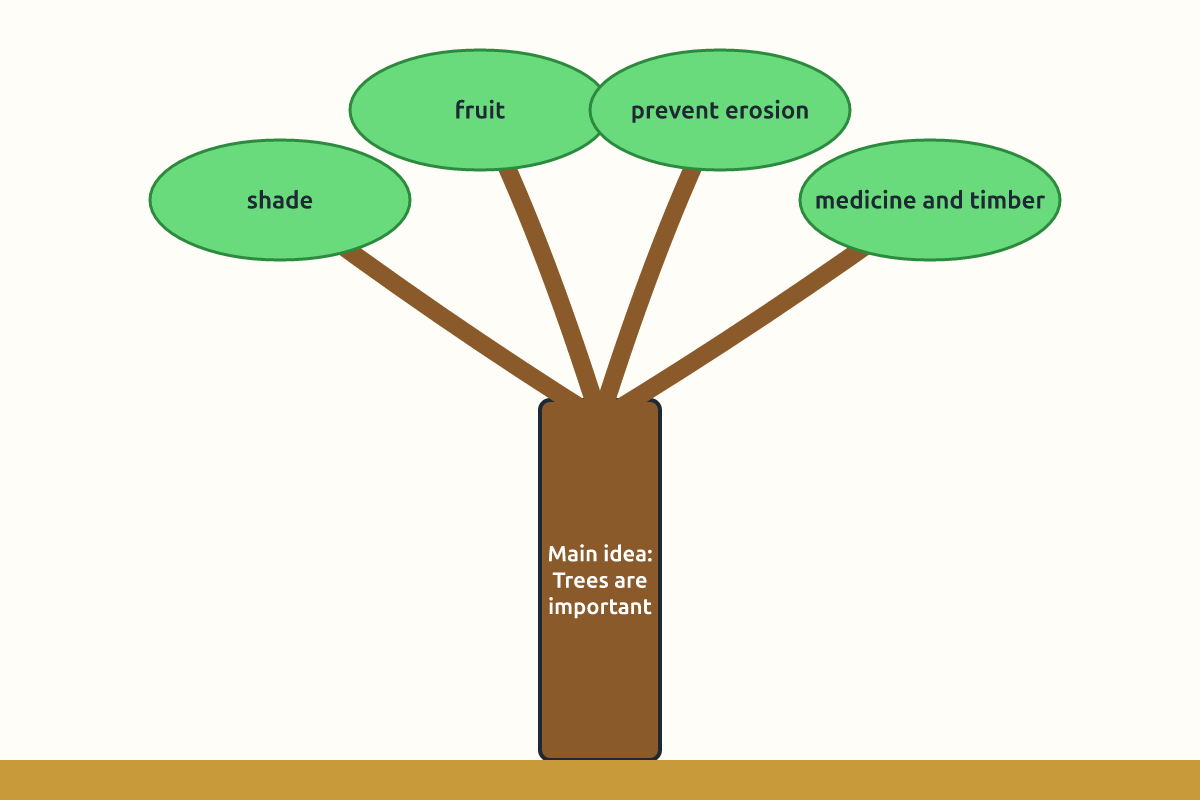
A paragraph has one main idea and several minor (supporting) ideas that explain it.
Main and Minor Ideas
Paragraph: "Trees are very important in our communities. They give us shade on hot afternoons. Their fruits, such as mangoes and oranges, feed us. Their roots hold the soil and prevent erosion. Many trees also provide medicine and timber."
| Type | Idea |
|---|---|
| main idea (topic sentence) | Trees are very important in our communities. |
| minor idea 1 | They give shade. |
| minor idea 2 | Their fruits feed us. |
| minor idea 3 | Their roots prevent erosion. |
| minor idea 4 | They provide medicine and timber. |
The main idea is often in the first sentence, called the topic sentence. Minor ideas give details, examples or reasons that support it.
New words
- main idea
- The most important point of a paragraph.
- topic sentence
- The sentence that states the main idea.
- supporting detail
- A minor idea that explains the main idea.
Summary
- The main idea is the key point; minor ideas support it.
- The topic sentence often comes first.
Exercises
Answer in your exercise book first, then check your answers.
1. The sentence that states the main idea is the…
- A. topic sentence
- B. last word
- C. title
- D. caption
Show answer
Answer: topic sentenceUsually first.2. Minor ideas support the main idea.
- A. True
- B. False
Show answer
Answer: TrueThey give details.3. Tree roots prevent soil ______.
Show answer
Answer: erosionFrom the paragraph.4. Write a topic sentence for a paragraph about the benefits of rain.
Show answer
Answer: E.g. Rain is very important to farmers and everyone.States the main idea.
Lesson 5
- Strand
- Writing Conventions/ Extensive Reading
- Sub-strand
- Using Adverbs, Building the Love and Culture of Reading
- Indicator
- B5.5.6.1.1 – Use adverbs to express manner
Introduction
Adverbs of manner tell us how an action is done. Many end in -ly.
Adverbs of Manner
| Adjective | Adverb |
|---|---|
| quick | quickly |
| careful | carefully |
| happy | happily |
| gentle | gently |
| good | well (irregular) |
| fast | fast (same form) |
| hard | hard (same form) |
Examples: "The nurse spoke gently to the child." "The pupils listened carefully." "Mensah plays football well."
Reading extract: "The old fisherman pulled his net slowly from the water. His grandson watched eagerly. Suddenly, the net jerked violently. The boy shouted excitedly, 'A big fish!' The old man smiled calmly and said, 'Patience, my son.'"
Common mistake: Say "She sings well", not "She sings good".
New words
- adverb
- A word that describes a verb.
- manner
- The way something is done.
- irregular
- Not following the usual pattern.
Summary
- Adverbs of manner tell how an action is done.
- Many are formed by adding -ly; some are irregular, such as well.
Exercises
Answer in your exercise book first, then check your answers.
1. Which is an adverb of manner?
- A. quickly
- B. quick
- C. quicker
- D. quickest
Show answer
Answer: quicklyIt tells how.2. "She sings good" is correct.
- A. True
- B. False
Show answer
Answer: False"She sings well."3. The old man smiled ______ (calm).
Show answer
Answer: calmlyAdd -ly.4. Find three adverbs of manner in the extract.
Show answer
Answer: slowly, eagerly, violently (or excitedly, calmly)-ly words.
Homework
- Write a paragraph with a topic sentence and three minor ideas about your school.