Basic 5 · English Language
Dramatisation, Vocabulary from Reading, Present Tense for Needs, Free Writing and Prepositions
In this topic you will dramatise stories with costumes, build vocabulary through reading, use the simple present to express needs and preferences, write freely on community issues and use prepositions.
By the end of these notes you should be able to:
- Use costumes and props to dramatise a story
- Learn new words from extensive reading
- Use the simple present to express needs and preferences
- Write freely on a community issue
- Use prepositions to show place, time and direction
What you already know
- Speaking Clearly, Two-Syllable Words, Subject-Verb Agreement, Main and Minor Ideas, and Adverbs of Manner
Copy everything that has a blue line on its left into your notebook. The other parts are for reading.
Lesson 1
- Strand
- Oral Language
- Sub-strand
- Dramatization and Role Play
- Indicator
- B5.1.5.1.1 – Use costume to dramatize or role-play parts/whole of stories
Introduction
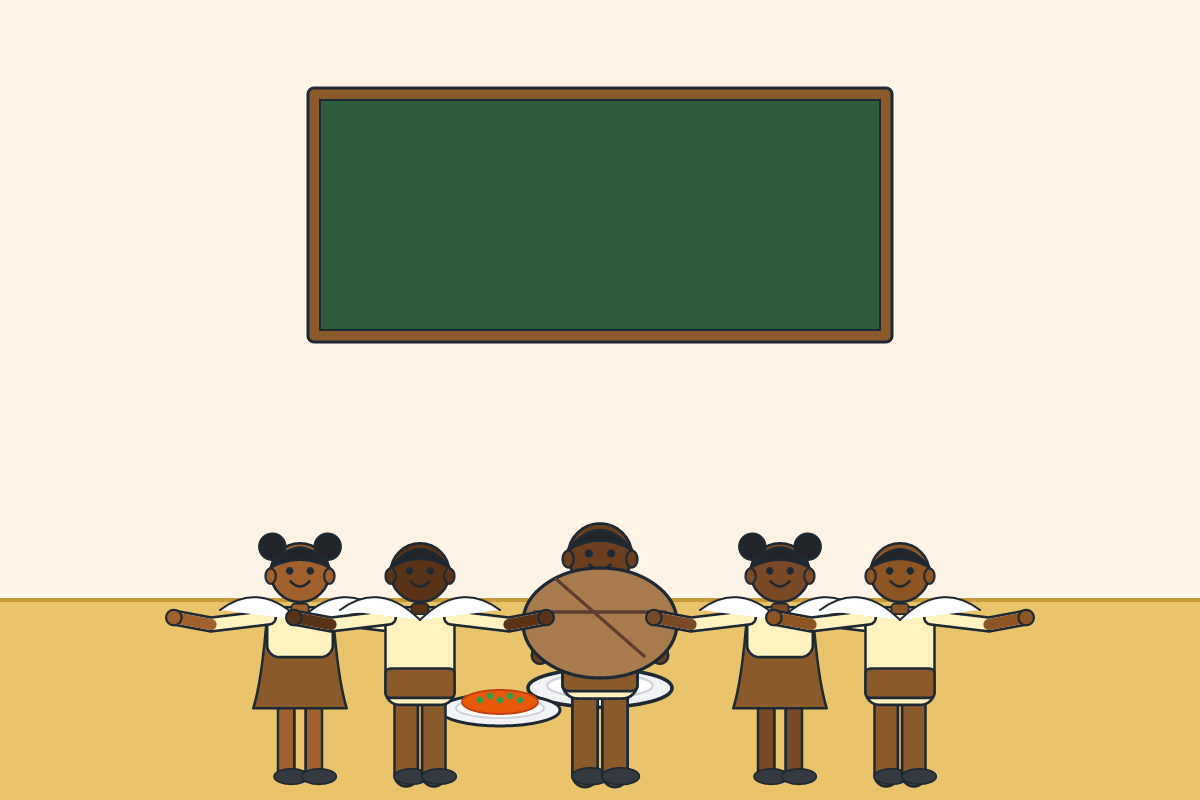
Dramatising a story brings it to life. Costumes and props help the audience believe in the characters.
Dramatising a Story with Costumes
| Element | Example for "The Tortoise and the Feast in the Sky" |
|---|---|
| characters | Tortoise, birds, host |
| costumes | a cardboard shell for Tortoise; paper feather wings for the birds |
| props | bowls of food, a cloth for the "sky" |
| setting | the feast in the sky |
| dialogue | Tortoise: "My name is All of You!" |
Steps
- choose a story and divide it into scenes
- assign roles to group members
- make simple costumes and props from local materials
- write or improvise the dialogue
- rehearse and perform for the class
Remember to face the audience, speak loudly and stay in character even when you are not speaking. A narrator can introduce each scene so that the audience follows the story easily.
New words
- dramatise
- To act out a story.
- costume
- Clothes worn to play a character.
- improvise
- To make up lines while acting.
Summary
- Costumes, props and dialogue bring a story to life.
- Plan scenes, roles and props, then rehearse.
Exercises
Answer in your exercise book first, then check your answers.
1. Clothes worn to play a character are…
- A. costumes
- B. props
- C. scripts
- D. stages
Show answer
Answer: costumese.g. a shell.2. Props are objects used in a play.
- A. True
- B. False
Show answer
Answer: Truee.g. bowls of food.3. To make up lines while acting is to ______.
Show answer
Answer: improviseWithout a script.4. Suggest a costume for a lion in a play.
Show answer
Answer: A paper mane and a brown cloth.Local materials.
Lesson 2
- Strand
- Reading
- Sub-strand
- Vocabulary
- Indicator
- B5.2.6.2.1 – Develop a rich vocabulary stock through extensive reading
Introduction
The more you read, the more words you learn. Extensive reading means reading many books for enjoyment.
Building Vocabulary through Reading
Reading extract: "The harmattan arrived early that year. A fine, dusty haze covered the town, and the sun looked pale like a coin. Grandmother rubbed shea butter on our cracked lips and warned us to wrap up warmly at dawn. By afternoon, the air was dry and scorching, and the leaves of the cassava drooped."
| Word | Clue in the text | Meaning |
|---|---|---|
| harmattan | dusty haze, dry air | a dry, dusty wind from the Sahara (Nov–Mar) |
| haze | covered the town | a thin mist of dust |
| pale | like a coin | light in colour |
| dawn | wrap up warmly | early morning |
| scorching | dry air in the afternoon | very hot |
| drooped | the leaves of the cassava | hung down weakly |
Ways to learn new words
- use context clues in the sentence
- look the word up in a dictionary
- keep a vocabulary notebook
- use the new word in your own sentences
New words
- extensive reading
- Reading many books for enjoyment.
- context clue
- Hints in the text that show a word's meaning.
- dictionary
- A book that gives the meanings of words.
Summary
- Reading widely builds a rich vocabulary.
- Use context clues and a dictionary, and keep a vocabulary notebook.
Exercises
Answer in your exercise book first, then check your answers.
1. "Scorching" means…
- A. very hot
- B. very cold
- C. wet
- D. dark
Show answer
Answer: very hotFrom context.2. The harmattan is a dry, dusty wind.
- A. True
- B. False
Show answer
Answer: TrueIt comes from the Sahara.3. Early morning is called ______.
Show answer
Answer: dawnFrom the extract.4. Use "drooped" in a sentence of your own.
Show answer
Answer: E.g. The flowers drooped in the heat.Correct use.
Lesson 3
- Strand
- Grammar
- Sub-strand
- Verbs
- Indicator
- B5.3.5.1.3 – Use the simple present form of verbs to express needs or preferences
Introduction
We use the simple present tense to talk about what we need, want or prefer now.
Simple Present for Needs and Preferences
| Purpose | Example |
|---|---|
| need | I need a new exercise book. |
| want | We want more time for sports. |
| preference | Esi prefers rice to banku. |
| liking | Kojo likes reading comics. |
| dislike | My father dislikes noise. |
Remember: with he, she, it or a singular noun, add -s or -es to the verb: "She needs", "He prefers", "It wants".
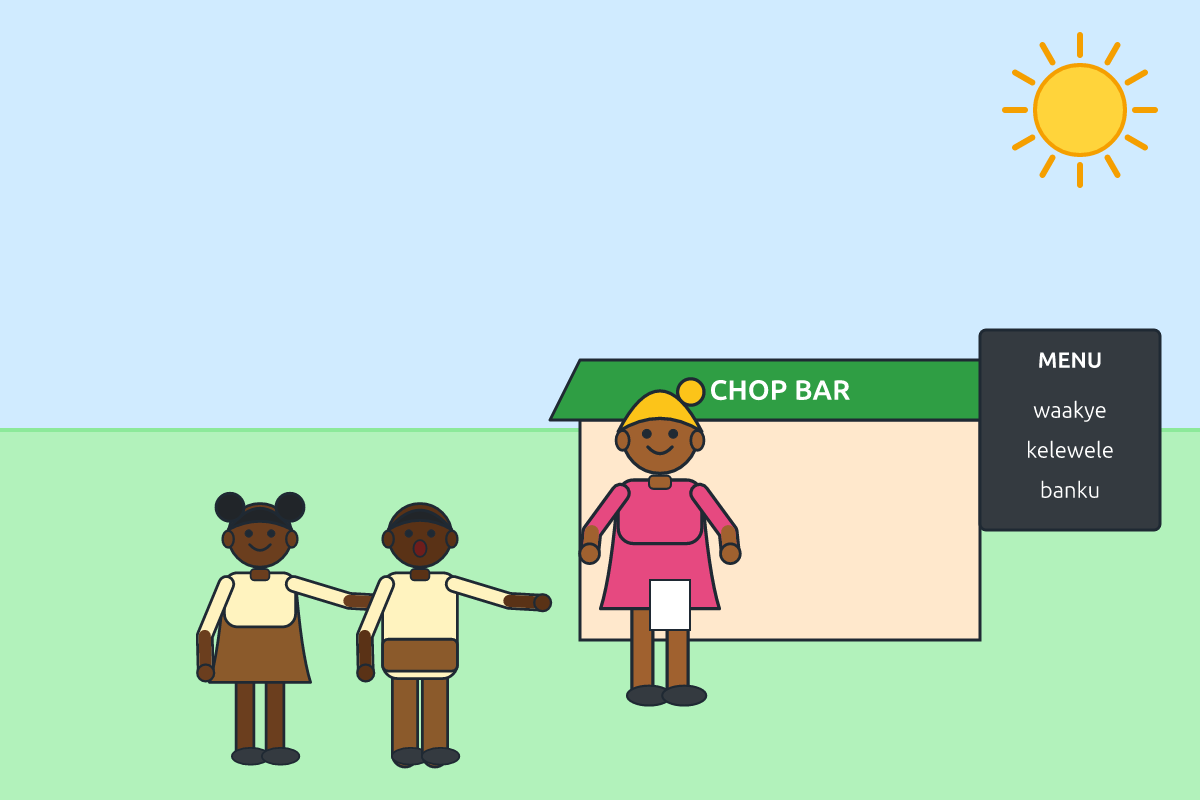
Dialogue: "Waiter: What would you like? Ama: I prefer waakye to rice, please. My brother likes kelewele. We both need cold water."
New words
- preference
- Something you like better than another.
- prefer
- To like one thing more than another.
- simple present
- A tense for habits, facts, needs and likes.
Summary
- Use the simple present to express needs, wants and preferences.
- Add -s or -es with he, she and it.
Exercises
Answer in your exercise book first, then check your answers.
1. Choose: She ___ rice to banku.
- A. prefers
- B. prefer
- C. preferring
- D. preferred
Show answer
Answer: prefersAdd -s with she.2. "I needs water" is correct.
- A. True
- B. False
Show answer
Answer: False"I need water."3. My brother ______ (like) kelewele.
Show answer
Answer: likesSingular subject.4. Write two sentences about what your class needs.
Show answer
Answer: E.g. We need more chairs. Our class needs a cupboard.Simple present.
Lesson 4
- Strand
- Writing
- Sub-strand
- Creative Writing
- Indicator
- B5.4.11.1.1 – Write freely on topics of choice on issues in the community
Introduction
Free writing lets you express your thoughts on a topic you care about. Write freely, then improve your work.
Free Writing on Community Issues
Sample free writing: "Our Town Needs a Library. In my town, Atebubu, many children love stories, but we have no library. After school, some of my friends sit at home doing nothing, while others wander around the lorry station. A library would give us a safe place to read, study and learn computer skills. The assembly could use the old post office building, and people could donate books. If we had a library, our town would have more readers, better results and brighter futures."
Tips for free writing
- choose an issue you feel strongly about
- write without stopping for about ten minutes
- do not worry about mistakes in the first draft
- read it again, then improve ideas, order and language
New words
- free writing
- Writing freely without stopping to correct.
- issue
- A problem or concern in the community.
- donate
- To give freely.
Summary
- Free writing helps you express ideas on issues you care about.
- Write first, then revise and edit.
Exercises
Answer in your exercise book first, then check your answers.
1. What does the writer want for Atebubu?
- A. a library
- B. a market
- C. a stadium
- D. a bank
Show answer
Answer: a libraryThe title says so.2. In free writing, you stop often to correct mistakes.
- A. True
- B. False
Show answer
Answer: FalseWrite freely first.3. The assembly could use the old ______ building.
Show answer
Answer: post officeFrom the sample.4. Name two benefits of a library mentioned in the sample.
Show answer
Answer: A safe place to read and study, and learning computer skills (or better results).Any two.
Lesson 5
- Strand
- Writing Conventions/ Extensive Reading
- Sub-strand
- Building the Love and Culture of Reading
- Indicator
- B5.5.7.1.1 – Use prepositions to convey a variety of meanings
Introduction
Prepositions show the relationship between a noun and other words. They tell us where, when and how.
Prepositions
| Meaning | Prepositions | Example |
|---|---|---|
| place | in, on, under, beside, between, behind | The cat is under the table. |
| time | at, on, in, before, after, during | We meet at 8 a.m. on Monday in June. |
| direction | to, into, towards, across, through | She walked across the bridge. |
| means | by, with | We travelled by bus. |
Time rules: "at" for exact times (at noon), "on" for days and dates (on Friday), "in" for months, years and parts of the day (in March, in the morning).
Reading extract: "During the holidays, Kojo travelled by train from Takoradi to Tarkwa. He sat beside a window and looked across the green fields. In the evening, the train passed through a dark forest and arrived at the station before midnight."
New words
- preposition
- A word showing the relationship between a noun and other words.
- direction
- The way something moves.
- relationship
- A connection between things.
Summary
- Prepositions show place, time, direction and means.
- Use at, on and in correctly for time.
Exercises
Answer in your exercise book first, then check your answers.
1. Choose: The book is ___ the bag.
- A. in
- B. at
- C. by
- D. during
Show answer
Answer: inPlace.2. We say "on Monday".
- A. True
- B. False
Show answer
Answer: True"On" for days.3. Kojo travelled ______ train.
Show answer
Answer: byMeans of transport.4. Find four prepositions in the extract.
Show answer
Answer: during, by, from, beside (or across, through, at, before).Any four.
Homework
- Write a free-writing piece on an issue in your community, then revise it.