Basic 5 · English Language
Pace and Stress, Inferring Meaning, Coordinating Conjunctions, Supporting Opinions and Correlative Conjunctions
In this topic you will use pace and stress to convey meaning, infer meaning from a passage, use coordinating conjunctions, support opinions with explanations and use paired conjunctions.
By the end of these notes you should be able to:
- Show how pace and stress change meaning
- Infer meaning from a level-appropriate passage
- Use coordinating conjunctions
- Write explanations to support opinions
- Use correlative conjunctions such as either … or
What you already know
- Dramatisation, Vocabulary from Reading, Present Tense for Needs, Free Writing and Prepositions
Copy everything that has a blue line on its left into your notebook. The other parts are for reading.
Lesson 1
- Strand
- Oral Language
- Sub-strand
- Presentation
- Indicator
- B5.1.10.1.3 – Demonstrate awareness of how meaning is conveyed through appropriate pace stress and tone
Introduction
How fast we speak (pace) and which words we stress can change what a sentence means.
Pace and Stress
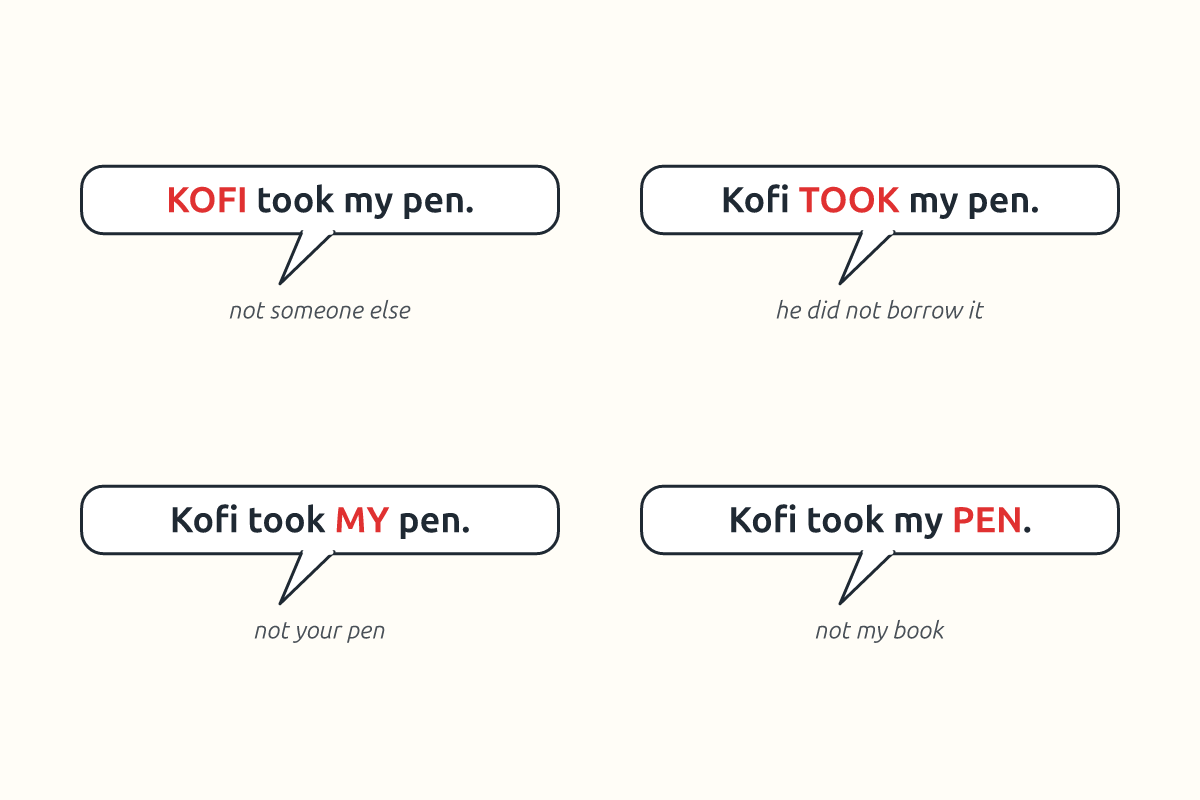
| Sentence (stressed word in capitals) | Meaning |
|---|---|
| KOFI took my pen. | It was Kofi, not someone else. |
| Kofi TOOK my pen. | He took it; he did not borrow it. |
| Kofi took MY pen. | It was my pen, not yours. |
| Kofi took my PEN. | It was my pen, not my book. |
| Pace | Effect | When to use |
|---|---|---|
| slow | serious, important, clear | announcements, instructions, sad news |
| normal | natural and easy to follow | conversation, reading aloud |
| fast | excited or urgent | describing a race or an emergency |
Try this: read "The fire is spreading. Everyone must leave the building now" slowly and firmly, then read "Goal! Ghana has scored!" quickly and excitedly. Notice how pace and stress change the effect on the listener.
New words
- pace
- The speed of speaking.
- stress
- Saying a word more strongly.
- emphasis
- Special importance given to a word.
Summary
- Stressing different words changes the meaning of a sentence.
- Pace should suit the message and the audience.
Exercises
Answer in your exercise book first, then check your answers.
1. "Kofi took MY pen" means…
- A. it was my pen, not yours
- B. Kofi borrowed it
- C. it was a book
- D. Kofi did not take it
Show answer
Answer: it was my pen, not yoursStress on "my".2. Important announcements should be read slowly.
- A. True
- B. False
Show answer
Answer: TrueFor clarity.3. The speed of speaking is called ______.
Show answer
Answer: paceSlow or fast.4. What does "Kofi TOOK my pen" suggest?
Show answer
Answer: That he took it without permission rather than borrowing it.Stress on "took".
Lesson 2
- Strand
- Reading
- Sub-strand
- Silent Reading
- Indicator
- B5.2.8.1.1 – Infer meaning from level-appropriate texts
Introduction
Writers do not always say everything directly. Good readers infer meaning by using clues in the text and their own knowledge.
Reading Passage: The Empty Chair
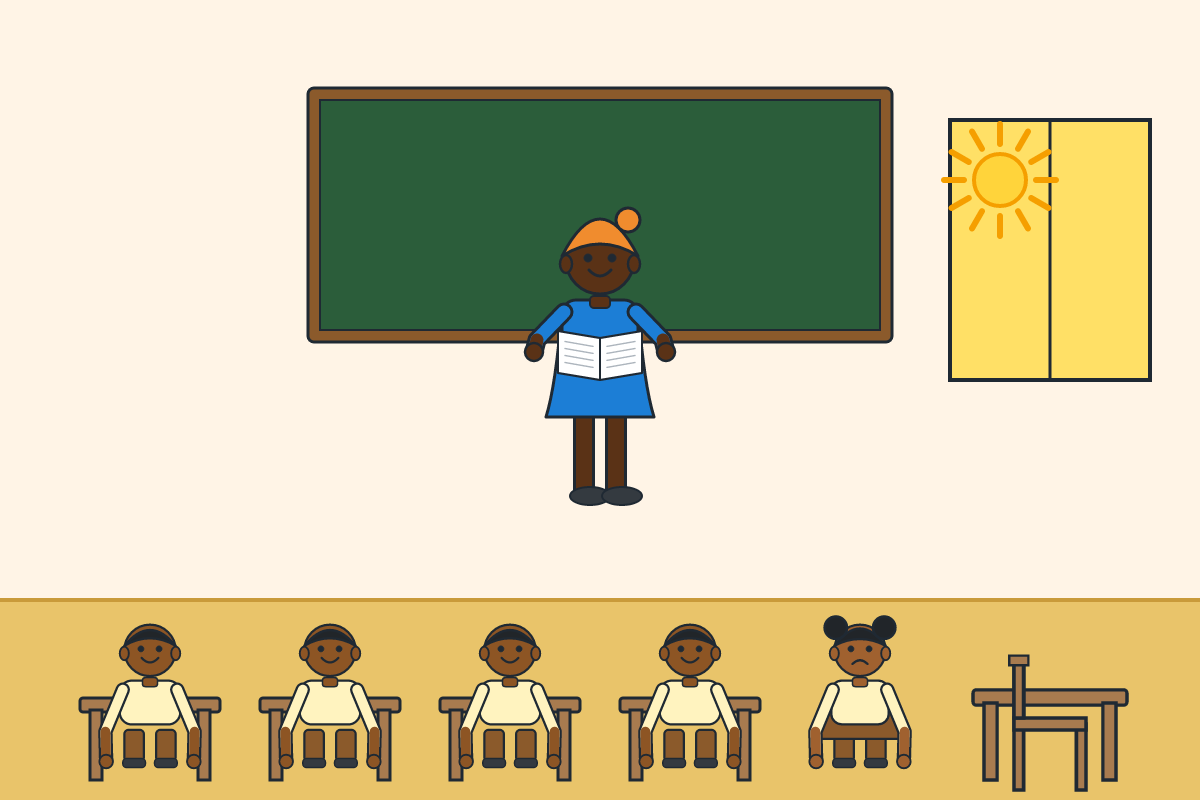
"Every morning, Mr Badu called the register, and every morning he paused at one name: 'Akosua Nyarko.' For two weeks, her chair by the window had been empty.
At break time, her best friend Efua sat alone, staring at the gate. She had stopped laughing at jokes, and her lunch box came back full each afternoon.
On Thursday, Mr Badu asked Efua to stay behind. 'You know where Akosua is, don't you?' he said gently. Efua's eyes filled with tears. 'Her mother is sick, sir. Akosua sells oranges at the lorry station so they can buy medicine.'
The next Monday, Mr Badu did not call Akosua's name. Instead, he announced that the Parent-Teacher Association had agreed to help Akosua's family. That afternoon, the chair by the window was no longer empty, and Efua's lunch box came back empty too."
| Question | Clue | Inference |
|---|---|---|
| How did Efua feel while Akosua was away? | sat alone, stopped laughing, did not eat | sad and worried |
| Why did Mr Badu pause at Akosua's name? | her chair was empty for two weeks | he was concerned about her |
| Why did Efua's lunch box come back empty at the end? | Akosua had returned | Efua was happy again and ate her food |
| What kind of teacher was Mr Badu? | asked gently, arranged help | caring and kind |
New words
- infer
- To work out something not stated directly.
- clue
- A hint that helps you understand.
- register
- A list of pupils' names for attendance.
Summary
- Inference uses clues in the text and your own knowledge.
- Writers often show feelings through actions instead of naming them.
Exercises
Answer in your exercise book first, then check your answers.
1. Why was Akosua absent?
- A. She was selling oranges to buy medicine for her mother
- B. She was lazy
- C. She moved town
- D. She was on holiday
Show answer
Answer: She was selling oranges to buy medicine for her motherParagraph 3.2. Efua was happy while Akosua was away.
- A. True
- B. False
Show answer
Answer: FalseShe was sad and worried.3. Akosua's chair was by the ______.
Show answer
Answer: windowParagraph 1.4. What can you infer from "Efua's lunch box came back empty too"?
Show answer
Answer: Efua was happy again and had her appetite back because Akosua had returned.Inference from action.
Lesson 3
- Strand
- Grammar
- Sub-strand
- Conjunctions
- Indicator
- B5.3.8.1.1 – Identify and use simple conjunctions
Introduction
Conjunctions are joining words. Coordinating conjunctions join words, phrases or sentences of equal importance.
Coordinating Conjunctions (FANBOYS)
| Conjunction | Use | Example |
|---|---|---|
| for | gives a reason | We stayed inside, for it was raining. |
| and | adds | Ama sings and dances. |
| nor | adds a negative | He does not drink, nor does he smoke. |
| but | shows contrast | Kofi is short, but he plays basketball well. |
| or | gives a choice | Do you want rice or yam? |
| yet | shows surprising contrast | It was late, yet the shop was open. |
| so | shows a result | The road was flooded, so we went home. |
When a coordinating conjunction joins two full sentences, put a comma before it: "It rained, so the match was cancelled."
Passage: "Yaw wanted to play football, but his mother asked him to help at the shop. He was disappointed, yet he obeyed. He arranged the tins and swept the floor, so his mother gave him money for a ball."
New words
- conjunction
- A joining word.
- coordinating
- Joining things of equal importance.
- contrast
- A difference between two things.
Summary
- Remember FANBOYS: for, and, nor, but, or, yet, so.
- Put a comma before the conjunction when joining two sentences.
Exercises
Answer in your exercise book first, then check your answers.
1. Which conjunction shows a result?
- A. so
- B. but
- C. or
- D. nor
Show answer
Answer: soCause and result.2. "But" shows contrast.
- A. True
- B. False
Show answer
Answer: Truee.g. short but skilful.3. Do you want rice ______ yam?
Show answer
Answer: orA choice.4. Join with a conjunction: "It was late. The shop was open."
Show answer
Answer: It was late, yet the shop was open.Surprising contrast.
Lesson 4
- Strand
- Writing
- Sub-strand
- Argumentative Writing
- Indicator
- B5.4.13.1.1 – Write explanations to support opinions
Introduction
An opinion is what you think or believe. A good writer supports opinions with reasons and examples.
Writing Explanations to Support Opinions
| Part | Example |
|---|---|
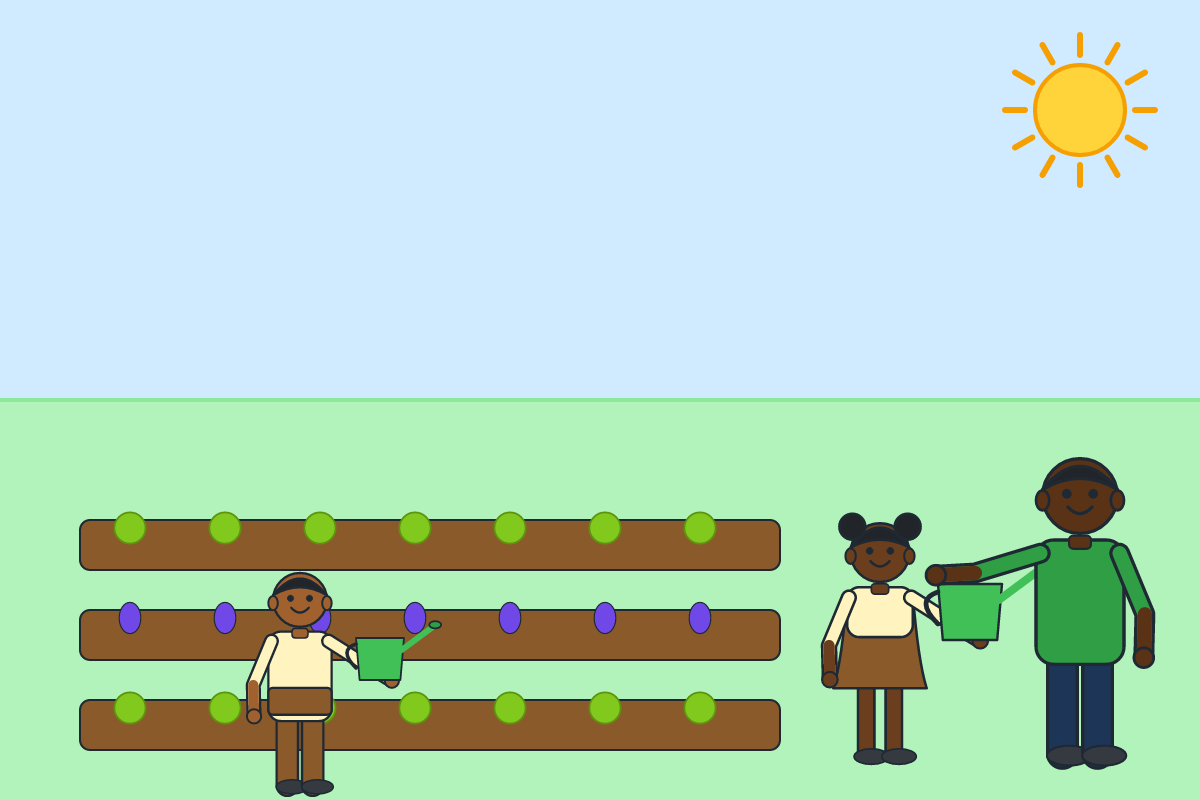
| opinion | I believe every school should have a school garden. |
| reason 1 + explanation | First, gardens teach pupils farming skills that they can use at home. |
| reason 2 + example | Second, the vegetables can be used in the school feeding programme, as happens at our school. |
| reason 3 | Finally, working together in the garden builds teamwork. |
| conclusion | For these reasons, school gardens are very useful. |
Useful phrases
- In my opinion, … / I believe that …
- This is because … / For example, …
- Furthermore, … / Moreover, …
- Therefore, … / For these reasons, …
New words
- opinion
- What a person thinks or believes.
- reason
- Why something is true or right.
- evidence
- Facts or examples that support an opinion.
Summary
- State your opinion clearly, then give reasons and examples.
- Use linking phrases and end with a conclusion.
Exercises
Answer in your exercise book first, then check your answers.
1. Which phrase introduces an opinion?
- A. In my opinion
- B. For example
- C. Finally
- D. Moreover
Show answer
Answer: In my opinionIt shows what you think.2. Opinions should be supported with reasons.
- A. True
- B. False
Show answer
Answer: TrueReasons convince readers.3. "______ example, our school uses the vegetables."
Show answer
Answer: ForGiving an example.4. Give one reason to support "Pupils should read every day."
Show answer
Answer: Reading improves vocabulary and helps in all subjects.A clear reason.
Lesson 5
- Strand
- Writing Conventions/ Extensive Reading
- Sub-strand
- Using Conjunctions., Building the Love and Culture of Reading
- Indicator
- B5.5.8.1.1 – Identify and use conjunctions (correlative pairs)
Introduction
Some conjunctions work in pairs. They are called correlative conjunctions.
Correlative Conjunctions
| Pair | Example |
|---|---|
| either … or | You can either walk or take a taxi. |
| neither … nor | Neither Ama nor Esi was late. |
| both … and | Both the teacher and the pupils clapped. |
| not only … but also | Kofi is not only clever but also kind. |
| whether … or | I do not know whether to stay or go. |
The verb agrees with the nearer subject after "either … or" and "neither … nor": "Neither the boys nor the girl is ready."
Reading extract: "Both the Black Stars and the Black Queens trained at the stadium. Neither the rain nor the heat stopped them. The coach said they must not only run fast but also pass accurately. 'You can either work hard or go home,' he said with a smile."
New words
- correlative
- Working in a pair.
- pair
- Two things that go together.
- accurately
- Correctly and exactly.
Summary
- Correlative conjunctions work in pairs: either … or, neither … nor.
- The verb agrees with the nearer subject.
Exercises
Answer in your exercise book first, then check your answers.
1. Complete: Neither Ama ___ Esi was late.
- A. nor
- B. or
- C. and
- D. but
Show answer
Answer: norNeither … nor.2. "Both … and" is a correlative pair.
- A. True
- B. False
Show answer
Answer: TrueUsed together.3. Kofi is not only clever ______ also kind.
Show answer
Answer: butNot only … but also.4. Write a sentence using "either … or".
Show answer
Answer: E.g. You can either read or draw.A choice.
Homework
- Write an opinion paragraph on "Pupils should wear school uniforms" with three reasons.