Basic 5 · English Language
Tone and Intonation, Scanning, Subordinating Conjunctions, Descriptive Writing and Compound Sentences
In this topic you will use tone and intonation, scan texts for details and read closely, use subordinating conjunctions, write descriptions with figurative language and identify subjects and predicates in compound sentences.
By the end of these notes you should be able to:
- Use tone and intonation to convey meaning
- Scan a text for details and read it closely
- Use subordinating conjunctions
- Describe places and events with figurative language
- Identify subjects and predicates in compound sentences
What you already know
- Pace and Stress, Inferring Meaning, Coordinating Conjunctions, Supporting Opinions and Correlative Conjunctions
Copy everything that has a blue line on its left into your notebook. The other parts are for reading.
Lesson 1
- Strand
- Oral Language
- Sub-strand
- Presentation
- Indicator
- B5.1.10.1.3 – Demonstrate awareness of how meaning is conveyed through appropriate tone and intonation
Introduction
Tone is the feeling in your voice. Intonation is the rise and fall of your voice. Both help listeners understand your meaning.
Tone and Intonation
| Pattern | Use | Example |
|---|---|---|
| falling ↘ | statements and commands | "Close the door." "It is raining." |
| rising ↗ | yes/no questions | "Are you coming?" |
| falling ↘ | wh- questions | "Where do you live?" |
| rising then falling | lists and choices | "Rice ↗, beans ↗ or yam ↘?" |
| Tone | Example situation |
|---|---|
| polite and warm | greeting a visitor |
| firm | giving a safety instruction |
| excited | announcing good news |
| sympathetic | comforting a friend |
The same words can mean different things with a different tone. "Well done" said warmly is praise; said with a falling, flat tone, it may sound like sarcasm.
New words
- intonation
- The rise and fall of the voice.
- tone
- The feeling expressed by the voice.
- sympathetic
- Showing care for someone's sadness.
Summary
- Statements fall in pitch; yes/no questions rise.
- Choose a tone that suits the situation.
Exercises
Answer in your exercise book first, then check your answers.
1. A yes/no question usually ends with…
- A. rising intonation
- B. falling intonation
- C. no sound
- D. shouting
Show answer
Answer: rising intonatione.g. Are you coming?2. A command usually has falling intonation.
- A. True
- B. False
Show answer
Answer: Truee.g. Close the door.3. The feeling expressed by the voice is ______.
Show answer
Answer: tonee.g. warm, firm.4. What tone would you use to comfort a friend who failed a test?
Show answer
Answer: A gentle, sympathetic tone.Suits the situation.
Lesson 2
- Strand
- Reading
- Sub-strand
- Comprehension
- Indicator
- B5.2.7.1.3 – Scan texts for details and read level-appropriate texts silently and closely for comprehension
Introduction
Scanning means looking quickly through a text to find specific details. Close reading means reading carefully to understand fully.
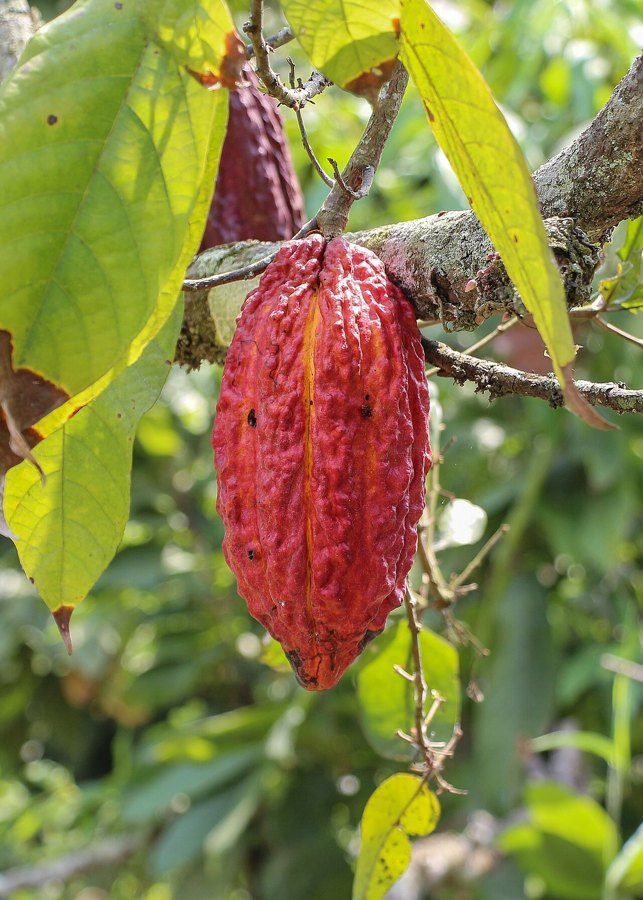
Reading Passage: Ghana's Cocoa Story
"Cocoa is one of Ghana's most important crops. It was introduced to the Gold Coast in 1879 by Tetteh Quarshie, a blacksmith who brought cocoa pods back from the island of Fernando Po. He planted them at Mampong in the Akuapem area of the Eastern Region.
Cocoa grows well in warm, wet forest areas, especially in the Western, Ashanti, Eastern and Central regions. Farmers plant seedlings under shade trees. After about three to five years, the trees begin to produce pods, which grow directly on the trunk and branches.
When the pods ripen, farmers cut them down, break them open and remove the beans. The beans are fermented under banana leaves for about six days and then dried in the sun for about a week. This process gives the chocolate its flavour.
Ghana is one of the world's largest producers of cocoa, and the crop brings in a lot of foreign money. However, cocoa farming faces problems such as diseases, ageing trees, galamsey on farmland and low prices. The Ghana Cocoa Board (COCOBOD) supports farmers with seedlings and advice."
| Question | Answer |
|---|---|
| Who introduced cocoa? | Tetteh Quarshie |
| In which year? | 1879 |
| Where were the first seeds planted? | Mampong, Akuapem |
| How long are beans fermented? | about six days |
| Which body supports cocoa farmers? | Ghana Cocoa Board (COCOBOD) |
New words
- scan
- To look quickly for specific information.
- ferment
- To change by the action of tiny organisms over time.
- producer
- A person or country that grows or makes something.
Summary
- Scan for names, dates and numbers; read closely for understanding.
- Cocoa was introduced by Tetteh Quarshie in 1879.
Exercises
Answer in your exercise book first, then check your answers.
1. Who introduced cocoa to the Gold Coast?
- A. Tetteh Quarshie
- B. Kwame Nkrumah
- C. Yaa Asantewaa
- D. Kofi Annan
Show answer
Answer: Tetteh QuarshieParagraph 1.2. Cocoa pods grow on the trunk and branches.
- A. True
- B. False
Show answer
Answer: TrueParagraph 2.3. Beans are dried in the sun for about a ______.
Show answer
Answer: weekParagraph 3.4. State two problems facing cocoa farming.
Show answer
Answer: Diseases and galamsey on farmland (or ageing trees, low prices).Paragraph 4.
Lesson 3
- Strand
- Grammar
- Sub-strand
- Conjunctions
- Indicator
- B5.3.8.1.1 – Identify and use simple conjunctions (subordinating conjunctions)
Introduction
Subordinating conjunctions join a main clause to a less important clause that cannot stand alone.
Subordinating Conjunctions
| Conjunction | Meaning | Example |
|---|---|---|
| because | reason | We stayed home because it rained. |
| although | contrast | Although she was tired, she finished her work. |
| when | time | Call me when you arrive. |
| if | condition | If you study, you will pass. |
| until | time limit | Wait until the bus stops. |
| unless | condition (if not) | You will be late unless you hurry. |
| while | at the same time | Mother cooked while we swept. |
If the sentence begins with the subordinate clause, use a comma: "Because it rained, we stayed home."
Passage: "When the rains came, the farmers rejoiced. Although the soil was hard, they began to plough. They worked until the sun set, because they wanted to plant before the next rain."
New words
- clause
- A group of words with a subject and a verb.
- main clause
- A clause that can stand alone.
- subordinate clause
- A clause that cannot stand alone.
Summary
- Subordinating conjunctions introduce clauses that depend on a main clause.
- Use a comma when the subordinate clause comes first.
Exercises
Answer in your exercise book first, then check your answers.
1. Which shows a reason?
- A. because
- B. although
- C. until
- D. while
Show answer
Answer: becauseGives a reason.2. "Although she was tired" can stand alone as a sentence.
- A. True
- B. False
Show answer
Answer: FalseIt is a subordinate clause.3. You will be late ______ you hurry.
Show answer
Answer: unlessCondition.4. Join: "It was hot. We played football." (although)
Show answer
Answer: Although it was hot, we played football.Comma after the clause.
Lesson 4
- Strand
- Writing
- Sub-strand
- Descriptive Writing
- Indicator
- B5.4.12.1.1 – Use descriptive words/ figurative language to describe places personal experiences and events
Introduction
Descriptive writing paints pictures with words. Figurative language makes descriptions vivid and memorable.
Descriptive Writing and Figurative Language
| Type | Meaning | Example |
|---|---|---|
| simile | compares using "like" or "as" | The kente shone like gold. |
| metaphor | says one thing is another | The market is a beehive. |
| personification | gives human qualities to things | The wind whispered through the palms. |
| onomatopoeia | words that sound like their meaning | The drum went boom, boom! |
| hyperbole | exaggeration | I have told you a million times! |
Sample description: "Makola Market at noon is a beehive. Traders call out like birds at dawn, and the smell of smoked fish dances through the air. Bright cloths flap in the breeze, and the sun beats down like a drum. Taxis honk, peep-peep, as they squeeze through the crowd."

New words
- figurative language
- Words used in a non-literal way for effect.
- simile
- A comparison using like or as.
- metaphor
- A direct comparison without like or as.
Summary
- Descriptive writing uses the senses and figurative language.
- Similes, metaphors and personification make writing vivid.
Exercises
Answer in your exercise book first, then check your answers.
1. "The kente shone like gold" is a…
- A. simile
- B. metaphor
- C. hyperbole
- D. onomatopoeia
Show answer
Answer: simileIt uses "like".2. "The wind whispered" is personification.
- A. True
- B. False
Show answer
Answer: TrueWind cannot really whisper.3. "The market is a beehive" is a ______.
Show answer
Answer: metaphorNo like or as.4. Write a simile to describe the harmattan morning.
Show answer
Answer: E.g. The air was as cold as ice water.Like or as.
Lesson 5
- Strand
- Writing Conventions/ Extensive Reading
- Sub-strand
- Using Simple and Complex Sentences, Building the Love and Culture of Reading
- Indicator
- B5.5.9.1.1 – Identify subjects and predicates in compound sentences
Introduction
Every sentence has two parts: the subject (who or what) and the predicate (what the subject does or is). A compound sentence joins two such sentences.
Subjects and Predicates in Compound Sentences
| Subject | Predicate |
|---|---|
| The farmer | planted maize. |
| My sister | is a nurse. |
A compound sentence joins two independent clauses with a coordinating conjunction: "The farmer planted maize, and his wife planted cassava."
| Clause | Subject | Predicate |
|---|---|---|
| 1 | The farmer | planted maize |
| conjunction | and | |
| 2 | his wife | planted cassava |
Reading extract: "The bell rang, and the pupils lined up. The headteacher spoke, but some pupils were not listening. The prefects clapped, so everyone joined in."
New words
- subject
- Who or what the sentence is about.
- predicate
- What is said about the subject.
- compound sentence
- Two independent clauses joined by a conjunction.
Summary
- A sentence has a subject and a predicate.
- A compound sentence has two subjects and two predicates joined by a conjunction.
Exercises
Answer in your exercise book first, then check your answers.
1. In "The bell rang", the subject is…
- A. The bell
- B. rang
- C. The
- D. bell rang
Show answer
Answer: The bellWho or what.2. A compound sentence has two independent clauses.
- A. True
- B. False
Show answer
Answer: TrueJoined by a conjunction.3. In "The prefects clapped", "clapped" is the ______.
Show answer
Answer: predicateWhat the subject did.4. Find the subjects and predicates: "The headteacher spoke, but some pupils were not listening."
Show answer
Answer: Subjects: The headteacher, some pupils. Predicates: spoke, were not listening.Two clauses.
Homework
- Write a descriptive paragraph about your community using two similes and one metaphor.