Basic 5 · English Language
Reading Aloud, Reading Fluency, Modals, News Reports and Constructing Compound Sentences
In this topic you will read aloud clearly with expression, read grade-level texts with speed and accuracy, use modals, write and present news reports and construct compound sentences.
By the end of these notes you should be able to:
- Read aloud clearly at a good pace with expression
- Read grade-level texts with good speed and accuracy
- Use modals to express ability, permission, advice and obligation
- Write a news report and present it like a radio or TV reporter
- Construct compound sentences correctly
What you already know
- Tone and Intonation, Scanning, Subordinating Conjunctions, Descriptive Writing and Compound Sentences
Copy everything that has a blue line on its left into your notebook. The other parts are for reading.
Lesson 1
- Strand
- Oral Language
- Sub-strand
- Presentation
- Indicator
- B5.1.10.2.1 – Read aloud clearly at a good pace and with expression
Introduction
Reading aloud well helps listeners enjoy and understand a text. It needs clear words, good pace and expression.
Reading Aloud with Expression
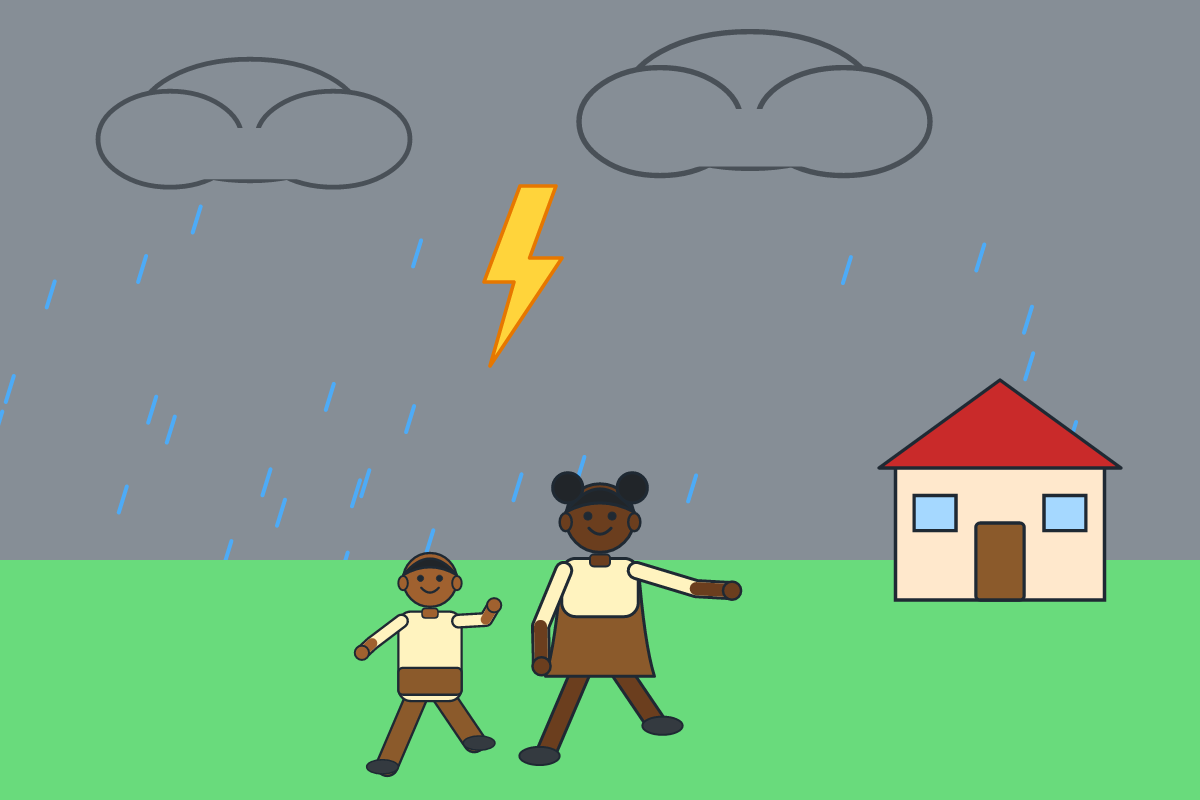
Practice passage: "The thunder roared. Mansa grabbed her little brother's hand and ran towards the house. 'Hurry, Kobby! The storm is coming!' she cried. Big drops began to fall, slowly at first, then faster and faster. Just as they reached the door, the sky opened and the rain poured down. Inside, they laughed and shook the water from their hair. 'We made it,' Kobby whispered."
| Part | How to read it |
|---|---|
| "The thunder roared." | strong, slightly loud |
| "'Hurry, Kobby! The storm is coming!'" | fast and urgent |
| "slowly at first, then faster and faster" | start slowly and speed up |
| "Inside, they laughed" | relieved and happy |
| "'We made it,' Kobby whispered." | soft and quiet |
New words
- expression
- Showing feelings with your voice.
- urgent
- Needing quick action.
- whisper
- To speak very softly.
Summary
- Change pace and volume to match the action and feelings.
- Read dialogue the way the character would say it.
Exercises
Answer in your exercise book first, then check your answers.
1. How should "Kobby whispered" be read?
- A. softly
- B. loudly
- C. angrily
- D. quickly
Show answer
Answer: softlyIt is a whisper.2. "Hurry, Kobby!" should be read with urgency.
- A. True
- B. False
Show answer
Answer: TrueThe storm is coming.3. "The thunder ______."
Show answer
Answer: roaredFirst line.4. Why should you speed up at "faster and faster"?
Show answer
Answer: To match the meaning and make listeners feel the rain getting heavier.Pace matches meaning.
Lesson 2
- Strand
- Reading
- Sub-strand
- Fluency
- Indicator
- B5.2.9.1.1 – Read grade-level texts with good speed and accuracy
Introduction
Fluent readers read with good speed and accuracy. Fluency improves with practice and repeated reading.
Reading Passage: The Kayayo's Dream
"At five o'clock every morning, Fati tied a cloth around her waist, lifted a large metal basin onto her head and walked into Agbogbloshie Market. She was fourteen, and she had come from a village near Tamale to work as a kayayo, carrying loads for shoppers.
The work was hard. Some loads were heavier than a bag of cement, and some customers argued over the fee. At night she slept in a crowded room with ten other girls. But Fati had a plan. Every day she saved part of her earnings in a small tin hidden under her mat.
One afternoon, a woman named Auntie Comfort hired her to carry yams. As they walked, Auntie Comfort asked, 'What would you do if you could do anything?' Fati answered quickly, 'I would go back to school and become a nurse.'
Auntie Comfort worked for a group that helped young head porters. Two months later, Fati returned to her village, enrolled in a junior high school, and used her savings to buy books and sandals. Today, she tells younger girls, 'Your load today does not decide your future. Keep your dream on your head too.'"
| Step | What to do |
|---|---|
| first reading | read silently and underline difficult words (Agbogbloshie, earnings, enrolled) |
| second reading | read aloud slowly and accurately |
| third reading | read aloud at a natural speed with expression |
| check | time yourself for one minute and count the words read correctly |
| Question | Answer |
|---|---|
| What work did Fati do? | she was a kayayo (head porter) in Agbogbloshie Market |
| How did she prepare for her dream? | she saved part of her earnings every day |
| Who helped her? | Auntie Comfort, who worked for a group helping head porters |
| What does "Keep your dream on your head too" mean? | do not forget your goals even when life is hard |
New words
- fluency
- Reading smoothly, quickly and accurately.
- accuracy
- Correctness.
- enrol
- To register at a school.
Summary
- Fluency improves through repeated reading.
- Fati's story shows that saving and determination can change a life.
Exercises
Answer in your exercise book first, then check your answers.
1. What did Fati want to become?
- A. a nurse
- B. a trader
- C. a driver
- D. a singer
Show answer
Answer: a nurseParagraph 3.2. Fati saved part of her earnings.
- A. True
- B. False
Show answer
Answer: TrueIn a tin under her mat.3. Fati came from a village near ______.
Show answer
Answer: TamaleParagraph 1.4. Explain the meaning of "Your load today does not decide your future."
Show answer
Answer: Present hardship should not stop you from achieving your goals later.Inference.
Lesson 3
- Strand
- Grammar
- Sub-strand
- Modals
- Indicator
- B5.3.9.1.1 – Use modals to express a variety of meanings
Introduction
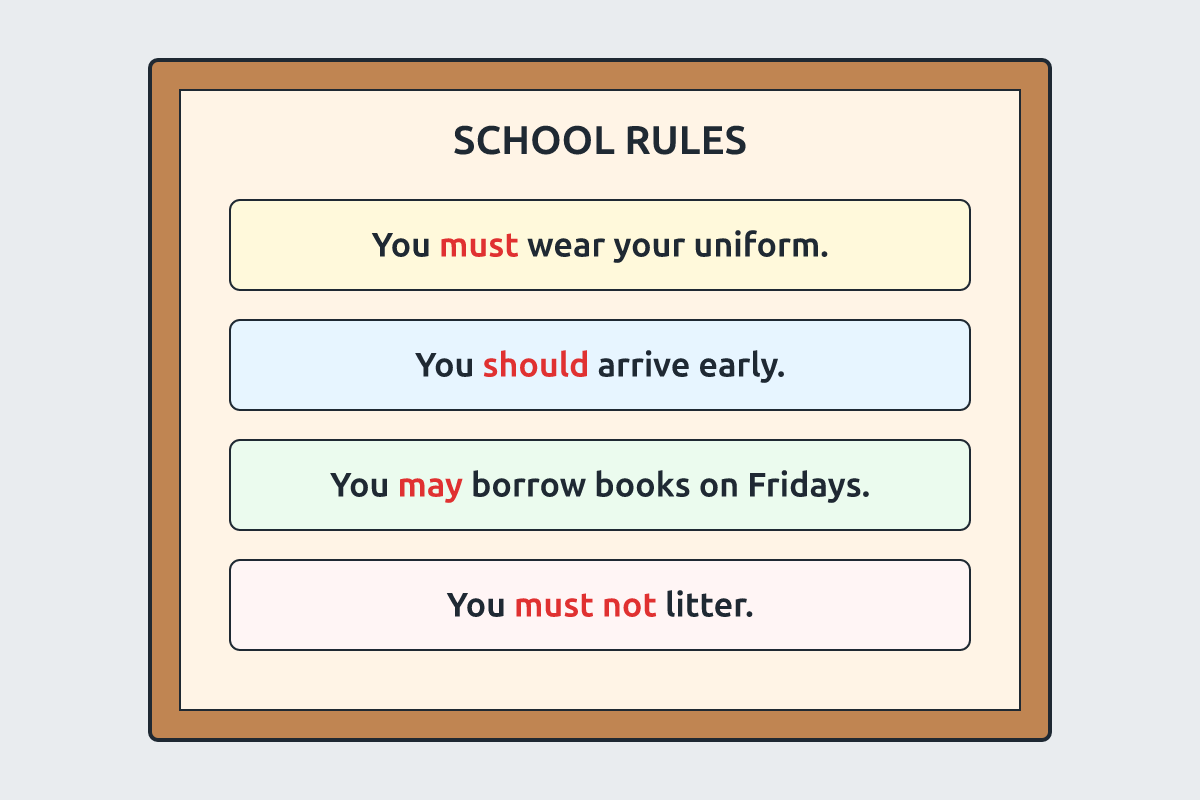
Modal verbs are helping verbs that show ability, permission, possibility, advice or obligation.
Modals
| Modal | Meaning | Example |
|---|---|---|
| can | ability | Kofi can swim. |
| could | past ability or polite request | Could you help me, please? |
| may | permission or possibility | May I go out? It may rain. |
| might | weaker possibility | We might win the match. |
| must | strong obligation | You must wear a seat belt. |
| should | advice | You should drink more water. |
| will | future or willingness | I will help you. |
| would | polite request or imagined situation | Would you like some tea? |
Modals are followed by the base form of the verb: "She can sing" (not "She can sings").
New words
- modal
- A helping verb that shows ability, permission, advice or obligation.
- obligation
- Something you must do.
- possibility
- Something that may happen.
Summary
- Modals show ability, permission, possibility, advice and obligation.
- Use the base form of the verb after a modal.
Exercises
Answer in your exercise book first, then check your answers.
1. Which modal shows ability?
- A. can
- B. must
- C. should
- D. may
Show answer
Answer: cane.g. Kofi can swim.2. "She can sings" is correct.
- A. True
- B. False
Show answer
Answer: False"She can sing."3. You ______ wear a seat belt. (strong obligation)
Show answer
Answer: mustObligation.4. Give advice to a friend who is always late, using "should".
Show answer
Answer: You should wake up earlier.Advice.
Lesson 4
- Strand
- Writing
- Sub-strand
- Informative Writing
- Indicator
- B5.4.14.2.1 – Write about incidence or events of the day and make radio/TV presentations
Introduction
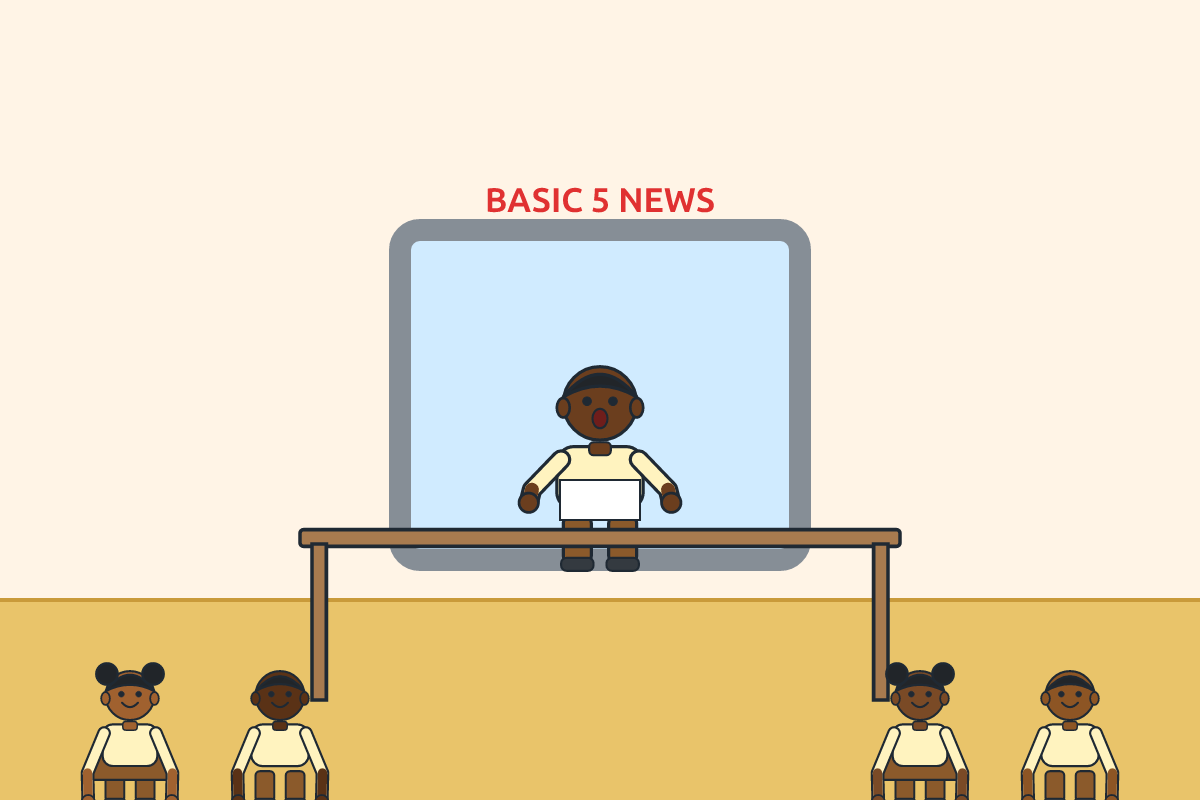
Reporters write about events of the day and present them on radio and TV. A news report gives facts clearly and briefly.
Writing and Presenting a News Report
| Part | Content |
|---|---|
| headline | short, catchy title |
| lead (first paragraph) | answers who, what, when, where |
| body | more details, why and how, quotes from people |
| ending | what will happen next |
Sample report: "BASIC 5 WINS INTER-SCHOOL QUIZ. Basic 5 pupils of Nsuta M/A Primary School won the district quiz competition on Friday at the district assembly hall. The team scored 48 points, beating five other schools. 'We studied every evening for a month,' said team leader Abigail Owusu. The team will represent the district at the regional finals next month."
Presenting on radio or TV
- greet the audience: "Good evening, and welcome to the news."
- read in a clear, steady and serious tone
- look at the camera (TV) or speak close to the microphone (radio)
- end with: "That is the news for today. Thank you."
New words
- headline
- The title of a news report.
- lead
- The opening paragraph of a news report.
- reporter
- A person who gathers and presents news.
Summary
- A news report has a headline, lead, body and ending.
- Present news in a clear, steady and serious tone.
Exercises
Answer in your exercise book first, then check your answers.
1. The title of a news report is the…
- A. headline
- B. lead
- C. body
- D. ending
Show answer
Answer: headlineShort and catchy.2. The lead answers who, what, when and where.
- A. True
- B. False
Show answer
Answer: TrueFirst paragraph.3. The team scored ______ points.
Show answer
Answer: 48From the report.4. Write a headline for a report about a school clean-up exercise.
Show answer
Answer: E.g. PUPILS CLEAN UP SCHOOL COMPOUND.Short and clear.
Lesson 5
- Strand
- Writing Conventions/ Extensive Reading
- Sub-strand
- Using Simple and Complex Sentences, Building the Love and Culture of Reading
- Indicator
- B5.5.9.1.2 – Construct compound sentences correctly
Introduction
You can join two simple sentences to make a compound sentence. This makes writing smoother and more interesting.
Constructing Compound Sentences
Steps
- check that both parts are complete sentences with a subject and a predicate
- choose a coordinating conjunction that shows the right relationship (and, but, or, so, yet, for, nor)
- put a comma before the conjunction
- check that the sentence makes sense
| Two simple sentences | Compound sentence |
|---|---|
| Ama washed the plates. Kofi swept the floor. | Ama washed the plates, and Kofi swept the floor. |
| It was raining. We played football. | It was raining, but we played football. |
| You can walk. You can take a taxi. | You can walk, or you can take a taxi. |
| The road was blocked. The bus turned back. | The road was blocked, so the bus turned back. |
Common mistake: Do not join two sentences with only a comma. "It rained, we stayed home" is wrong. Write "It rained, so we stayed home."
Reading extract: "The harvest was good, and the barns were full. The farmers were tired, but they were happy. They could sell the maize, or they could keep it for the dry season. They chose to keep half, so their families would not go hungry."
New words
- construct
- To build or make.
- independent clause
- A clause that can stand alone as a sentence.
- comma splice
- Wrongly joining two sentences with only a comma.
Summary
- Join two complete sentences with a comma and a coordinating conjunction.
- Avoid comma splices.
Exercises
Answer in your exercise book first, then check your answers.
1. Which is a correct compound sentence?
- A. It rained, so we stayed home.
- B. It rained, we stayed home.
- C. It rained so, we stayed home.
- D. Rained, so stayed home.
Show answer
Answer: It rained, so we stayed home.Comma + conjunction.2. A compound sentence joins two independent clauses.
- A. True
- B. False
Show answer
Answer: TrueWith a conjunction.3. The farmers were tired, ______ they were happy.
Show answer
Answer: butContrast.4. Join: "Esi likes music. Her brother likes football."
Show answer
Answer: Esi likes music, but her brother likes football (or and).Compound sentence.
Homework
- Write a news report about an event in your community and present it to your family.