Basic 5 · English Language
Lessons in Stories, Closing Diphthongs, Indefinite Pronouns, Setting and Characters, and Two Past Tenses
In this topic you will comment on lessons in stories, use closing diphthongs, use indefinite pronouns, create settings and characters, and compare the simple past with the present perfect tense.
By the end of these notes you should be able to:
- Make relevant comments on the lessons in stories
- Use closing diphthongs in meaningful sentences
- Identify and use indefinite pronouns
- Create settings and characters for a narrative
- Distinguish the simple past from the present perfect tense
What you already know
- Values in Poems, Reading for Meaning, Quantifiers, Organising Ideas and Festivals
Copy everything that has a blue line on its left into your notebook. The other parts are for reading.
Lesson 1
- Strand
- Oral Language
- Sub-strand
- Story Telling
- Indicator
- B5.1.4.1.1 – Demonstrate understanding of lessons in stories by making relevant comments
Introduction
Stories teach lessons. After listening to a story, a good listener can comment on its lesson and relate it to life.
Story: The Tortoise and the Feast in the Sky
"Long ago, the birds were invited to a feast in the sky. Tortoise wanted to go, so he begged each bird for a feather. With borrowed wings, he flew with them. On the way, he said, 'At feasts in the sky, everyone takes a new name. Mine is All of You.' When the food arrived, the host said, 'This is for all of you.' Tortoise ate everything. The angry birds took back their feathers. Tortoise had to jump down to earth, and his shell cracked into pieces. That is why the tortoise's shell looks patched today."
| Prompt | Possible comment |
|---|---|
| The lesson is… | greed and trickery bring shame and punishment |
| I agree because… | people who cheat others lose their trust |
| This reminds me of… | a classmate who took all the sweets and lost his friends |
| The character I admire is… | none of them fully, but the birds were right to stand up to cheating |

New words
- lesson
- What a story teaches.
- trickery
- Cheating or deceiving people.
- relevant
- Connected to what is being discussed.
Summary
- The story teaches that greed and trickery lead to shame.
- Good comments state the lesson and link it to real life.
Exercises
Answer in your exercise book first, then check your answers.
1. What name did Tortoise take?
- A. All of You
- B. Feather
- C. Sky
- D. King
Show answer
Answer: All of YouTo trick the birds.2. The birds were happy with Tortoise at the end.
- A. True
- B. False
Show answer
Answer: FalseThey were angry.3. Tortoise's shell ______ when he fell.
Show answer
Answer: crackedIt broke into pieces.4. Make one relevant comment on the lesson of the story.
Show answer
Answer: E.g. Greedy people lose their friends, so we should share fairly.Lesson + link to life.
Lesson 2
- Strand
- Reading
- Sub-strand
- Diphthongs
- Indicator
- B5.2.4.1.1 – Use closing diphthongs to make meaningful sentences
Introduction
A diphthong is a sound made when the voice glides from one vowel sound to another in one syllable. Closing diphthongs glide towards a closed sound like /ɪ/ or /ʊ/.
Closing Diphthongs
| Diphthong | Example words |
|---|---|
| /eɪ/ as in day | day, rain, cake, eight |
| /aɪ/ as in my | my, time, light, buy |
| /ɔɪ/ as in boy | boy, coin, noise, toy |
| /əʊ/ as in go | go, road, home, slow |
| /aʊ/ as in now | now, house, cow, town |
Sentences: "The boy found a coin on the road." "My house is near the town." "We play on a rainy day."
Passage: "On a rainy day, Joy and her brother Roy went down the road to town. They wanted to buy a toy boat. The rain made a loud noise on the roofs of the houses. 'Now we can sail our boat in the gutter!' cried Roy. But Mum said, 'No, it is too late. Come home!'" Find: day, rain, Joy, Roy, road, town, toy, boat, noise, houses, now, late, home.
New words
- diphthong
- A gliding sound of two vowels in one syllable.
- glide
- To move smoothly from one sound to another.
- syllable
- A part of a word with one vowel sound.
Summary
- Closing diphthongs include the sounds in day, my, boy, go and now.
- The voice glides from one vowel to another.
Exercises
Answer in your exercise book first, then check your answers.
1. Which word has the /ɔɪ/ sound?
- A. coin
- B. cake
- C. cow
- D. cat
Show answer
Answer: coinAs in boy.2. "Day" and "rain" have the same diphthong.
- A. True
- B. False
Show answer
Answer: True/eɪ/.3. "House" has the same sound as "n______" (now/nine).
Show answer
Answer: now/aʊ/.4. Write a sentence with three words that have closing diphthongs.
Show answer
Answer: E.g. The boy goes home by road.boy, goes, home, road.
Lesson 3
- Strand
- Grammar
- Sub-strand
- Pronouns
- Indicator
- B5.3.3.1.1 – Identify and use indefinite pronouns
Introduction
Indefinite pronouns refer to people or things in a general way, not to a particular one.
Indefinite Pronouns
| For people | For things | For number or amount |
|---|---|---|
| someone, anyone, everyone, no one | something, anything, everything, nothing | all, some, many, few, both, none |
| somebody, anybody, everybody, nobody | each, either, neither |
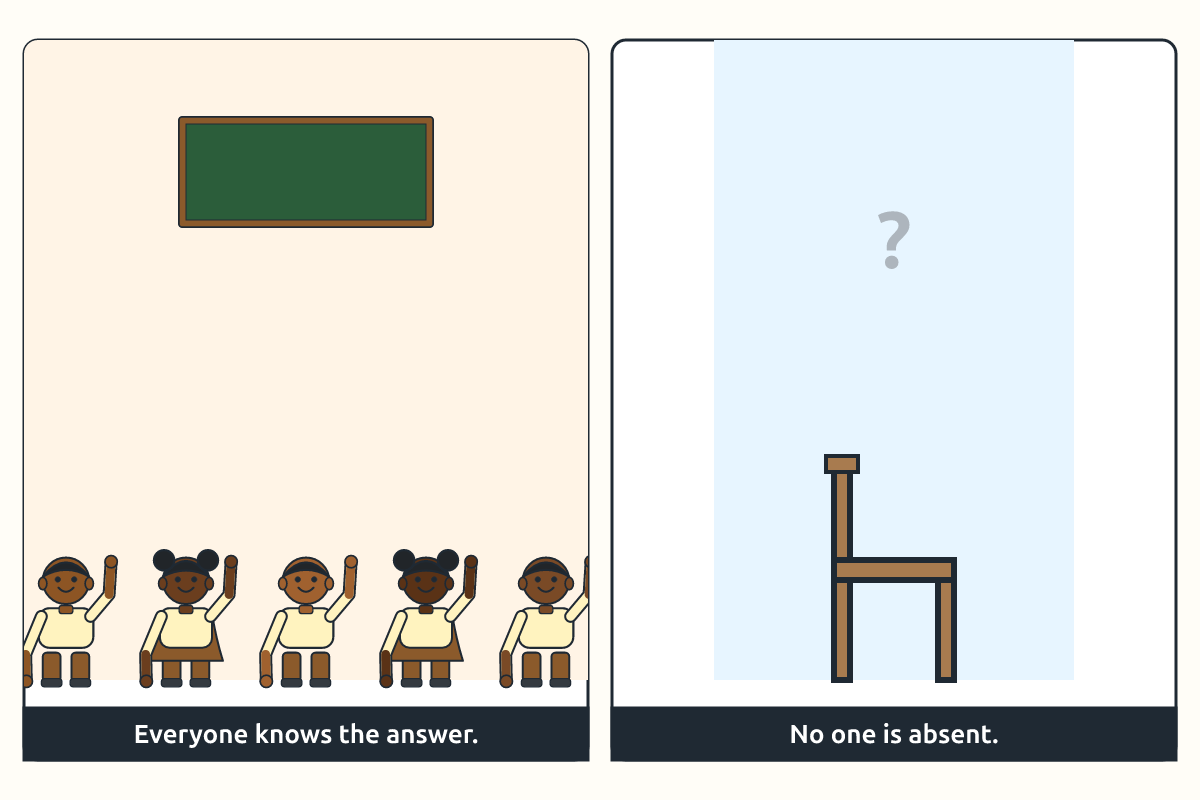
Most indefinite pronouns ending in -one, -body and -thing are singular: "Everyone is here." "Nobody knows the answer."
"Both", "many" and "few" are plural: "Many were absent."
Passage: "On Sports Day, everyone came early. Somebody brought a drum and someone else brought a whistle. Nobody wanted to miss the relay race. Many cheered for the Red House, but a few supported the Blue House. When the race ended, each of the runners received a medal, and everything was cleared away before sunset."
New words
- pronoun
- A word used instead of a noun.
- indefinite
- Not referring to a particular person or thing.
- singular
- One.
Summary
- Indefinite pronouns refer to people or things generally.
- Words ending in -one, -body and -thing take singular verbs.
Exercises
Answer in your exercise book first, then check your answers.
1. Which is an indefinite pronoun?
- A. everyone
- B. Kofi
- C. table
- D. quickly
Show answer
Answer: everyoneIt is general.2. "Everybody are happy" is correct.
- A. True
- B. False
Show answer
Answer: False"Everybody is happy."3. ______ (Nobody / Many) knows where the key is.
Show answer
Answer: NobodySingular verb "knows".4. Correct: "Everyone have finished their work."
Show answer
Answer: Everyone has finished their work.Singular verb.
Lesson 4
- Strand
- Writing
- Sub-strand
- Narrative Writing
- Indicator
- B5.4.10.1.1 – Create settings characters and at least one plot in a narrative text
Introduction
Every story needs a setting (where and when) and characters (who). Strong settings and characters make readers interested.
Creating Settings and Characters
| Sense | Example |
|---|---|
| sight | The lorry station was full of yellow taxis and blue trotros. |
| sound | Drivers' mates shouted "Kumasi! Kumasi!" |
| smell | The smell of roasted plantain filled the air. |
| time | It was early Monday morning. |
| Feature | Example |
|---|---|
| name and age | Yaw, a twelve-year-old boy |
| appearance | thin, with a big school bag |
| personality | curious and brave |
| goal | to find his lost little sister |
Sample opening: "It was early Monday morning at the Kejetia lorry station. Drivers' mates shouted for passengers, and the smell of roasted plantain filled the air. Yaw, a thin twelve-year-old with a big school bag, pushed through the crowd. His little sister had let go of his hand, and now she was nowhere to be seen."
New words
- setting
- Where and when a story takes place.
- character
- A person or animal in a story.
- personality
- A person's character and behaviour.
Summary
- Describe the setting using the senses and time.
- Give characters a name, appearance, personality and goal.
Exercises
Answer in your exercise book first, then check your answers.
1. The setting tells us…
- A. where and when
- B. who
- C. why
- D. how many
Show answer
Answer: where and whenPlace and time.2. Using the senses makes a setting vivid.
- A. True
- B. False
Show answer
Answer: TrueSights, sounds, smells.3. Yaw's goal was to find his little ______.
Show answer
Answer: sisterFrom the opening.4. Write two sentences describing a market setting using two senses.
Show answer
Answer: E.g. Traders shouted their prices. The smell of fried fish was everywhere.Sound and smell.
Lesson 5
- Strand
- Writing Conventions & Grammar Usage / Extensive Reading
- Sub-strand
- Using Action Words, Building the Love and Culture of Reading
- Indicator
- B5.5.4.1.1 – Differentiate between how the simple past and the present perfect tense forms are used in speech and in writing. Learners can read a variety of level appropriate books and present at least a-three-paragraph summary
Introduction
The simple past and the present perfect both talk about the past, but they are used differently.
Simple Past and Present Perfect
| Tense | Form | Use | Example |
|---|---|---|---|
| simple past | verb + ed (or irregular form) | a finished action at a stated past time | I visited Kumasi last year. |
| present perfect | has/have + past participle | a past action connected to now, time not stated | I have visited Kumasi. |
| Simple past | Present perfect |
|---|---|
| yesterday, last week, in 2020, ago | already, yet, ever, never, just, since, for |
"Ama ate her lunch at noon." (finished, stated time) "Ama has eaten her lunch." (she is not hungry now)
Common mistake: Do not use the present perfect with a stated past time. Say "I saw him yesterday", not "I have seen him yesterday".
Reading task: read a storybook this week and write a summary of at least three paragraphs: beginning, middle and end.
New words
- simple past
- A tense for finished actions at a known past time.
- present perfect
- A tense for past actions linked to the present.
- past participle
- The verb form used after has/have, e.g. eaten.
Summary
- The simple past gives a finished action at a stated time.
- The present perfect links a past action to now.
Exercises
Answer in your exercise book first, then check your answers.
1. Which is present perfect?
- A. She has finished
- B. She finished
- C. She finishes
- D. She will finish
Show answer
Answer: She has finishedhas + participle.2. "I have seen him yesterday" is correct.
- A. True
- B. False
Show answer
Answer: FalseUse "I saw him yesterday."3. We ______ (visit/visited) the zoo last month.
Show answer
Answer: visitedStated past time.4. Write one sentence in each tense about eating.
Show answer
Answer: I ate rice yesterday. I have eaten already.Two tenses.
Homework
- Write a three-paragraph summary of a storybook you have read.