Basic 5 · English Language
Values in Songs, Minimal Pairs, Proper Nouns, Modes of Writing and Addresses
In this topic you will relate values in songs to real life, use minimal pairs to decode words, use proper nouns, choose modes of writing and use commas in addresses.
By the end of these notes you should be able to:
- Relate values in songs to real-life experiences
- Use minimal pairs to decode words
- Identify and use proper nouns
- Choose the right mode of writing for a purpose
- Use commas correctly to write an address
What you already know
- Messages in Songs, Hard and Soft C and G, Nouns of Quantity, Joined Script and Capital Letters
Copy everything that has a blue line on its left into your notebook. The other parts are for reading.
Lesson 1
- Strand
- Oral Language
- Sub-strand
- Songs
- Indicator
- B5.1.1.1.2 – Relate values in songs to real life experiences
Introduction
Songs teach values such as honesty, kindness and hard work. A value becomes real when we practise it in daily life.
Values in Songs and Real Life
"Little drops of water, little grains of sand,
Make the mighty ocean and the pleasant land.
Little deeds of kindness, little words of love,
Help to make earth happy, like the heaven above."
| Value in the song | Real-life example |
|---|---|
| small efforts matter | saving one cedi every day adds up |
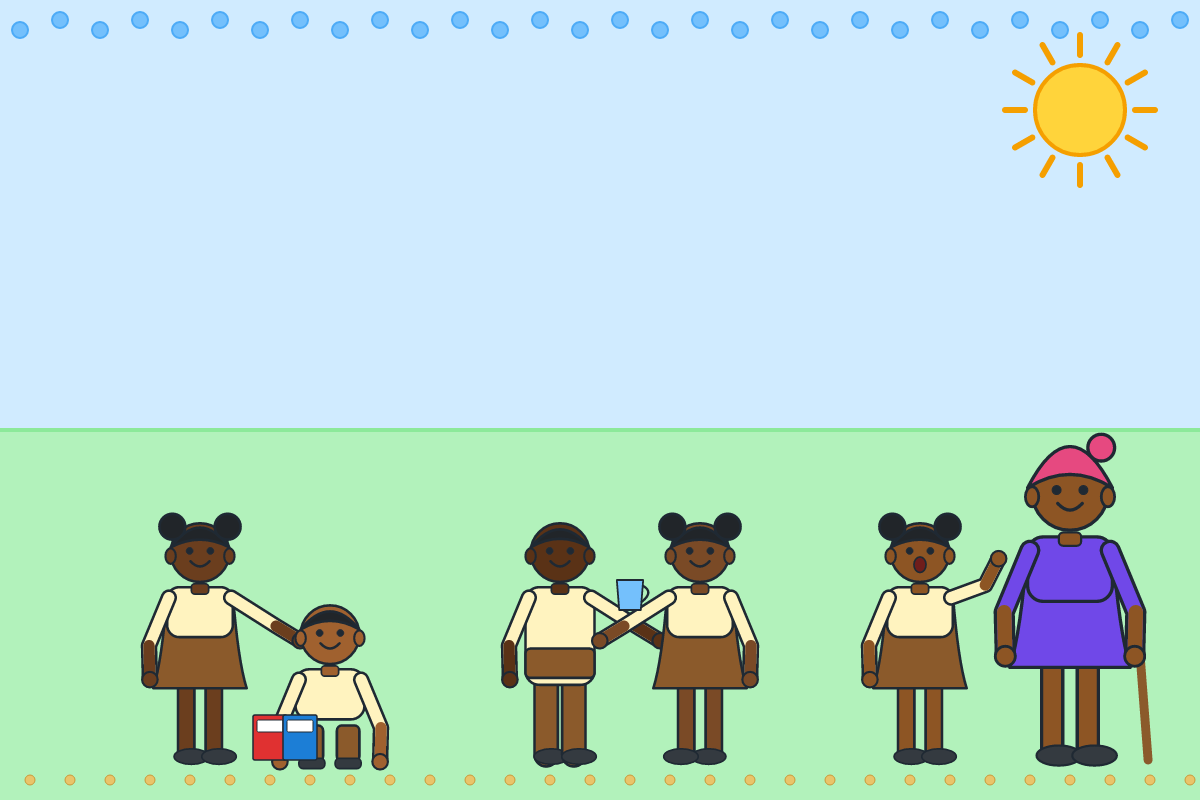
| kindness | helping a classmate who dropped her books |
| love | speaking gently to a younger sibling |
Passage: "Every morning, Abena dropped one pesewa coin into a tin. Her brother laughed: 'What can one pesewa buy?' By the end of the year, the tin was heavy. Abena used the money to buy a new school bag for her little cousin, who had none. Her brother stopped laughing and started his own tin." Like the song, the story shows that little efforts add up to something great.
New words
- value
- A belief about what is good and right.
- deed
- An action.
- mighty
- Very great or powerful.
Summary
- Songs teach values such as kindness and love.
- We live values through small daily actions.
Exercises
Answer in your exercise book first, then check your answers.
1. Which value does the song teach?
- A. Kindness
- B. Greed
- C. Pride
- D. Laziness
Show answer
Answer: Kindness"Little deeds of kindness".2. The song says small things can make something great.
- A. True
- B. False
Show answer
Answer: TrueDrops make an ocean.3. "Little ______ of kindness"
Show answer
Answer: deedsFrom the song.4. Give one real-life example of "little deeds of kindness".
Show answer
Answer: E.g. helping a classmate carry books.Any kind act.
Lesson 2
- Strand
- Reading
- Sub-strand
- Word Families and Common Digraphs
- Indicator
- B5.2.3.1.1 – Use common minimal pairs to decode words. e.g. – sash wash
Introduction
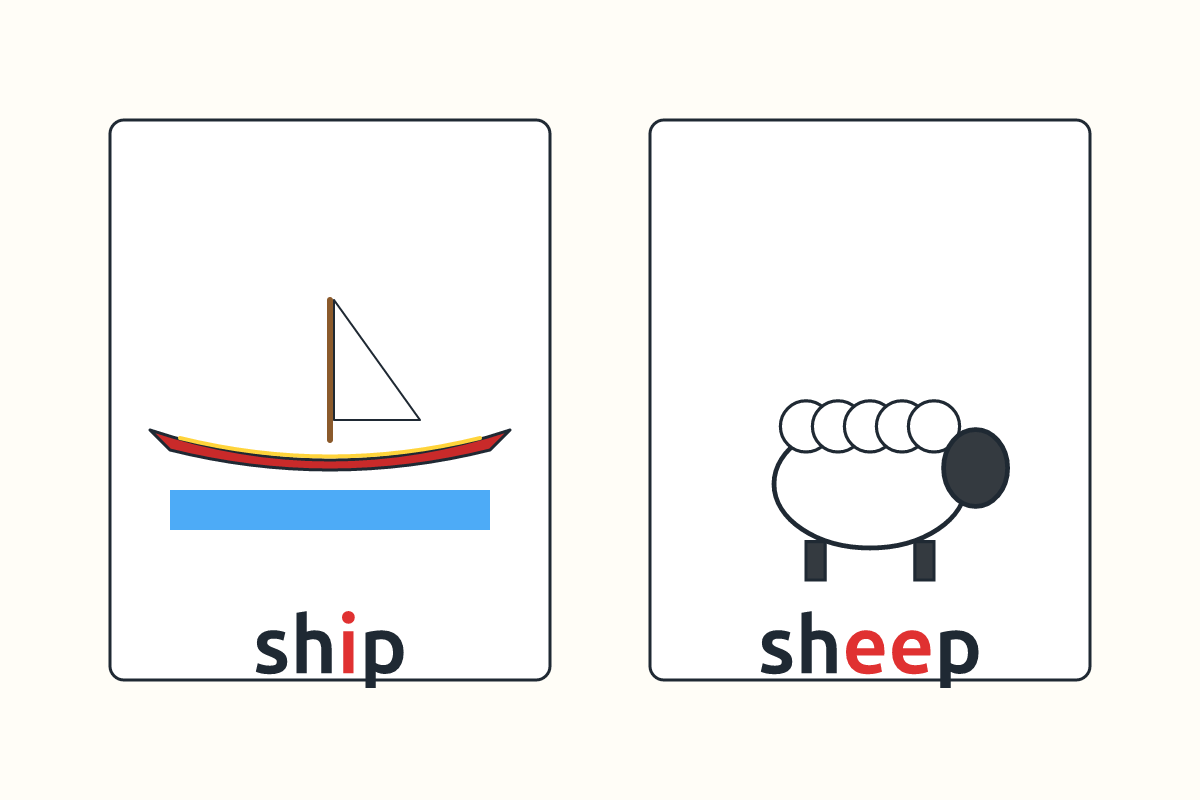
Minimal pairs are two words that differ in only one sound, such as "ship" and "sheep". They help us hear and read sounds correctly.
Minimal Pairs
| Pair | Different sound |
|---|---|
| sash / wash | /s/ and /w/ |
| ship / sheep | short i and long ee |
| pen / pan | e and a |
| fan / van | /f/ and /v/ |
| light / right | /l/ and /r/ |
| sink / think | /s/ and /th/ |
Read the sentences and choose the correct word: "The fisherman pulled his (net/nut) from the sea. The children (sheep/ship) sailed to Accra. Mother bought a (van/fan) to cool the room."
Answers: net; ship; fan.
New words
- minimal pair
- Two words that differ in one sound.
- decode
- To work out how to read a word.
- vowel sound
- A sound made with an open mouth, such as a, e, i.
Summary
- Minimal pairs differ by only one sound.
- They help us hear, say and read words correctly.
Exercises
Answer in your exercise book first, then check your answers.
1. Which is a minimal pair?
- A. ship, sheep
- B. cat, dog
- C. tree, house
- D. book, pen
Show answer
Answer: ship, sheepThey differ in one sound.2. "Fan" and "van" are a minimal pair.
- A. True
- B. False
Show answer
Answer: True/f/ and /v/.3. The fisherman pulled his ______ (net/nut) from the sea.
Show answer
Answer: netContext helps.4. Write a sentence using "light" and another using "right".
Show answer
Answer: E.g. Switch on the light. Turn right at the junction.Different meanings.
Lesson 3
- Strand
- Grammar
- Sub-strand
- Nouns
- Indicator
- B5.3.1.1.2 – Identify and use proper nouns
Introduction
A proper noun is the special name of a particular person, place or thing. It always begins with a capital letter.
Proper Nouns
| Common noun | Proper noun |
|---|---|
| boy | Kwabena |
| city | Tamale |
| river | Volta |
| school | Achimota School |
| month | December |
| festival | Hogbetsotso |
| newspaper | Daily Graphic |
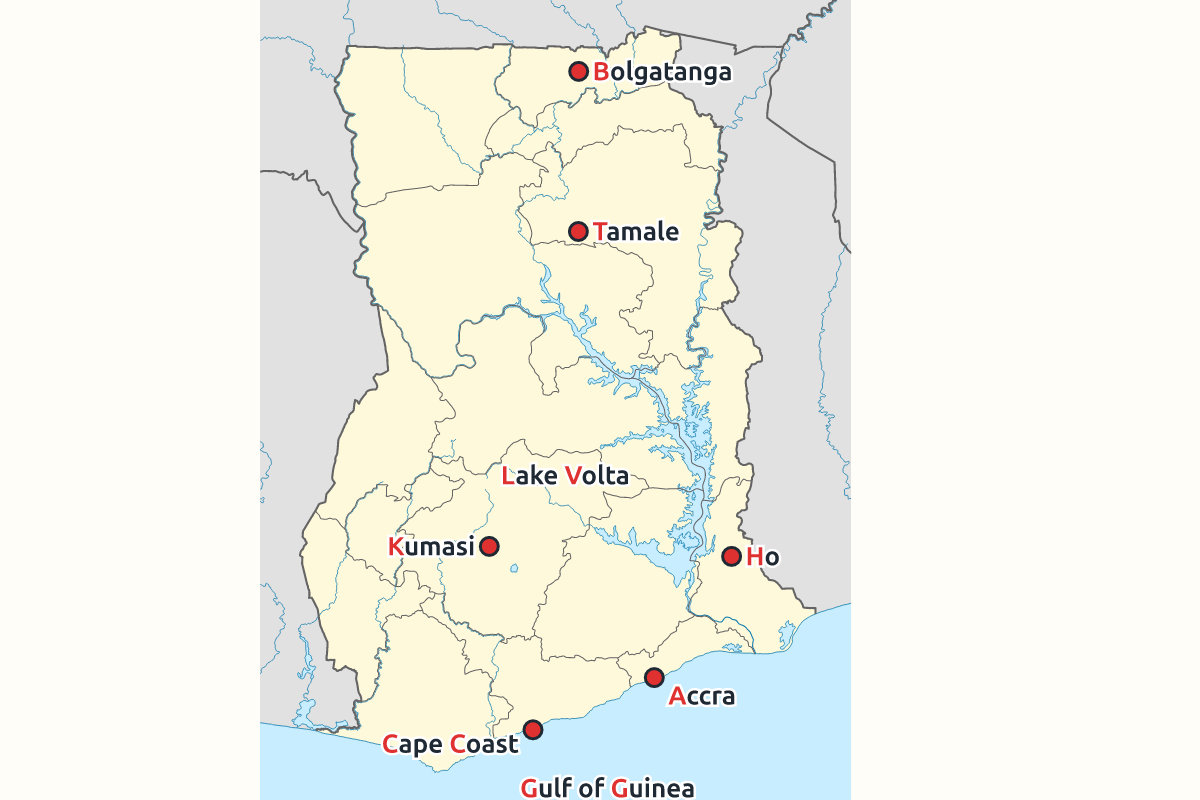
Read this passage and find the proper nouns: "Last December, Kwabena travelled from Tamale to Cape Coast with his uncle, Mr Iddrisu. They crossed the Volta at Yeji by ferry and reached Cape Coast on Christmas Eve. On Boxing Day, they visited Cape Coast Castle and Kakum National Park. Kwabena wrote about the trip in his diary and sent a copy to the Junior Graphic."
Proper nouns: December, Kwabena, Tamale, Cape Coast, Mr Iddrisu, Volta, Yeji, Christmas Eve, Boxing Day, Cape Coast Castle, Kakum National Park, Junior Graphic.
New words
- proper noun
- The special name of a particular person, place or thing.
- common noun
- A general name for a person, place or thing.
- particular
- One special one.
Summary
- Proper nouns name particular people, places and things.
- They always begin with a capital letter.
Exercises
Answer in your exercise book first, then check your answers.
1. Which is a proper noun?
- A. Tamale
- B. city
- C. river
- D. boy
Show answer
Answer: TamaleIt names a particular city.2. "Volta" is a proper noun.
- A. True
- B. False
Show answer
Answer: TrueIt names a particular river.3. ______ is the capital of the Volta Region. (Ho / ho)
Show answer
Answer: HoA proper noun takes a capital.4. Give the proper noun for: a school you know, a festival and a month.
Show answer
Answer: E.g. Accra Academy, Homowo, March.Answers will vary.
Lesson 4
- Strand
- Writing
- Sub-strand
- Paragraph Development
- Indicator
- B5.4.3.1.1 – Choose appropriate ways and modes of writing for a variety of purposes
Introduction
Writers choose how to write depending on their purpose. A story, a report and an advertisement are written in different ways.
Modes of Writing for Different Purposes
| Mode | Purpose | Example |
|---|---|---|
| narrative | to tell a story | "The Day the River Flooded" |
| descriptive | to describe a person, place or thing | "Our School Compound" |
| expository (informative) | to explain or inform | "How to Plant Maize" |
| argumentative (persuasive) | to give an opinion and convince | "Why Pupils Should Not Use Phones in Class" |
Before you write, ask: What is my purpose? Who will read it? Then choose the mode that fits.
Here is the same topic, "Our School Farm", in two modes. Descriptive: "Rows of green maize stand tall beside the purple garden eggs, and the soil smells fresh after the rain." Expository: "To start a school farm, clear the land, make beds, plant seeds in rows and water them every evening." The first helps the reader see the farm; the second teaches the reader how to make one.
New words
- mode
- A type or way of writing.
- purpose
- The reason for writing.
- audience
- The people who will read the writing.
Summary
- Narrative tells, descriptive describes, expository informs, argumentative persuades.
- Choose the mode that fits your purpose and audience.
Exercises
Answer in your exercise book first, then check your answers.
1. Which mode tells a story?
- A. narrative
- B. descriptive
- C. expository
- D. argumentative
Show answer
Answer: narrativeIt narrates events.2. "How to Plant Maize" is expository writing.
- A. True
- B. False
Show answer
Answer: TrueIt explains.3. Writing to convince readers is ______ writing.
Show answer
Answer: argumentativeIt persuades.4. Which mode would you use to describe your best friend? Why?
Show answer
Answer: Descriptive, because it describes a person.Purpose decides mode.
Lesson 5
- Strand
- Writing Conventions/ Extensive Reading
- Sub-strand
- Using Punctuation, Building the Love and Culture of Reading
- Indicator
- B5.5.2.1.1 – Use the comma to write an address
Introduction
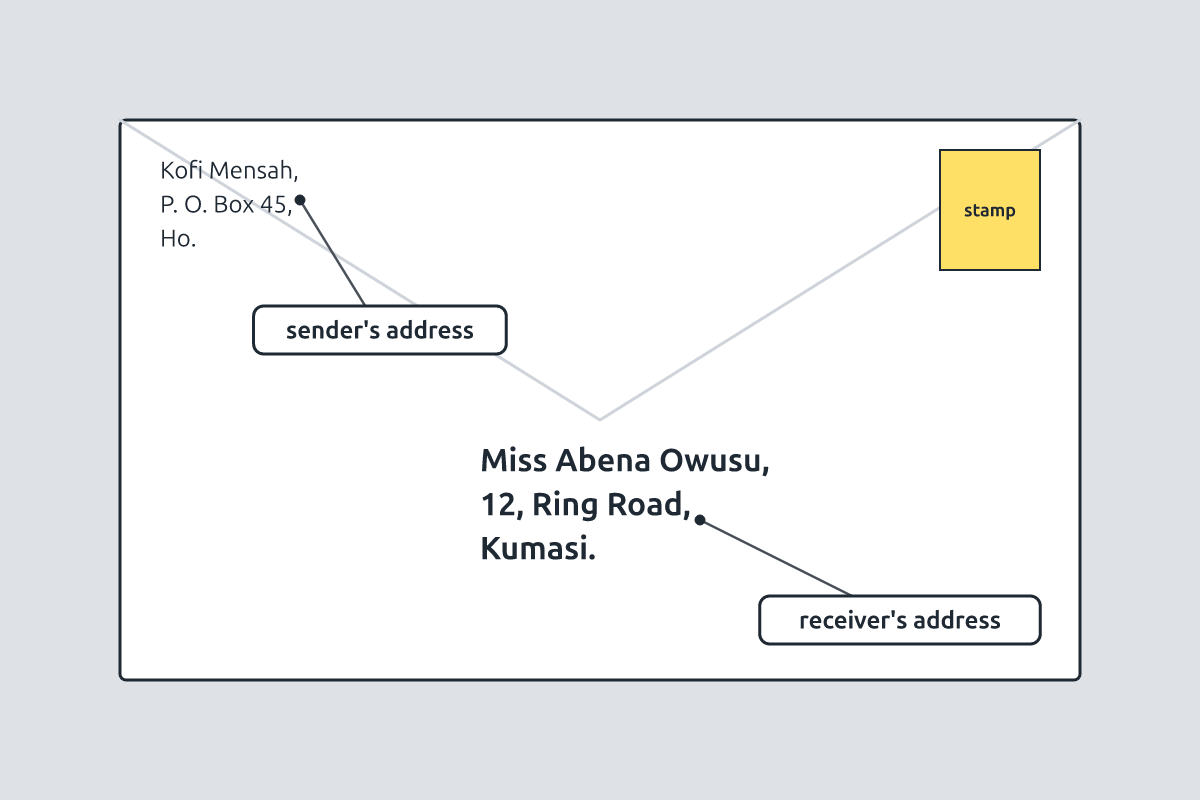
When you write a letter or an envelope, you write an address. Commas help to separate parts of an address written on one line.
Commas in Addresses
When an address is written on one line, commas separate its parts:
"Kofi lives at House No. 12, Adum Street, Kumasi, Ashanti Region."
When an address is written in a block, each part goes on a new line. In modern letters, many writers leave out the commas at line ends.
| Line | Example |
|---|---|
| name | Miss Abena Mensah |
| house number and street | House No. 12, Adum Street |
| box or digital address | GhanaPost GPS: AK-039-5028 |
| town | Kumasi |
| region | Ashanti Region |
New words
- address
- The details of where someone lives or works.
- envelope
- A paper cover for a letter.
- block form
- Writing each part on a new line.
Summary
- Use commas to separate parts of an address written on one line.
- In block form, each part of the address goes on a new line.
Exercises
Answer in your exercise book first, then check your answers.
1. Which address is correctly punctuated?
- A. House No. 5, Liberty Road, Ho
- B. House No. 5 Liberty, Road Ho
- C. House, No. 5 Liberty Road Ho
- D. House No. 5 Liberty Road, Ho,
Show answer
Answer: House No. 5, Liberty Road, HoCommas separate parts.2. Each part of a block address goes on a new line.
- A. True
- B. False
Show answer
Answer: TrueThat is block form.3. Kofi lives at House No. 12______ Adum Street.
Show answer
Answer: , (comma)Separate the parts.4. Write your school's address on one line using commas.
Show answer
Answer: Answers will vary, e.g. Presby Primary School, P.O. Box 20, Akropong.Commas between parts.
Homework
- Write the addresses of two relatives in block form and on one line with commas.