Basic 5 · English Language
Poems, Content and Function Words, Articles, Brainstorming and Partitive Nouns
In this topic you will discuss the central messages of poems, use content and function words, use articles, brainstorm ideas for writing and use nouns that show parts of quantities.
By the end of these notes you should be able to:
- Discuss the central message of a poem
- Use content words and function words correctly
- Use the articles a, an and the
- Brainstorm ideas on a community issue
- Use partitive nouns such as a loaf of bread
What you already know
- Values in Songs, Minimal Pairs, Proper Nouns, Modes of Writing and Addresses
Copy everything that has a blue line on its left into your notebook. The other parts are for reading.
Lesson 1
- Strand
- Oral Language
- Sub-strand
- Poems
- Indicator
- B5.1.3.1.1 – Respond to poems by discussing their central messages
Introduction
Poems often teach through pictures in words. The central message is what the poet wants us to understand most.
Responding to a Poem
"The Weaver"
"At his loom beneath the mango tree,
The old man weaves for all to see;
Thread by thread, and strip by strip,
Gold and green beneath his grip.
He does not hurry, he does not shout,
He knows what patience is about.
And when at last the kente's done,
It shines like gold before the sun."
| Question | Answer |
|---|---|
| Where does the weaver work? | at his loom beneath a mango tree |
| How does he work? | slowly, carefully, thread by thread, without hurrying |
| What does he make? | kente cloth |
| What is the central message? | patience and careful work produce something beautiful |

New words
- loom
- A frame used for weaving cloth.
- strip
- A long narrow piece.
- patience
- Calmly waiting and working steadily.
Summary
- The poem describes a patient kente weaver.
- Its message is that patience and care produce beautiful results.
Exercises
Answer in your exercise book first, then check your answers.
1. What does the weaver make?
- A. kente cloth
- B. pots
- C. baskets
- D. drums
Show answer
Answer: kente clothStrips of kente.2. The weaver works in a hurry.
- A. True
- B. False
Show answer
Answer: False"He does not hurry."3. "Thread by thread, and ______ by strip."
Show answer
Answer: stripFrom the poem.4. What is the central message of "The Weaver"?
Show answer
Answer: Patience and careful work produce beautiful results.Main idea.
Lesson 2
- Strand
- Reading
- Sub-strand
- Vocabulary
- Indicator
- B5.2.6.1.1 – Use level-appropriate content words and function words appropriately in spoken and written communication
Introduction
Words can be divided into two groups: content words, which carry meaning, and function words, which hold sentences together.
Content Words and Function Words
| Content words (carry meaning) | Function words (join and connect) |
|---|---|
| nouns: farmer, river | articles: a, an, the |
| main verbs: plant, run | prepositions: in, on, at, to |
| adjectives: tall, green | conjunctions: and, but, or |
| adverbs: quickly, slowly | pronouns: he, it, they |
| helping verbs: is, was, can |
In the sentence "The farmer planted maize in the field", the content words are farmer, planted, maize and field. The function words are the, in and the.
Content words are usually stressed when we speak. Function words are said quickly and lightly.
New words
- content word
- A word that carries the main meaning.
- function word
- A word that connects other words.
- stress
- Saying a word or syllable more strongly.
Summary
- Content words carry meaning: nouns, verbs, adjectives, adverbs.
- Function words join words: articles, prepositions, conjunctions.
Exercises
Answer in your exercise book first, then check your answers.
1. Which is a function word?
- A. the
- B. farmer
- C. green
- D. plant
Show answer
Answer: theIt is an article.2. Nouns are content words.
- A. True
- B. False
Show answer
Answer: TrueThey carry meaning.3. In "Ama sat on the bench", "on" is a ______ word.
Show answer
Answer: functionIt is a preposition.4. Pick the content words: "The boy kicked the ball quickly."
Show answer
Answer: boy, kicked, ball, quicklyThey carry meaning.
Lesson 3
- Strand
- Grammar
- Sub-strand
- Determiners
- Indicator
- B5.3.2.1.1 – Identify and use indefinite and definite articles
Introduction
Articles are small words that come before nouns. English has three: a, an and the.
Definite and Indefinite Articles
| Article | Type | Use | Example |
|---|---|---|---|
| a | indefinite | before a consonant sound, for any one thing | a goat, a uniform |
| an | indefinite | before a vowel sound | an egg, an hour |
| the | definite | for a particular or known thing | the goat we bought |
Notice: "a uniform" (sounds like "you") but "an hour" (the h is silent). The sound, not the letter, decides a or an.
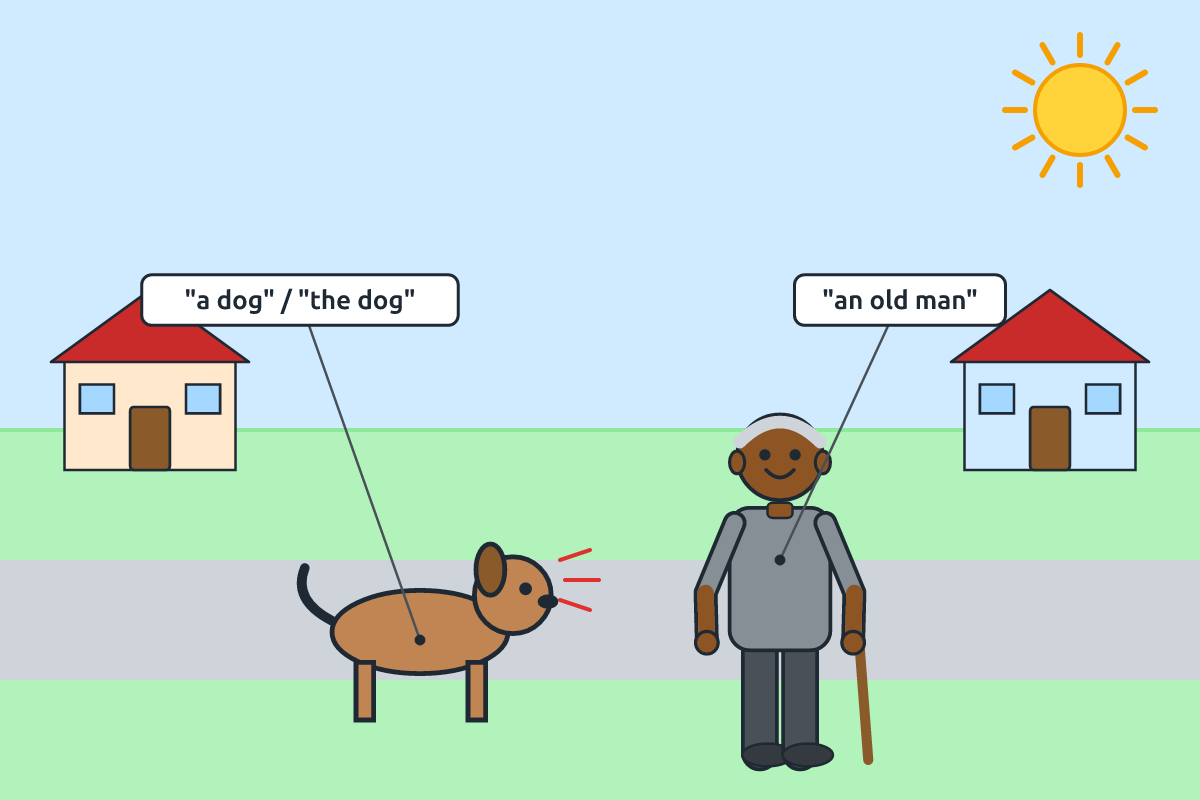
Example: "I saw a dog in the street. The dog was barking at an old man."
Notice how the article changes once the thing is known: we first say "a dog" (any dog, new information), then "the dog" (the one already mentioned). We also use "the" for things that are the only one of their kind: the sun, the moon, the President of Ghana, the Volta River.
New words
- article
- A word used before a noun (a, an, the).
- definite
- Particular and known.
- indefinite
- Not particular; any one.
Summary
- "A" and "an" are indefinite; "the" is definite.
- Use "an" before a vowel sound and "a" before a consonant sound.
Exercises
Answer in your exercise book first, then check your answers.
1. Choose the correct article: ___ orange
- A. an
- B. a
- C. the only
- D. no article
Show answer
Answer: anVowel sound.2. "The" is the definite article.
- A. True
- B. False
Show answer
Answer: TrueIt points to a particular thing.3. She waited for ______ hour. (a/an)
Show answer
Answer: anThe h is silent.4. Explain why we say "a university" but "an umbrella".
Show answer
Answer: "University" begins with a "you" consonant sound; "umbrella" begins with a vowel sound.Sound decides.
Lesson 4
- Strand
- Writing
- Sub-strand
- Writing As a Process
- Indicator
- B5.4.9.1.1 – Select a topic of choice on issues in their community brainstorm and organize ideas before writing
Introduction
Good writing begins before you write. Writers choose a topic and brainstorm ideas first.
Choosing a Topic and Brainstorming
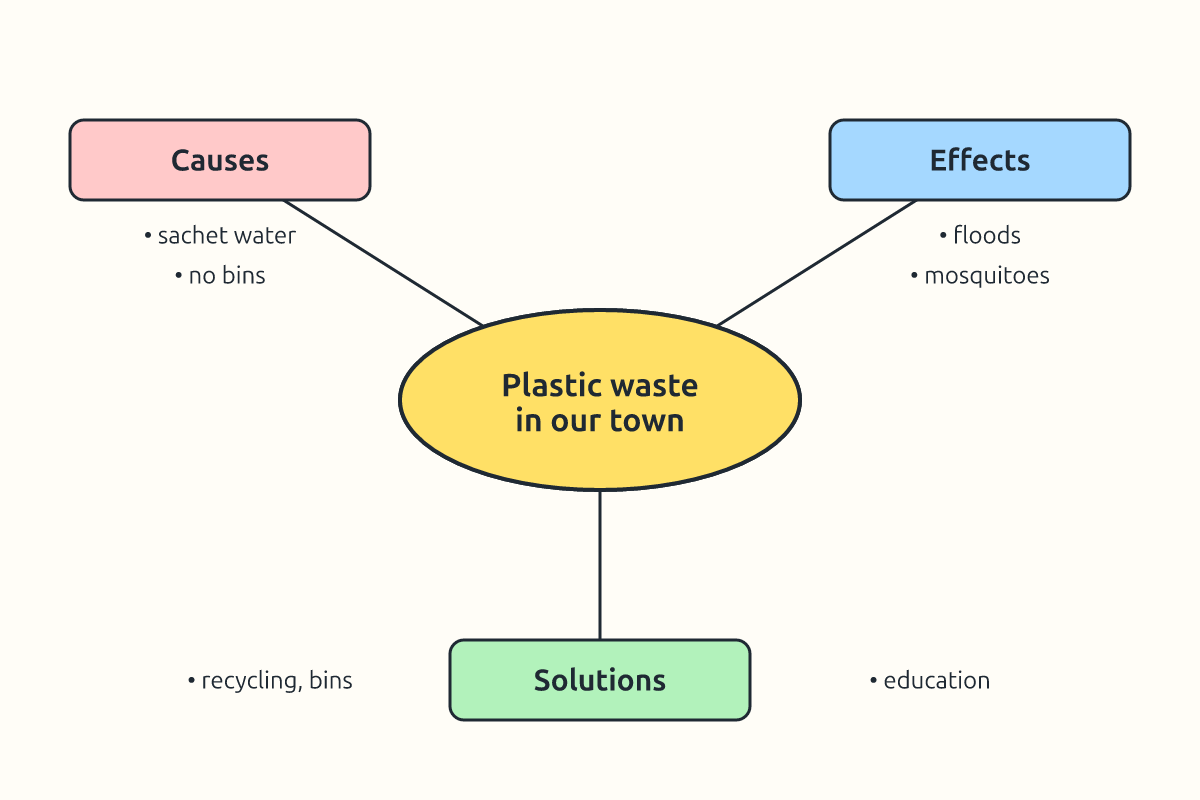
Writing is a process with stages: brainstorming, planning, drafting, revising, editing and publishing. Today we focus on the first stage.
Steps for brainstorming
- choose an issue in your community, e.g. "Plastic waste in our town"
- write the topic in the centre of a page
- write every idea that comes to mind around it, without judging
- group related ideas (causes, effects, solutions)
- circle the best ideas to use
Example: Akua chose the topic "Road accidents near our school". In five minutes she wrote: speeding trotros, no zebra crossing, children running across, broken streetlights, a boy injured last term, need for a road warden, speed ramps. She grouped them into causes, effects and solutions, and circled "no zebra crossing" and "need for a road warden" as her strongest ideas.
New words
- brainstorm
- To list many ideas quickly.
- issue
- A problem people discuss.
- web
- A diagram linking ideas to a central topic.
Summary
- Writing is a process that begins with brainstorming.
- Group your ideas into causes, effects and solutions.
Exercises
Answer in your exercise book first, then check your answers.
1. The first stage of the writing process is…
- A. brainstorming
- B. publishing
- C. editing
- D. printing
Show answer
Answer: brainstormingIdeas come first.2. In brainstorming, you should write every idea that comes to mind.
- A. True
- B. False
Show answer
Answer: TrueJudge later.3. A diagram linking ideas to a central topic is a ______.
Show answer
Answer: webSpider diagram.4. Name three community issues you could write about.
Show answer
Answer: E.g. plastic waste, road accidents, galamsey.Any three.
Lesson 5
- Strand
- Writing Conventions/ Extensive Reading
- Sub-strand
- Using Naming Words, Building the Love and Culture of Reading
- Indicator
- B5.5.3.1.1 – Identify and use nouns or noun phrases to refer to quantities or units (partitive nouns)
Introduction
Some noun phrases name a part or a piece of something, such as "a slice of bread" or "a bunch of bananas". They are called partitive nouns.
Partitive Nouns
| Phrase | Used with |
|---|---|
| a loaf of | bread |
| a slice of | bread, cake, pawpaw |
| a bunch of | bananas, keys, flowers |
| a piece of | paper, advice, chalk |
| a bar of | soap, chocolate |
| a sachet of | water, milk |
| a heap of | tomatoes, sand |
| a pair of | shoes, scissors, trousers |
Reading extract: "Esi went to the shop. She bought a loaf of bread, a bar of soap and two sachets of water. On the way home, her grandmother gave her a piece of advice: 'Always save a little of what you earn.'"
New words
- partitive
- Showing a part of something.
- loaf
- A whole shaped piece of bread.
- sachet
- A small sealed packet.
Summary
- Partitive nouns show a part or amount: a slice of, a bunch of.
- They help us count uncountable things.
Exercises
Answer in your exercise book first, then check your answers.
1. Which is correct?
- A. a bunch of bananas
- B. a loaf of bananas
- C. a bar of bananas
- D. a slice of keys
Show answer
Answer: a bunch of bananasBananas come in bunches.2. "A piece of advice" is correct.
- A. True
- B. False
Show answer
Answer: TrueAdvice is uncountable.3. Esi bought a ______ of soap.
Show answer
Answer: barFrom the extract.4. Write three partitive noun phrases you use at home.
Show answer
Answer: E.g. a pair of shoes, a sachet of water, a slice of bread.Any correct three.
Homework
- Write a shopping list of six items using partitive nouns and units.