Basic 5 · English Language
Messages in Songs, Hard and Soft C and G, Nouns of Quantity, Joined Script and Capital Letters
In this topic you will explain the messages in songs, read words with hard and soft c and g, use nouns for quantities and units, write in joined script and use capital letters correctly.
By the end of these notes you should be able to:
- Explain the central message of a song
- Read words with hard and soft c and g
- Use nouns and noun phrases for quantities and units
- Copy sentences neatly in joined script
- Use capital letters correctly
What you already know
- English Basic 4
Copy everything that has a blue line on its left into your notebook. The other parts are for reading.
Lesson 1
- Strand
- Oral Language
- Sub-strand
- Songs
- Indicator
- B5.1.1.1.1 – Explain the central messages in songs
Introduction
Every song has a central message, the main idea the singer wants us to understand. Some songs teach, some praise and some warn.
Finding the Central Message of a Song
Read this song:
"Arise, arise, O children of Ghana,
The sun is up, the day is new;
Take your hoe and take your pen,
For the land depends on you.
Work with joy and work with others,
Sisters, brothers, hand in hand;
What we plant today with patience
Feeds tomorrow's happy land."
| Question | Answer |
|---|---|
| Who is the song for? | the children of Ghana |
| What does it ask them to do? | work hard on the farm and in school, and work together |
| Which words show unity? | "Sisters, brothers, hand in hand" |
| What is the central message? | hard work and unity today will build a better Ghana tomorrow |
How to find the central message
- read or sing the whole song
- ask what the singer wants us to know, feel or do
- look for words that are repeated
- say the message in one sentence

New words
- central message
- The main idea of a song, poem or story.
- unity
- Being together as one.
- patience
- Waiting calmly for results.
Summary
- The central message is the main idea the singer wants us to understand.
- Find it by asking what the singer wants us to know, feel or do.
Exercises
Answer in your exercise book first, then check your answers.
1. What is the central message of the song?
- A. Hard work and unity build a better Ghana
- B. Play all day
- C. Sleep late
- D. Stay alone
Show answer
Answer: Hard work and unity build a better GhanaThat is the main idea.2. "Hand in hand" shows unity.
- A. True
- B. False
Show answer
Answer: TruePeople join together.3. "Take your hoe and take your ______."
Show answer
Answer: penFrom the song.4. Why does the song mention both a hoe and a pen?
Show answer
Answer: The hoe stands for farming and the pen for learning; both are needed to build the nation.Symbols of work.
Lesson 2
- Strand
- Reading
- Sub-strand
- Phonics
- Indicator
- B5.2.2.1.1 – Apply common phonic generalizations (e.g. hard and soft “c” and “g”) when reading continuous texts
Introduction
The letters c and g each have two sounds: a hard sound and a soft sound. Knowing the rule helps you read new words.
Hard and Soft C and G
| Letter | Followed by a, o, u or a consonant | Followed by e, i or y |
|---|---|---|
| c | hard /k/: cat, cocoa, cup, class | soft /s/: cedi, city, cycle |
| g | hard /g/: gate, goat, gum, grass | soft /j/: gentle, giant, gym |
Common mistake: Some common words break the g rule: get, give, girl and gift have a hard g.
Read this passage and find the hard and soft c and g words:
"In the city of Cape Coast, a gentle girl named Grace sold cold coconut water. One day a giant cargo ship came into the harbour. Grace counted her cedis carefully and smiled at the good sales."
| Hard c /k/ | Soft c /s/ | Hard g /g/ | Soft g /j/ |
|---|---|---|---|
| Cape, Coast, cold, coconut, came, cargo, counted, carefully | city, cedis | girl, Grace, cargo, good | gentle, giant |
New words
- hard sound
- The /k/ sound of c or the /g/ sound of g.
- soft sound
- The /s/ sound of c or the /j/ sound of g.
- generalisation
- A rule that is true most of the time.
Summary
- C and g are usually soft before e, i and y.
- They are usually hard before a, o, u and consonants.
Exercises
Answer in your exercise book first, then check your answers.
1. Which word has a soft c?
- A. city
- B. cat
- C. cup
- D. cold
Show answer
Answer: cityc before i is soft.2. The g in "giant" is soft.
- A. True
- B. False
Show answer
Answer: Trueg before i.3. The g in "goat" is ______ (hard/soft).
Show answer
Answer: hardg before o.4. Sort these words: cedi, cocoa, gem, gate.
Show answer
Answer: Soft: cedi, gem. Hard: cocoa, gate.Use the rule.
Lesson 3
- Strand
- Grammar
- Sub-strand
- Nouns
- Indicator
- B5.3.1.1.1 – Identify and use nouns or noun phrases to refer to quantities or units
Introduction
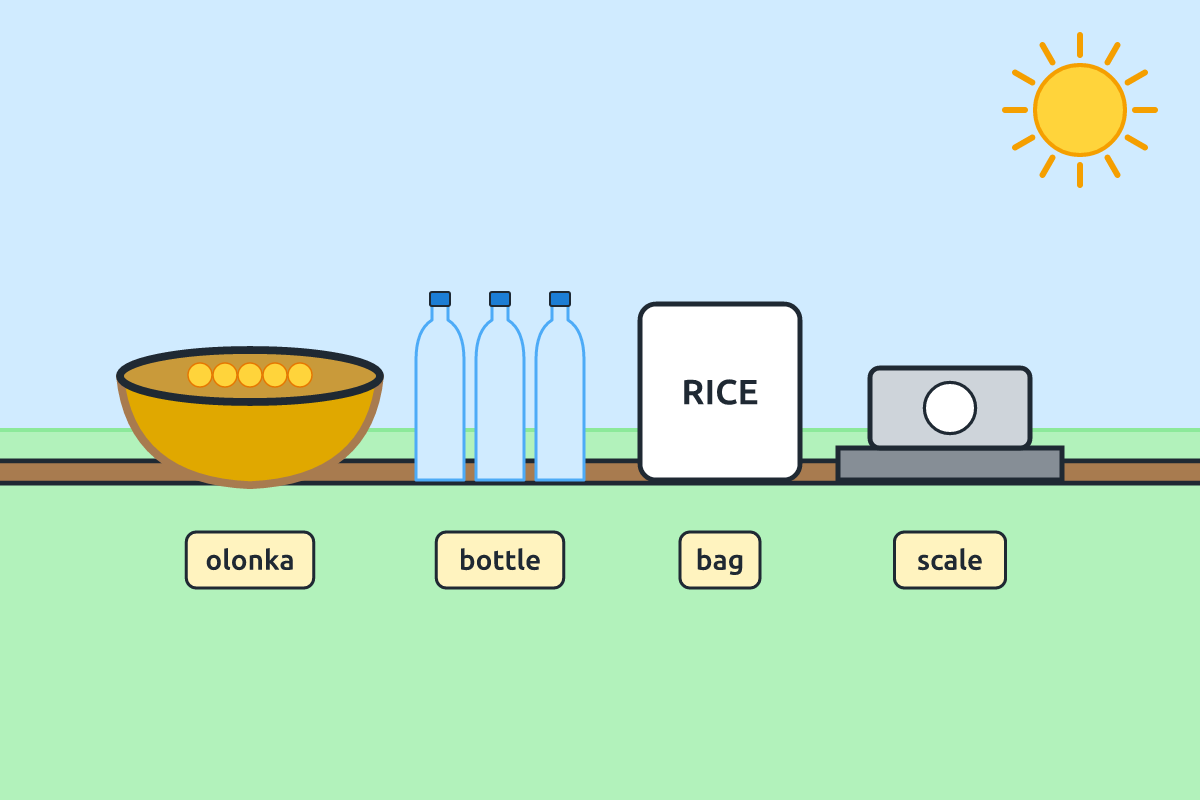
When we buy and measure things, we use special nouns to show quantities and units, such as "a litre of oil" or "a bag of rice".
Nouns for Quantities and Units
Some nouns cannot be counted one by one, for example water, rice, sugar and oil. To show how much, we use a noun of quantity or unit followed by "of".
| Unit noun | Example |
|---|---|
| litre | a litre of palm oil |
| kilogram | two kilograms of sugar |
| metre | five metres of cloth |
| bag | a bag of cement |
| bowl (olonka) | an olonka of maize |
| gallon | a gallon of water |
| tin | a tin of tomato paste |
In a noun phrase such as "two kilograms of sugar", the unit noun (kilograms) takes the plural, not the uncountable noun (sugar). We say "two bags of rice", not "two bag of rices".
New words
- quantity
- How much of something there is.
- unit
- A standard amount used to measure.
- uncountable noun
- A noun that cannot be counted one by one.
Summary
- Use unit nouns with "of" to show quantities.
- Make the unit noun plural, not the uncountable noun.
Exercises
Answer in your exercise book first, then check your answers.
1. Which is correct?
- A. two bags of rice
- B. two bag of rices
- C. two bags of rices
- D. two bag rice
Show answer
Answer: two bags of ricePluralise the unit.2. "Litre" is a unit noun.
- A. True
- B. False
Show answer
Answer: TrueIt measures liquids.3. Mother bought three ______ of cloth. (metre)
Show answer
Answer: metresPlural unit noun.4. Write two noun phrases showing units.
Show answer
Answer: E.g. a litre of oil; a kilogram of sugar.Unit + of + noun.
Lesson 4
- Strand
- Writing
- Sub-strand
- Penmanship
- Indicator
- B5.4.2.1.1 – Copy sentences clearly in joint script maintaining legible handwriting
Introduction
Joined script (cursive) lets you write faster and more neatly. In Basic 5 you will copy whole sentences in joined script.
Copying Sentences in Joined Script
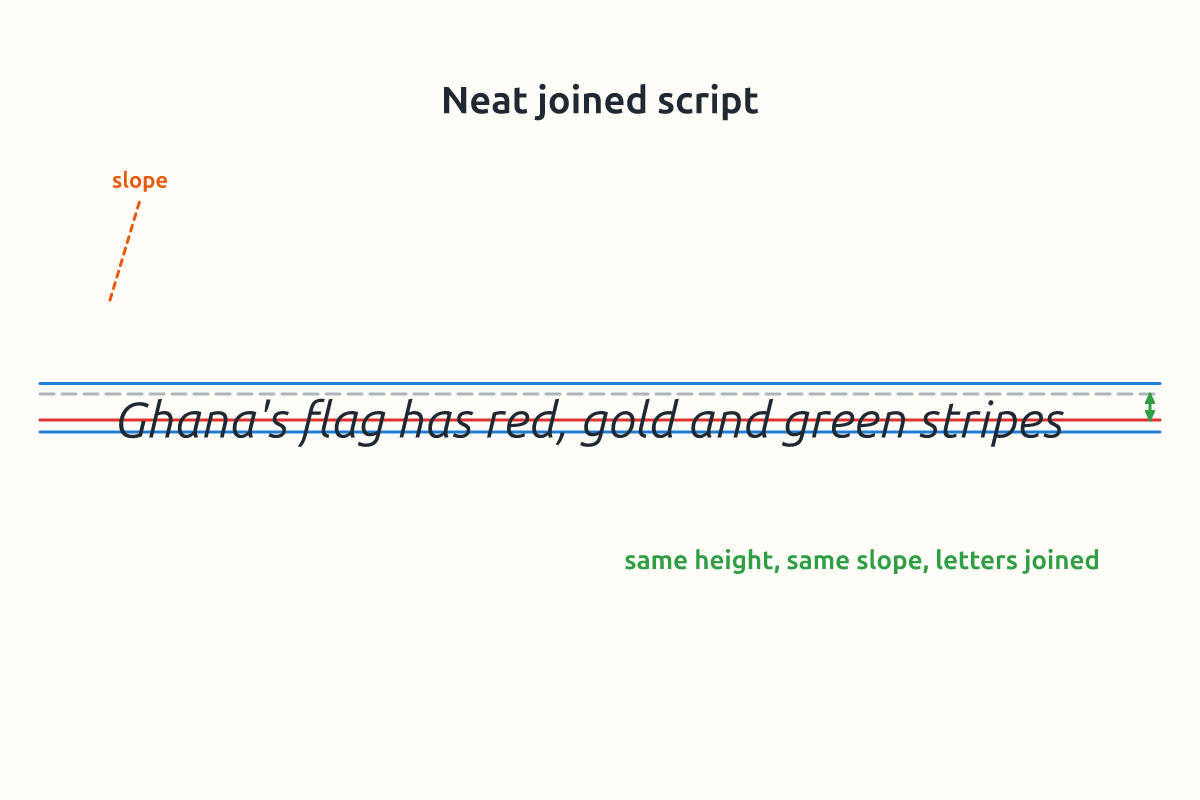
Rules for legible joined script
- sit upright and hold the pencil lightly between the thumb and first two fingers
- slope all letters the same way
- keep small letters the same height and tall letters twice as tall
- join letters with smooth connecting strokes
- leave a finger space between words
- dot i and j and cross t after finishing the word
Copy: "Ghana's flag has red, gold and green stripes with a black star in the centre."
New words
- joined script
- Handwriting where letters are connected.
- legible
- Clear enough to be read easily.
- slope
- The slant of the letters.
Summary
- Joined script connects letters with smooth strokes.
- Keep letter size, slope and spacing consistent.
Exercises
Answer in your exercise book first, then check your answers.
1. Handwriting that is easy to read is…
- A. legible
- B. messy
- C. joined only
- D. small
Show answer
Answer: legibleClear writing.2. Tall letters should be about twice as tall as small letters.
- A. True
- B. False
Show answer
Answer: TrueThat is the guideline.3. Leave a ______ space between words.
Show answer
Answer: fingerOne finger width.4. State two rules for neat joined script.
Show answer
Answer: Keep the same slope and same letter heights (or join smoothly, space words).Any two.
Lesson 5
- Strand
- Writing Conventions/ Extensive Reading
- Sub-strand
- Using Capitalization, Building the Love and Culture of Reading
- Indicator
- B5.5.1.1.1 – Follow appropriate mechanical convention
Introduction
Mechanical conventions are the rules of writing, such as capital letters, spelling and punctuation. Good readers also notice how writers use them.
Using Capital Letters
| Use | Example |
|---|---|
| first word of a sentence | The bell rang. |
| names of people and titles | Mrs Asare, Nana Ofori |
| places, rivers, mountains | Ho, River Pra, Mount Afadjato |
| days, months, festivals | Tuesday, August, Homowo |
| the pronoun I | Kofi and I went home. |
| titles of books and songs | "The Lion and the Mouse" |
Read this extract and notice the capital letters: "On Monday, Mr Owusu took Basic 5 to the Kakum National Park in the Central Region. Afua and I walked on the canopy walkway high above the trees."
New words
- convention
- An agreed rule.
- capital letter
- A large letter (A, B, C).
- title
- The name of a book, song or person's rank.
Summary
- Capital letters begin sentences, names, places, days and titles.
- The pronoun "I" is always a capital letter.
Exercises
Answer in your exercise book first, then check your answers.
1. Which needs a capital letter?
- A. tuesday
- B. book
- C. river
- D. school
Show answer
Answer: tuesdayDays take capitals.2. "I" is always written as a capital letter.
- A. True
- B. False
Show answer
Answer: TrueIt is a rule.3. We climbed Mount ______. (afadjato)
Show answer
Answer: AfadjatoName of a place.4. Correct: "ama visited kumasi in june."
Show answer
Answer: Ama visited Kumasi in June.Name, place, month.
Homework
- Learn a patriotic song and write its central message in two sentences.