Basic 5 · Computing · Data, Sources and Usage
Primary Sources of Information
In this topic you will identify primary sources of information and explain how they are used to collect data.
By the end of these notes you should be able to:
- Define a primary source of information
- Give examples of primary sources
- Collect data using an interview or observation
What you already know
- Data and information (Basic 4)
Copy everything that has a blue line on its left into your notebook. The other parts are for reading.
- Strand
- Introduction To Computing
- Sub-strand
- Data, Sources and Usage
- Indicator
- B5.1.3.1.1-2 – Identify primary sources of information
Introduction
If you want to know how many pupils in your class like rice, you can ask each one yourself. The answers you collect directly are from a primary source.
1. What Is a Primary Source?
Primary source: Information collected first-hand, directly from the people, objects or events involved.
Primary information has not been changed or explained by someone else. It is original. Primary data is collected by the person who needs it, for a specific purpose. It is usually accurate and up to date, but it can take time and money to collect.
| Source | Example |
|---|---|
| interview | asking a farmer about his harvest |
| questionnaire | pupils filling a form about favourite foods |
| observation | counting cars passing the school gate |
| experiment | measuring plant growth in science |
| eyewitness account | a person describing an accident they saw |
| original documents | a birth certificate, diary or letter |
| photographs and recordings | a video of a school event |
2. Methods of Collecting Primary Data
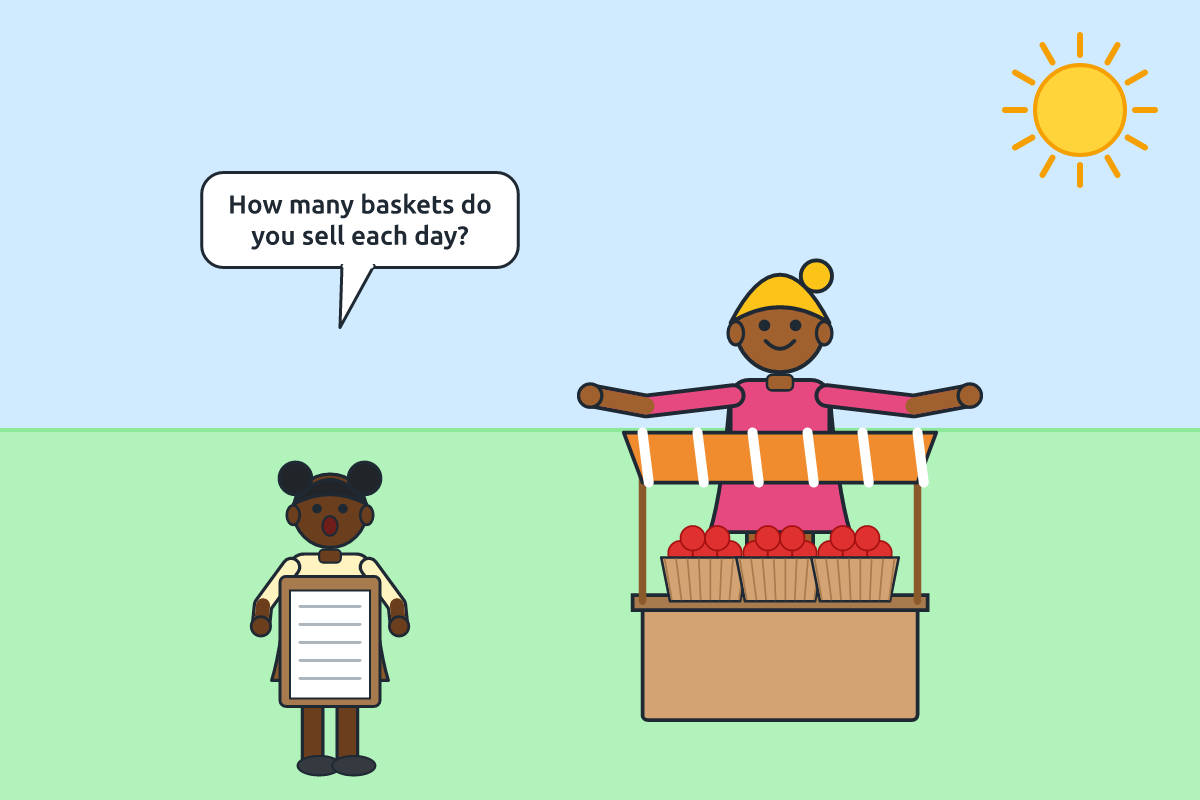
Interview: You ask questions face to face or by phone and record the answers. Prepare your questions before the interview.
Questionnaire: A printed or online form with questions. Many people can answer at the same time.
Observation: You watch and record what happens, often using a tally chart.
3. Advantages and Disadvantages
| Advantages | Disadvantages |
|---|---|
| accurate and original | can take a long time |
| up to date | can be expensive |
| collected for your exact purpose | people may not answer honestly |
Mobile phones help to collect primary data today. You can record interviews, take photos and use online forms. Always ask permission before recording or photographing anyone.
New words
- primary source
- First-hand, original information.
- data
- Raw facts and figures.
- interview
- Asking someone questions to collect information.
- questionnaire
- A form of written questions.
- observation
- Watching and recording.
- eyewitness
- A person who saw an event.
Summary
- A primary source gives first-hand information.
- Interviews, questionnaires, observation and experiments collect primary data.
- Primary data is original and up to date but takes time.
- Ask permission before recording people.
Class activity: Class Survey
- Prepare three questions about pupils' favourite school subject.
- Interview ten pupils and record the answers in a tally chart.
- Report your results to the class.
You need: Portable radio, Basic mobile phone, Printed interview form
Exercises
Answer in your exercise book first, then check your answers.
1. Which is a primary source?
- A. An interview you carry out
- B. A textbook
- C. A newspaper report
- D. An encyclopedia
Show answer
Answer: An interview you carry outYou collect it yourself.2. Counting vehicles at a junction is collecting data by…
- A. observation
- B. interview
- C. questionnaire
- D. reading
Show answer
Answer: observationYou watch and record.3. Which is an advantage of primary data?
- A. It is up to date
- B. It is always cheap
- C. It takes no time
- D. It is already processed
Show answer
Answer: It is up to dateIt is newly collected.4. A birth certificate is a primary source.
- A. True
- B. False
Show answer
Answer: TrueIt is an original document.5. Primary data is always quick to collect.
- A. True
- B. False
Show answer
Answer: FalseIt can take a long time.6. A printed form with questions for many people is a ______.
Show answer
Answer: questionnaireIt collects primary data.7. List three methods of collecting primary data.
Show answer
Answer: Interview, questionnaire, observation (or experiment).Any three.8. Why must you ask permission before recording someone?
Show answer
Answer: To respect their privacy and rights; they may not want to be recorded.Ethics of data collection.
Homework
- Interview a family member about their favourite food and record the answers.