Basic 5 · Computing · Data, Sources and Usage
Secondary Sources of Information
In this topic you will identify secondary sources of information, including radio, telephone calls, SMS and fax.
By the end of these notes you should be able to:
- Define a secondary source of information
- Give examples of secondary sources
- Compare primary and secondary sources
What you already know
- Primary sources
Copy everything that has a blue line on its left into your notebook. The other parts are for reading.
- Strand
- Introduction To Computing
- Sub-strand
- Data, Sources and Usage
- Indicator
- B5.1.3.1.3 – Identify secondary sources of information e.g. radio fax telephones calls,, SMS etc
Introduction
You hear on the radio that it will rain in Kumasi tomorrow. You did not measure the weather yourself; someone else collected and reported it. That is a secondary source.
1. What Is a Secondary Source?
Secondary source: Information that has been collected, explained or reported by someone else.
Secondary sources take information from primary sources and present it in another form. They are quick and easy to get, but the information may be old, incomplete or changed. Always check secondary information from more than one source.
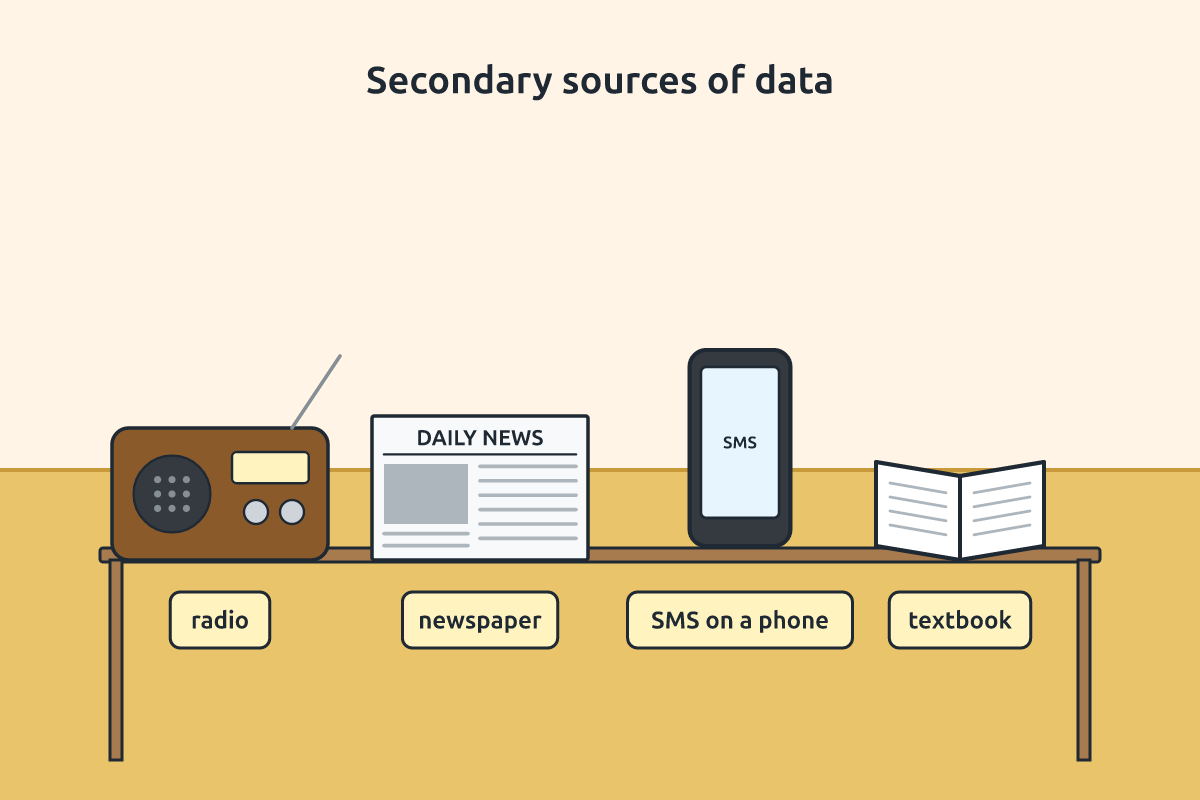
| Source | Example |
|---|---|
| radio and television | news and weather reports |
| newspapers and magazines | reports about events |
| books and encyclopedias | textbooks explaining history |
| websites | online articles |
| telephone calls | someone telling you news they heard |
| SMS and messaging apps | a text message passing on information |
| fax | a copy of a document sent through a telephone line |
2. Communication Devices as Sources
Radio sends information by sound to many people at once. It is the most common source of news in rural Ghana. A telephone call lets two people talk across long distances. SMS (Short Message Service) sends short text messages from phone to phone. A fax machine scans a paper document and sends a copy through a telephone line to another fax machine, which prints it. Fax is now rarely used because email is faster.
3. Comparing Primary and Secondary Sources
| Feature | Primary | Secondary |
|---|---|---|
| who collects | you, first-hand | someone else |
| speed | slow | quick |
| cost | can be expensive | usually cheap |
| accuracy | original | may be changed or old |
| examples | interview, observation | radio, books, SMS |
Common mistake: Not everything on social media or forwarded SMS is true. Check with trusted sources such as GBC, the Ghana Meteorological Agency or your teacher.
New words
- secondary source
- Information reported by someone else.
- SMS
- Short Message Service; text messages.
- fax
- Sending a copy of a document through a telephone line.
- encyclopedia
- A book or website of facts on many topics.
- reliable
- Trustworthy and accurate.
- fake news
- False information presented as true.
Summary
- Secondary sources report information collected by others.
- Radio, TV, newspapers, books, SMS, calls and fax are secondary sources.
- They are quick and cheap but may be inaccurate.
- Always check information from trusted sources.
Class activity: Source Sort
- Your teacher gives cards with 12 sources.
- Sort them into primary and secondary.
- Explain one advantage of each group.
You need: Portable radio, Basic mobile phone, Printed interview form
Exercises
Answer in your exercise book first, then check your answers.
1. Which is a secondary source?
- A. Radio news
- B. Your own interview
- C. Your experiment
- D. Your diary
Show answer
Answer: Radio newsSomeone else reported it.2. Which device sends a copy of a paper document through a telephone line?
- A. Fax machine
- B. Radio
- C. Projector
- D. Speaker
Show answer
Answer: Fax machineIt scans and sends.3. What does SMS stand for?
- A. Short Message Service
- B. Simple Mail System
- C. Send My Story
- D. Secure Mobile Signal
Show answer
Answer: Short Message ServiceText messaging.4. A newspaper is a secondary source.
- A. True
- B. False
Show answer
Answer: TrueReporters collect and present the information.5. Every forwarded SMS is true.
- A. True
- B. False
Show answer
Answer: FalseCheck with trusted sources.6. Information reported by someone else is from a ______ source.
Show answer
Answer: secondaryNot first-hand.7. Give two advantages of secondary sources.
Show answer
Answer: Quick to get and cheap (or easy to find).Any two.8. Why should you check secondary information from more than one source?
Show answer
Answer: It may be old, incomplete, changed or false; comparing sources helps confirm it.Reliability.
Homework
- Listen to a radio news bulletin and write three pieces of information you heard.