Basic 4 · Science · Materials
Separating Liquid–Liquid Mixtures
In this topic you will describe ways of separating liquid–liquid mixtures.
By the end of these notes you should be able to:
- Separate immiscible liquids by decanting and scooping
- Describe how a separating funnel works
- Describe how miscible liquids are separated
What you already know
- Liquid–liquid mixtures
Copy everything that has a blue line on its left into your notebook. The other parts are for reading.
- Strand
- Diversity of matter
- Sub-strand
- Materials
- Indicator
- B4.1.2.2.1 – Identify a liquid–liquid mixture and describe how to separate its components
Introduction
When mother makes palm nut soup, the oil rises to the top. She scoops off some oil with a spoon. She is separating a liquid–liquid mixture.
1. Separating Immiscible Liquids
| Method | How it works |
|---|---|
| scooping | spoon off the top layer (e.g. oil from soup) |
| decanting | carefully pour off the top layer |
| separating funnel | open the tap to let the bottom layer flow out, then close it |
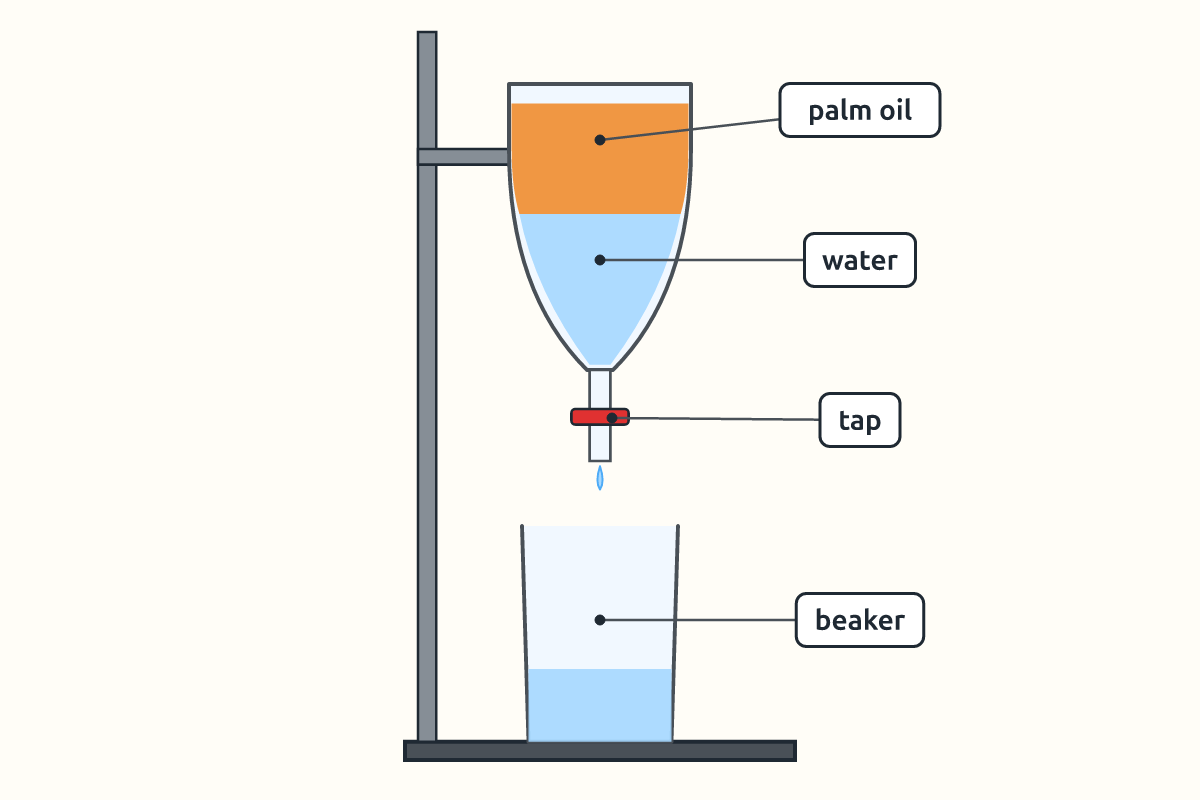
2. Separating Miscible Liquids
Miscible liquids do not form layers, so we cannot pour one off.
They are separated by distillation: heating the mixture so the liquid with the lower boiling point turns into vapour first, then cooling the vapour back into a liquid.
Safety: Heating liquids must only be done by an adult or your teacher.
3. Uses in Everyday Life
- skimming oil from soup
- separating cream from milk
- removing oil spills from water
New words
- separate
- To take the parts of a mixture apart.
- decant
- To pour off a top layer carefully.
- separating funnel
- Glassware with a tap for separating layers.
- distillation
- Separating liquids by boiling and cooling.
- boiling point
- The temperature at which a liquid boils.
- skim
- To remove from the surface.
Summary
- Immiscible liquids are separated by scooping, decanting or a separating funnel.
- In a separating funnel, the bottom layer flows out first.
- Miscible liquids are separated by distillation.
- We skim oil from soup in everyday life.
Class activity: Decanting Practice
- Mix water and palm oil in a clear cup and let it settle.
- Pour off the oil carefully into another cup.
- Scoop the last bits with a spoon.
You need: Water, Palm oil, Clear plastic bottles, Metal spoon
Exercises
Answer in your exercise book first, then check your answers.
1. Pouring off a top layer carefully is…
- A. Decanting
- B. Boiling
- C. Freezing
- D. Sieving
Show answer
Answer: DecantingThat is decanting.2. In a separating funnel, which layer comes out first?
- A. The bottom layer
- B. The top layer
- C. Both at once
- D. Neither
Show answer
Answer: The bottom layerThe tap is at the bottom.3. Miscible liquids are separated by…
- A. Distillation
- B. Decanting
- C. Scooping
- D. Sieving
Show answer
Answer: DistillationThey do not form layers.4. We can scoop oil from soup with a spoon.
- A. True
- B. False
Show answer
Answer: TrueOil floats on top.5. A sieve separates oil from water.
- A. True
- B. False
Show answer
Answer: FalseLiquids pass through sieves.6. To remove something from the surface is to ______ it.
Show answer
Answer: skimThat is skimming.7. Describe how to separate palm oil from water.
Show answer
Answer: Let it settle, then decant or scoop the oil, or use a separating funnel.Oil forms a top layer.8. Why can we not decant a mixture of water and vinegar?
Show answer
Answer: They are miscible and do not form separate layers.Decanting needs layers.
Homework
- Watch an adult make soup. Describe how oil is removed from the top.