Basic 4 · Science · Earth Science
Cyclic Movements
In this topic you will study movements in nature and in objects that repeat in cycles.
By the end of these notes you should be able to:
- Explain cyclic movement
- Describe the Earth's rotation and revolution
- Observe a swinging pendulum and clock hands
What you already know
- Repeating natural events (Basic 3)
Copy everything that has a blue line on its left into your notebook. The other parts are for reading.
- Strand
- Cycles
- Sub-strand
- Earth Science
- Indicator
- B4.2.1.1.1 – Demonstrate understanding of cyclic movements in the environment
Introduction
A pendulum swings back and forth. Clock hands go round and round. The Earth spins every day and travels round the sun every year. These are cyclic movements.
1. What is a Cyclic Movement?
Cyclic movement: A movement that repeats in the same pattern again and again.
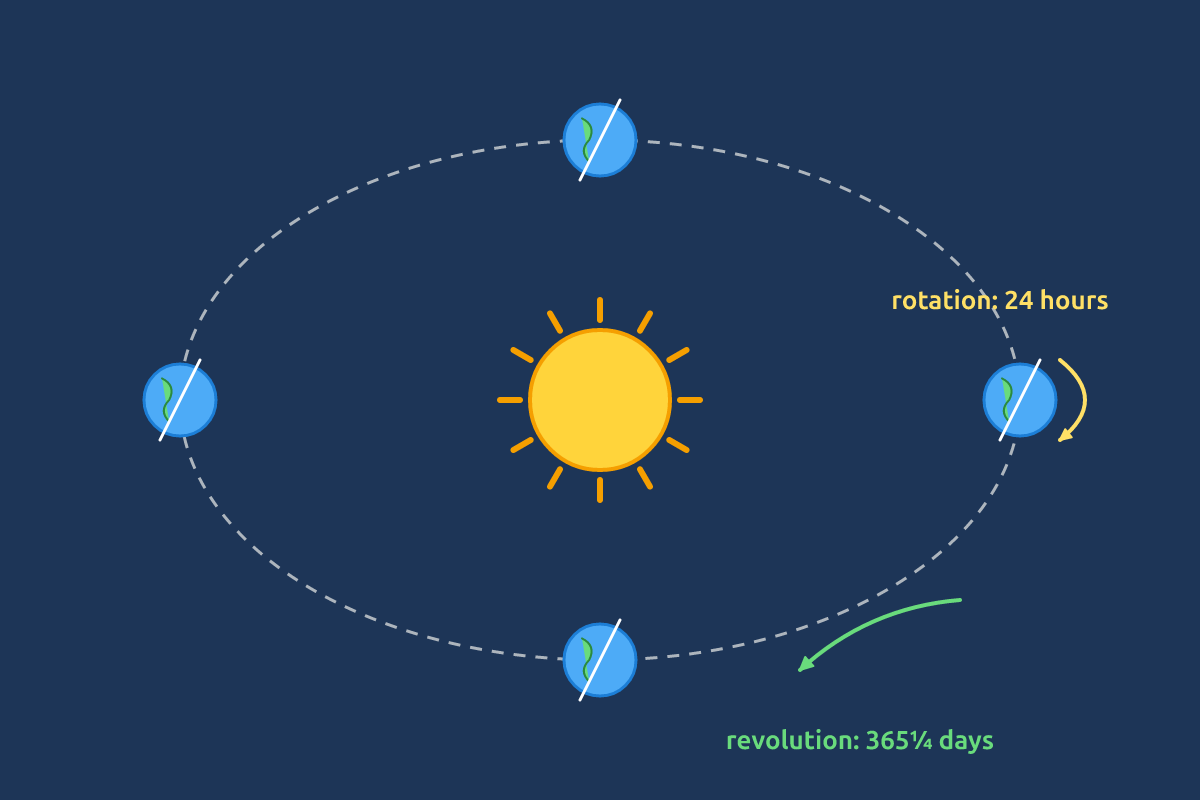
2. The Earth's Movements
| Movement | Meaning | Time taken | Result |
|---|---|---|---|
| rotation | spinning on its axis | about 24 hours | day and night |
| revolution | moving round the sun | about 365¼ days | a year and the seasons |
3. Other Cyclic Movements
- a pendulum swinging back and forth
- the hands of an analogue clock
- the moon going round the Earth (about a month)
- a bicycle wheel turning
Remember: The extra ¼ day each year is why we add one day (29 February) every four years in a leap year.
New words
- cycle
- A pattern that repeats.
- rotation
- Spinning on an axis.
- revolution
- Moving round another object.
- axis
- An imaginary line through the Earth from North Pole to South Pole.
- pendulum
- A weight on a string that swings.
- orbit
- The path of one object round another.
Summary
- A cyclic movement repeats again and again.
- The Earth rotates every 24 hours, causing day and night.
- The Earth revolves round the sun in about 365¼ days.
- Pendulums and clock hands also move in cycles.
Class activity: Pendulum Count
- Tie a stone to a string and let it swing.
- Count the swings in 30 seconds.
- Watch the analogue clock and describe how its hands move.
You need: String-and-stone pendulum, Analogue clock, Printed maize life-cycle cards
Exercises
Answer in your exercise book first, then check your answers.
1. How long does the Earth take to rotate once?
- A. About 24 hours
- B. One week
- C. One year
- D. One month
Show answer
Answer: About 24 hoursThat gives day and night.2. What causes day and night?
- A. The Earth's rotation
- B. The Earth's revolution
- C. The moon
- D. Clouds
Show answer
Answer: The Earth's rotationSpinning turns each side to the sun.3. How long does the Earth take to go round the sun?
- A. About 365¼ days
- B. 24 hours
- C. 30 days
- D. 7 days
Show answer
Answer: About 365¼ daysThat is one year.4. A swinging pendulum is a cyclic movement.
- A. True
- B. False
Show answer
Answer: TrueIt repeats back and forth.5. Revolution means spinning on an axis.
- A. True
- B. False
Show answer
Answer: FalseThat is rotation.6. The path of one object round another is its ______.
Show answer
Answer: orbitThat is an orbit.7. Name three cyclic movements.
Show answer
Answer: Any three: Earth's rotation, revolution, pendulum, clock hands, moon's orbit, wheel.They repeat.8. Why do we have a leap year every four years?
Show answer
Answer: The Earth takes about 365¼ days to orbit the sun; four quarters make an extra day.The ¼ days add up.
Homework
- Make a pendulum at home and count its swings in one minute.