Basic 4 · Science · Earth Science
Objects in the Sky by Day and Night
In this topic you will identify objects we see in the sky during the day and at night.
By the end of these notes you should be able to:
- Name objects seen in the day sky
- Name objects seen in the night sky
- Explain why the moon shines
What you already know
- Cyclic movements
Copy everything that has a blue line on its left into your notebook. The other parts are for reading.
- Strand
- Cycles
- Sub-strand
- Earth Science
- Indicator
- B4.2.1.2.1 – Identify the objects in the sky during day and night
Introduction
In the day we see the sun, clouds and birds. At night we see the moon and many stars. Why do we see different things?
1. Day and Night Sky
| Day | Night |
|---|---|
| the sun | the moon |
| clouds | stars |
| birds and aeroplanes | planets (like Venus) |
| sometimes the moon | satellites and meteors |
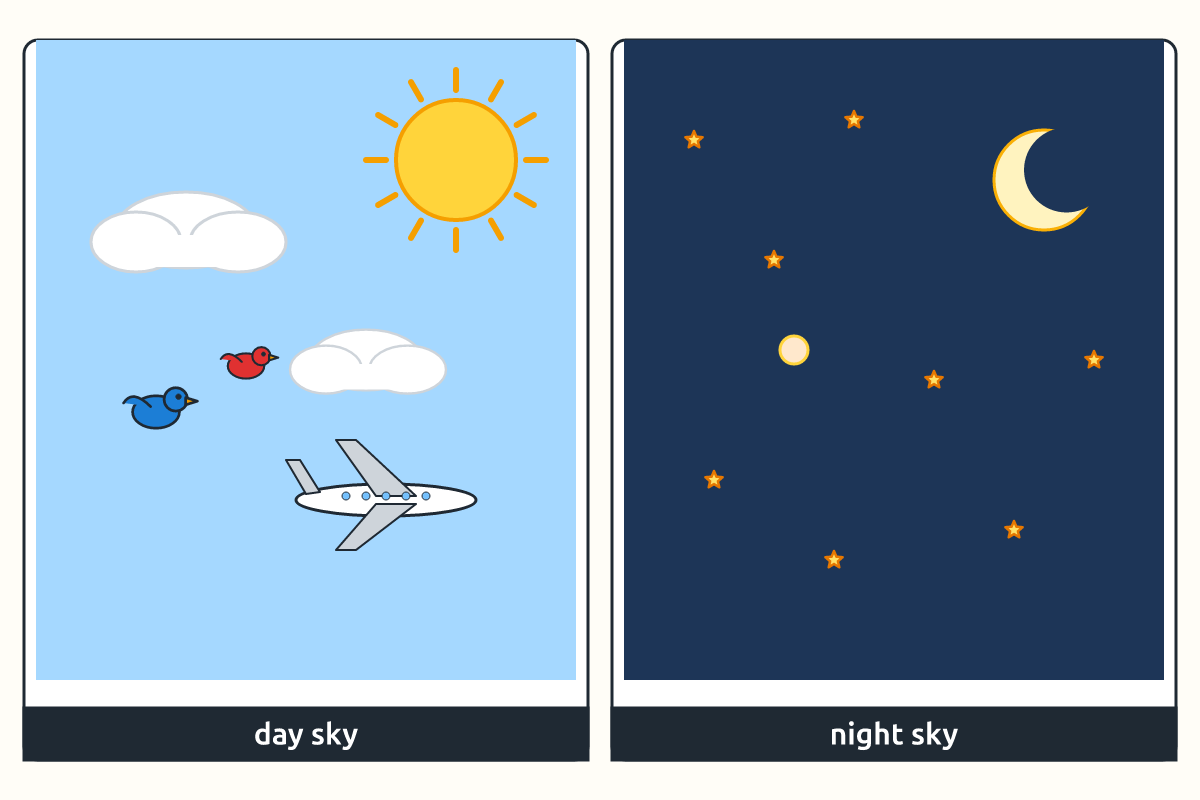
2. The Sun and Stars
- The sun is a star. It is the closest star to the Earth.
- Other stars are very far away, so they look tiny.
- We cannot see stars in the day because the sun is too bright.
3. The Moon
- The moon does not make its own light.
- It reflects light from the sun.
- Its shape seems to change over about a month. These shapes are called phases.
Remember: Never look straight at the sun. It can damage your eyes.
New words
- star
- A huge ball of burning gas that gives out light.
- planet
- A large body that moves round the sun.
- moon
- A natural body that moves round the Earth.
- reflect
- To bounce light back.
- phase
- A shape the moon appears to have.
- satellite
- An object that moves round a planet.
Summary
- We see the sun, clouds and birds by day.
- We see the moon, stars and planets at night.
- The sun is the nearest star to the Earth.
- The moon reflects the sun's light.
Class activity: Torch and Globe
- Shine a torch on the clay globe in a dark corner.
- Hold a small ball (the moon) near the globe and see light reflect from it.
- Sort picture cards into day sky and night sky.
You need: Locally made clay globe, Torch, Printed day-and-night picture cards
Exercises
Answer in your exercise book first, then check your answers.
1. Which do we see at night?
- A. Stars
- B. The sun
- C. Rainbows only
- D. Clouds only
Show answer
Answer: StarsStars show at night.2. Why does the moon shine?
- A. It reflects sunlight
- B. It burns gas
- C. It has bulbs
- D. It is a star
Show answer
Answer: It reflects sunlightThe moon has no light of its own.3. The sun is a…
- A. Star
- B. Planet
- C. Moon
- D. Cloud
Show answer
Answer: StarIt is the nearest star.4. Aeroplanes can be seen in the day sky.
- A. True
- B. False
Show answer
Answer: TrueThey fly in the sky.5. Stars disappear completely during the day.
- A. True
- B. False
Show answer
Answer: FalseThey are still there; the sun is too bright to see them.6. The shapes of the moon are called ______.
Show answer
Answer: phasesThey change over a month.7. Name two objects seen in the day sky and two in the night sky.
Show answer
Answer: Day: sun, clouds; night: moon, stars.They differ.8. Why can we not see stars during the day?
Show answer
Answer: The sun's light is so bright that it hides the faint starlight.Stars are still there.
Homework
- Draw the moon every night for a week. Notice how its shape changes.