Basic 4 · Science · Earth Science
Evapotranspiration
In this topic you will show how water leaves the ground and plants and enters the air.
By the end of these notes you should be able to:
- Explain evaporation and transpiration
- Explain evapotranspiration
- Demonstrate transpiration with a plastic bag
What you already know
- Precipitation and the water cycle (Basic 3)
Copy everything that has a blue line on its left into your notebook. The other parts are for reading.
- Strand
- Cycles
- Sub-strand
- Earth Science
- Indicator
- B4.2.1.3.1 – Demonstrate the process of evapotranspiration
Introduction
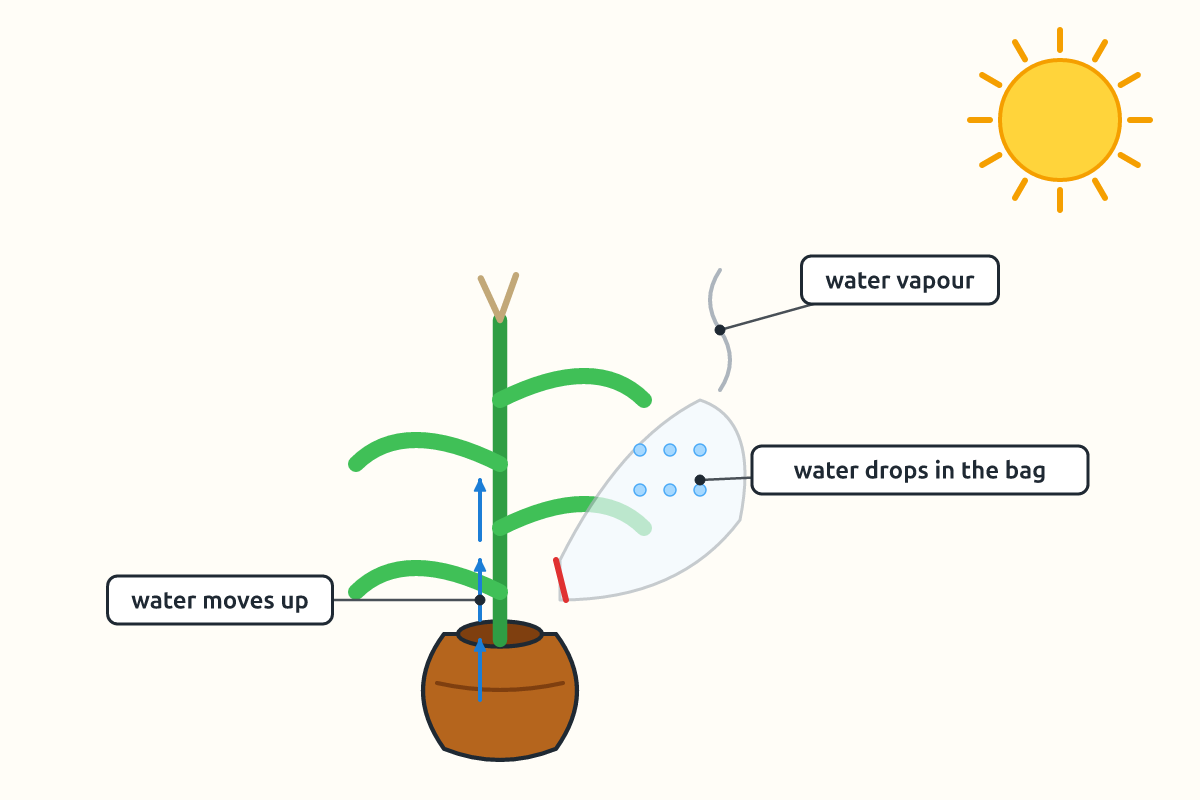
Tie a clear plastic bag around the leaves of a potted maize plant. After a few hours in the sun, water drops appear inside the bag. Where did the water come from?
1. Two Processes
| Process | Meaning |
|---|---|
| evaporation | water turns into vapour from soil, rivers and seas |
| transpiration | water vapour escapes from plant leaves through tiny holes called stomata |
Evapotranspiration: The total water that moves into the air by evaporation from the ground and transpiration from plants.
2. Demonstration
- Water a young potted maize plant.
- Cover some leaves with a clear plastic bag and tie it with a rubber band.
- Leave the plant in the sun for a few hours.
- Observe drops of water inside the bag.
3. Why It Matters
- It adds water vapour to the air, which forms clouds and rain.
- It cools plants on hot days.
- Forests produce a lot of water vapour, helping rainfall.
New words
- evaporation
- Water changing into vapour.
- transpiration
- Water vapour leaving plant leaves.
- evapotranspiration
- Water moving into the air from soil and plants together.
- stomata
- Tiny holes on leaves.
- water vapour
- Water in the form of a gas.
- observation
- Something noticed by watching carefully.
Summary
- Evaporation is water turning to vapour from soil and water bodies.
- Transpiration is water vapour escaping from leaves through stomata.
- Together they are called evapotranspiration.
- Evapotranspiration helps form clouds and rain.
Class activity: Bag Test
- Set up the plastic bag test on the potted maize plant.
- Record observations every hour on the observation sheet.
- Explain where the water came from.
You need: Young potted maize plant, Clear plastic bag with rubber band, Observation cards, Pencils
Exercises
Answer in your exercise book first, then check your answers.
1. Water leaving leaves as vapour is…
- A. Transpiration
- B. Condensation
- C. Freezing
- D. Germination
Show answer
Answer: TranspirationIt happens through stomata.2. Tiny holes on leaves are called…
- A. Stomata
- B. Roots
- C. Veins
- D. Petals
Show answer
Answer: StomataWater vapour exits there.3. Evapotranspiration is…
- A. Evaporation plus transpiration
- B. Only rain
- C. Only freezing
- D. Melting
Show answer
Answer: Evaporation plus transpirationBoth add vapour to the air.4. Water drops form inside the bag on the plant.
- A. True
- B. False
Show answer
Answer: TrueTranspired vapour condenses.5. Cutting down forests increases rainfall.
- A. True
- B. False
Show answer
Answer: FalseFewer trees means less transpiration and less rain.6. Water in the form of a gas is water ______.
Show answer
Answer: vapourThat is water vapour.7. Explain where the water in the plastic bag came from.
Show answer
Answer: Water from the plant leaves escaped as vapour (transpiration) and condensed on the bag.Leaves give out water vapour.8. Why do forest areas often get more rain?
Show answer
Answer: Trees release a lot of water vapour through transpiration, which forms clouds.Evapotranspiration adds moisture.
Homework
- Try the plastic bag test on a plant at home and record what you see.