Basic 4 · Science · Earth Science
Making Water Safe to Use
In this topic you will demonstrate ways of making water safe for drinking and use.
By the end of these notes you should be able to:
- Explain why water must be made safe
- Demonstrate filtering, boiling and settling
- Describe chemical and solar ways of treating water
What you already know
- Impure water (Basic 3)
Copy everything that has a blue line on its left into your notebook. The other parts are for reading.
- Strand
- Cycles
- Sub-strand
- Earth Science
- Indicator
- B4.2.1.5.1 – Demonstrate ways of making water safe for use
Introduction
Water from a stream may look clear but still contain germs. Before we drink it, we must make it safe.
1. Why Treat Water?
Unsafe water may contain dirt, germs and chemicals. It can cause cholera, typhoid, diarrhoea and guinea worm.
2. Ways to Make Water Safe
| Method | How | What it removes |
|---|---|---|
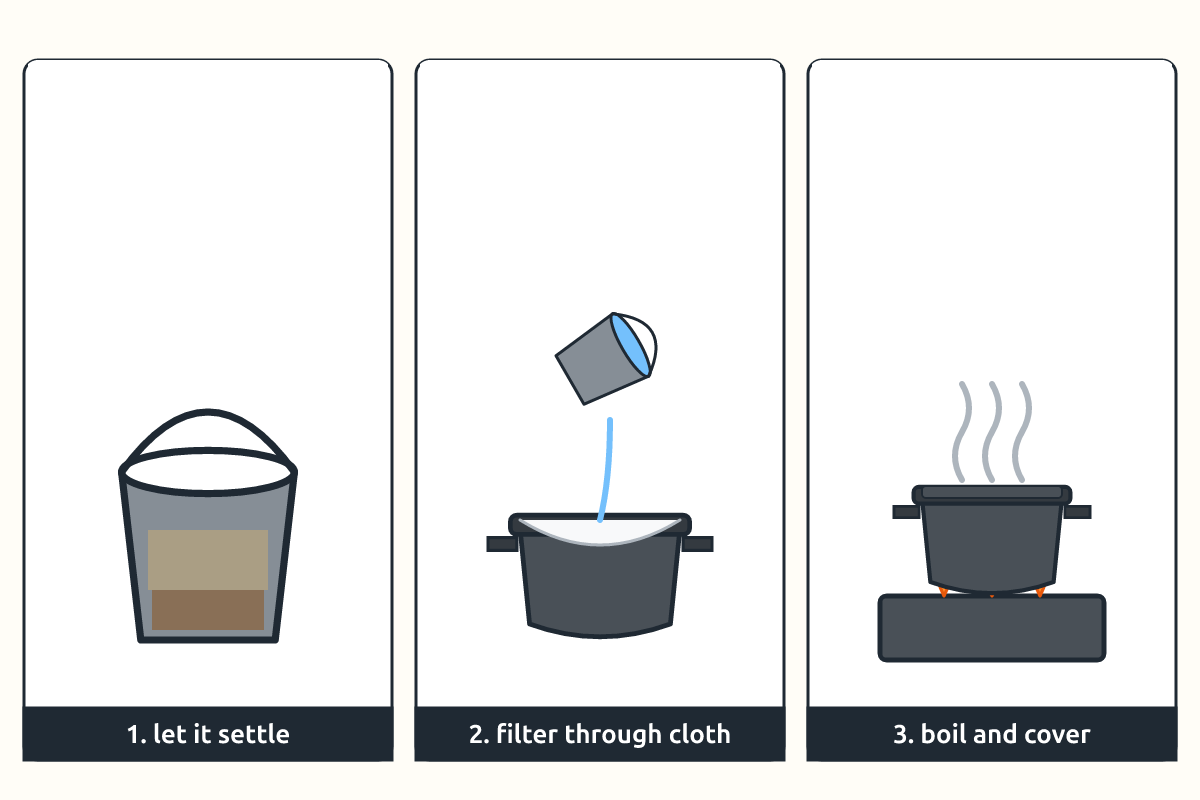
| sedimentation (settling) | leave water to stand so dirt sinks | heavy dirt |
| decanting | pour off the clear water on top | settled dirt |
| filtering | pour through a clean cloth or sand filter | dirt and some germs |
| boiling | boil for at least one minute, then cool and cover | germs |
| chlorination | add chlorine or water-treatment tablets as directed | germs |
| solar disinfection (SODIS) | fill clear plastic bottles and leave in full sun for about 6 hours | germs |
3. Storing Safe Water
- Store in a clean, covered container.
- Use a clean cup or tap to take water out.
- Do not put hands into the container.
New words
- treat
- To make safe.
- sedimentation
- Letting dirt sink to the bottom.
- filter
- To pass through cloth or sand to remove dirt.
- chlorination
- Adding chlorine to kill germs.
- germ
- A tiny living thing that causes disease.
- disinfect
- To kill germs.
Summary
- Unsafe water causes diseases like cholera and typhoid.
- Settle, decant and filter to remove dirt.
- Boil, chlorinate or use SODIS to kill germs.
- Store treated water in clean covered containers.
Class activity: Filter It
- Look at the sealed water samples.
- Pour a cloudy sample through the clean cotton filter cloth.
- Compare the water before and after. Discuss why it still needs boiling.
You need: Sealed local water samples in clear bottles, Clean cotton filter cloth, Printed safe-water treatment cards
Exercises
Answer in your exercise book first, then check your answers.
1. Which method kills germs?
- A. Boiling
- B. Settling
- C. Decanting
- D. Stirring
Show answer
Answer: BoilingHeat kills germs.2. Letting dirt sink to the bottom is…
- A. Sedimentation
- B. Chlorination
- C. Filtration
- D. Evaporation
Show answer
Answer: SedimentationDirt settles.3. In SODIS, water in clear bottles is left in the sun for about…
- A. 6 hours
- B. 5 minutes
- C. 1 month
- D. 1 second
Show answer
Answer: 6 hoursSunlight kills germs.4. Treated water should be stored in covered containers.
- A. True
- B. False
Show answer
Answer: TrueIt keeps it clean.5. Filtering through cloth kills all germs.
- A. True
- B. False
Show answer
Answer: FalseIt removes dirt; boil to kill germs.6. Adding chlorine to kill germs is ______.
Show answer
Answer: chlorinationThat is chlorination.7. List three ways of making water safe.
Show answer
Answer: Any three: settling, decanting, filtering, boiling, chlorination, SODIS.These treat water.8. Why should water still be boiled after filtering?
Show answer
Answer: Filtering removes dirt but may not remove all germs; boiling kills germs.Both steps are needed.
Homework
- Ask an adult how your family makes drinking water safe.