Basic 4 · Science · Cycle of Organism
Parts of a Plant and Their Functions
In this topic you will observe, identify and explain the functions of the parts of a flowering plant.
By the end of these notes you should be able to:
- Identify the parts of a flowering plant
- State the function of each part
- Explain photosynthesis simply
What you already know
- Parts of a plant (Basic 2)
Copy everything that has a blue line on its left into your notebook. The other parts are for reading.
- Strand
- Cycles
- Sub-strand
- Cycle of Organism
- Indicator
- B4.2.2.1.1 – Observe identify and give functions of the parts of a plant
Introduction
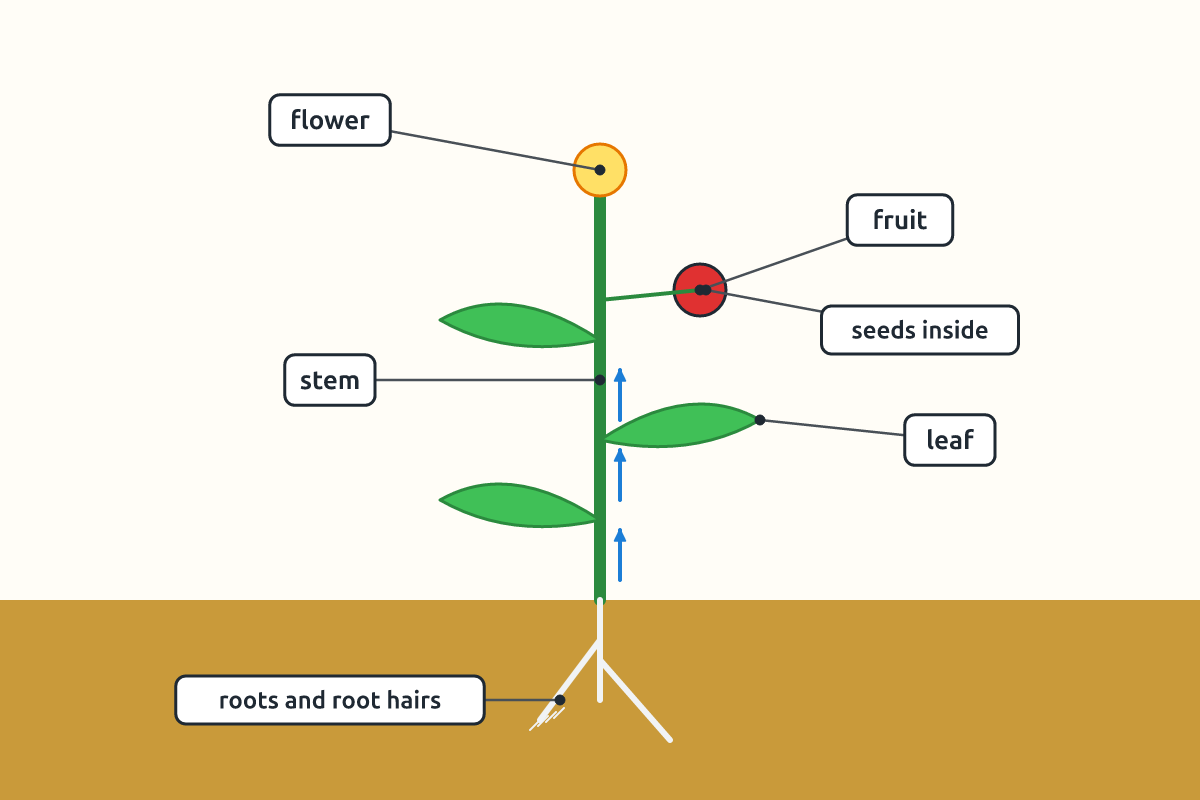
Uproot a young bean plant. You will see roots, a stem and leaves. Older plants also have flowers, fruits and seeds. Each part has a job.
1. Parts and Functions
| Part | Functions |
|---|---|
| roots | hold the plant firmly in the soil; absorb water and mineral salts |
| stem | holds up leaves and flowers; carries water and food through the plant |
| leaves | make food (photosynthesis); lose water (transpiration) |
| flowers | produce seeds (reproduction); attract insects |
| fruits | protect seeds; help spread them |
| seeds | grow into new plants |
2. Photosynthesis
Photosynthesis: The process by which green leaves use sunlight, water and carbon dioxide to make food.
Leaves are green because they contain chlorophyll, which traps sunlight.
During photosynthesis, plants give out oxygen, which we breathe.
3. Types of Roots
| Type | Description | Example |
|---|---|---|
| tap root | one main root with smaller side roots | bean, mango |
| fibrous roots | many thin roots of similar size | maize, grass |
New words
- function
- The job of a part.
- absorb
- To take in.
- mineral salts
- Nutrients in the soil that plants need.
- photosynthesis
- Making food in leaves using sunlight.
- chlorophyll
- The green substance in leaves.
- tap root
- One main root with side roots.
Summary
- Roots anchor the plant and absorb water and minerals.
- The stem supports the plant and transports water and food.
- Leaves make food by photosynthesis using sunlight.
- Flowers produce seeds; fruits protect them.
Class activity: Plant Dissection
- Look at the uprooted bean, grass and cassava cutting.
- Compare the bean's tap root with the grass's fibrous roots.
- Label the parts on a drawing and write each function.
You need: Uprooted bean, Grass plants, Cassava cutting, Hand lens
Exercises
Answer in your exercise book first, then check your answers.
1. Which part makes food for the plant?
- A. Leaves
- B. Roots
- C. Seeds
- D. Fruits
Show answer
Answer: LeavesLeaves carry out photosynthesis.2. Which plant has fibrous roots?
- A. Maize
- B. Bean
- C. Mango
- D. Orange
Show answer
Answer: MaizeGrasses have fibrous roots.3. What gas do plants give out during photosynthesis?
- A. Oxygen
- B. Carbon dioxide
- C. Smoke
- D. Steam
Show answer
Answer: OxygenWe breathe this oxygen.4. Roots absorb water from the soil.
- A. True
- B. False
Show answer
Answer: TrueThat is a root's job.5. Fruits make food for the plant.
- A. True
- B. False
Show answer
Answer: FalseFruits protect seeds; leaves make food.6. The green substance in leaves is ______.
Show answer
Answer: chlorophyllIt traps sunlight.7. State two functions of the stem.
Show answer
Answer: Supports the plant; carries water and food.The stem supports and transports.8. Why would a plant kept in darkness become weak?
Show answer
Answer: It cannot carry out photosynthesis without sunlight, so it cannot make food.Leaves need light.
Homework
- Uproot a weed carefully. Identify whether it has a tap root or fibrous roots.