Basic 4 · Science · Materials
Liquid–Liquid Mixtures
In this topic you will identify liquid–liquid mixtures and tell mixtures that mix well from those that do not.
By the end of these notes you should be able to:
- Explain what a liquid–liquid mixture is
- Identify miscible and immiscible liquids
- Give everyday examples
What you already know
- Solid–solid mixtures (Basic 2)
Copy everything that has a blue line on its left into your notebook. The other parts are for reading.
- Strand
- Diversity of matter
- Sub-strand
- Materials
- Indicator
- B4.1.2.2.1 – Identify a liquid-liquid mixture and describe how to separate its components
Introduction
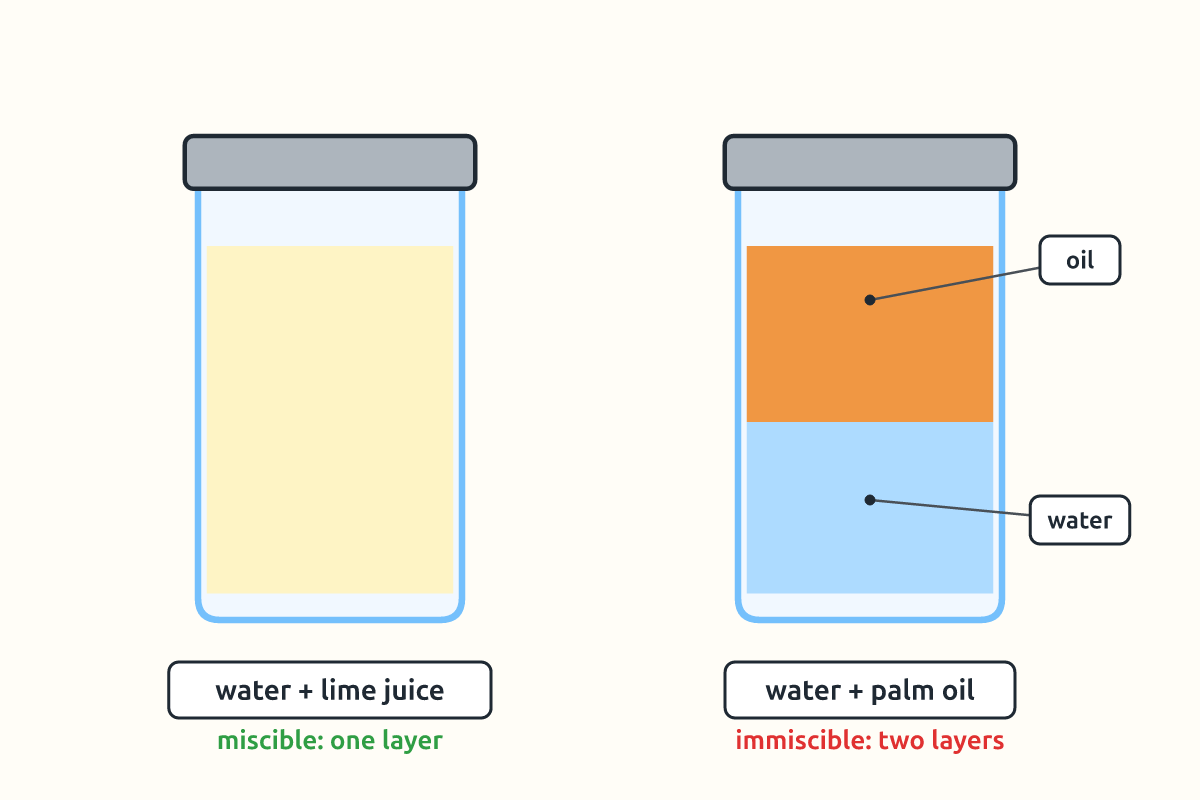
Pour palm oil into water. The oil floats on top and does not mix. Pour lime juice into water. They mix completely. Both are liquid–liquid mixtures.
1. Liquid–Liquid Mixtures
Liquid–liquid mixture: A mixture of two or more liquids.
2. Miscible and Immiscible Liquids
| Kind | Meaning | Examples |
|---|---|---|
| miscible | mix completely; you cannot see two layers | water and lime juice; water and vinegar |
| immiscible | do not mix; they form layers | water and palm oil; water and kerosene |
3. Why Oil Floats
Palm oil is lighter (less dense) than water, so it floats on top.
Safety: Never taste or smell kerosene. Keep it away from fire.
New words
- mixture
- Two or more substances mixed together.
- miscible
- Able to mix completely.
- immiscible
- Not able to mix.
- layer
- A level of one substance lying on another.
- dense
- Heavy for its size.
- float
- To stay on top of a liquid.
Summary
- A liquid–liquid mixture contains two or more liquids.
- Miscible liquids mix completely.
- Immiscible liquids form separate layers.
- Palm oil floats on water because it is less dense.
Class activity: Mix Test
- Pour water and palm oil into a clear cup. Observe.
- Pour water and lime juice into another cup. Observe.
- Record which is miscible and which is immiscible.
You need: Water, Palm oil, Clear plastic bottles, Metal spoon
Exercises
Answer in your exercise book first, then check your answers.
1. Which pair is immiscible?
- A. Water and palm oil
- B. Water and lime juice
- C. Water and vinegar
- D. Water and sugar syrup
Show answer
Answer: Water and palm oilThey form layers.2. Liquids that mix completely are…
- A. Miscible
- B. Immiscible
- C. Solid
- D. Dense
Show answer
Answer: MiscibleThey form one layer.3. Why does oil float on water?
- A. It is less dense
- B. It is heavier
- C. It is colder
- D. It is solid
Show answer
Answer: It is less denseLighter liquids float.4. Water and vinegar are miscible.
- A. True
- B. False
Show answer
Answer: TrueThey mix completely.5. Kerosene and water mix completely.
- A. True
- B. False
Show answer
Answer: FalseThey form layers.6. A level of one substance on another is a ______.
Show answer
Answer: layerImmiscible liquids form layers.7. Give one example each of miscible and immiscible liquids.
Show answer
Answer: E.g. water and lime juice; water and palm oil.They behave differently.8. How could you tell if two clear liquids are miscible?
Show answer
Answer: Mix them and look for separate layers; if there is only one layer, they are miscible.Observe for layers.
Homework
- Mix a little cooking oil and water in a cup at home. Draw what you see.