Basic 4 · Science · Living and Non-Living Things
Types of Plants: Climbers, Creepers and Grasses
In this topic you will describe climbers, creepers and grasses, and compare flowering and non-flowering plants.
By the end of these notes you should be able to:
- Describe climbers, creepers and grasses
- Explain how climbers hold on to support
- Tell flowering from non-flowering plants
What you already know
- Trees, shrubs and herbs
Copy everything that has a blue line on its left into your notebook. The other parts are for reading.
- Strand
- Diversity of matter
- Sub-strand
- Living and Non-Living Things
- Indicator
- B4.1.1.2.2 – Describe the physical appearance of different types of plants
Introduction
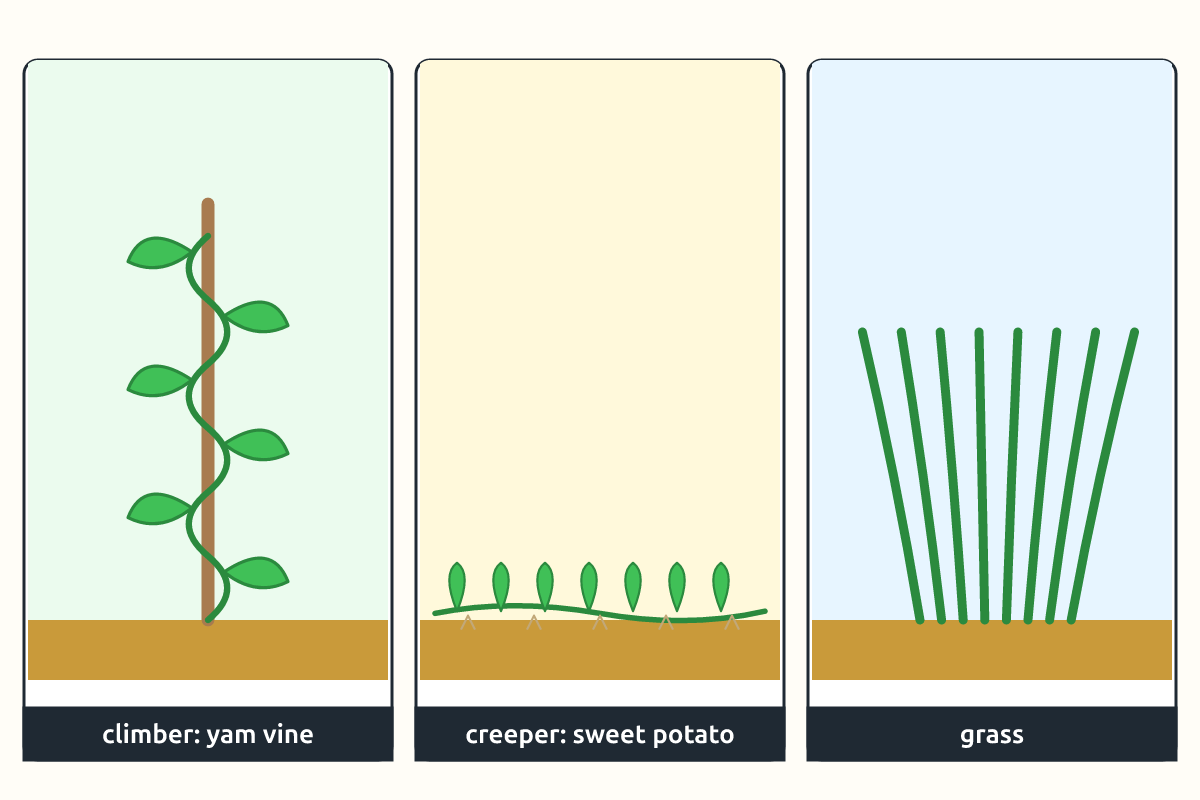
A yam vine twists around a stick. A sweet potato plant spreads over the ground. Grass covers the football field. These plants grow in special ways.
1. Climbers
Climbers have weak stems. They grow upwards by holding on to support.
| Method | Example |
|---|---|
| twining stem | yam vine |
| tendrils (curly threads) | passion fruit, cucumber |
| clinging roots | money plant (pothos) |
2. Creepers
Creepers have weak stems that spread along the ground.
Examples: sweet potato, pumpkin, watermelon.
3. Grasses
Grasses have thin, long leaves and hollow or jointed stems.
Examples: lawn grass, maize, rice, sugarcane, elephant grass.
4. Flowering and Non-Flowering Plants
| Flowering plants | Non-flowering plants |
|---|---|
| produce flowers, fruits and seeds | do not produce flowers |
| mango, hibiscus, maize | ferns, mosses |
New words
- climber
- A plant with a weak stem that grows upwards on support.
- creeper
- A plant with a weak stem that spreads on the ground.
- tendril
- A curly thread a climber uses to hold on.
- vine
- A climbing or trailing plant.
- fern
- A non-flowering plant with feathery leaves.
- moss
- A tiny non-flowering plant that grows in damp places.
Summary
- Climbers grow upwards on support using twining stems or tendrils.
- Creepers spread along the ground.
- Grasses have long thin leaves; maize and rice are grasses.
- Flowering plants make seeds; ferns and mosses do not flower.
Class activity: Plant Hunt
- Look at the local shrub and climbing-plant cuttings.
- Find a climber, a creeper and a grass in the school compound.
- Describe how each one grows.
You need: Local shrub, Climbing-plant cuttings, Printed photographs of Ghanaian trees, Creepers, Exercise books
Exercises
Answer in your exercise book first, then check your answers.
1. Which plant is a creeper?
- A. Sweet potato
- B. Mango
- C. Hibiscus
- D. Odum
Show answer
Answer: Sweet potatoIt spreads on the ground.2. Curly threads that help climbers hold on are…
- A. Tendrils
- B. Roots
- C. Thorns
- D. Leaves
Show answer
Answer: TendrilsPassion fruit has tendrils.3. Which is a non-flowering plant?
- A. Fern
- B. Maize
- C. Mango
- D. Tomato
Show answer
Answer: FernFerns do not flower.4. Maize is a type of grass.
- A. True
- B. False
Show answer
Answer: TrueIt has long thin leaves.5. Climbers have very strong, thick stems.
- A. True
- B. False
Show answer
Answer: FalseClimbers have weak stems.6. A yam ______ twists around a stick.
Show answer
Answer: vineYam is a climbing vine.7. Give two examples of climbers and two of creepers.
Show answer
Answer: Climbers: yam, passion fruit; creepers: sweet potato, pumpkin.They grow differently.8. Why do farmers put sticks beside yam plants?
Show answer
Answer: Yam is a climber with a weak stem; it needs support to grow upwards towards light.Climbers need support.
Homework
- Find one climber at home or nearby. Describe how it holds on.