Basic 4 · Physical Education · Manipulative Skills
The Tripod Balance
In this topic you will perform an inverted balance called the tripod.
By the end of these notes you should be able to:
- Explain the tripod balance
- Perform a tripod safely
- Hold the balance with control
What you already know
- Balancing on different body parts (Basic 2)
Copy everything that has a blue line on its left into your notebook. The other parts are for reading.
- Strand
- Motor Skill And Movement Patterns
- Sub-strand
- Manipulative Skills
- Indicator
- B4.1.4.1.4 – Perform an inverted balance (tripod) by evenly distributing weight on body parts
Introduction
A tripod has three legs, like a camera stand. In the tripod balance, your head and two hands form three points of support.
1. What is a Tripod?
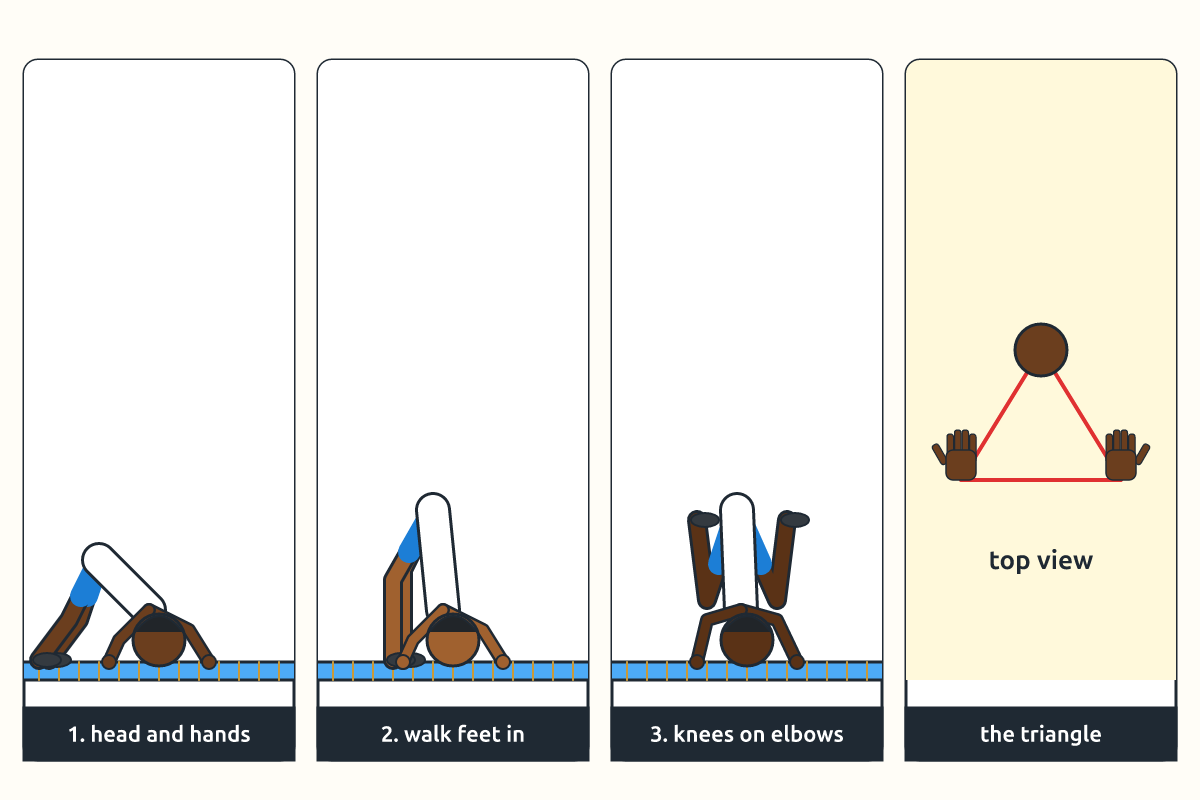
Tripod balance: An upside-down balance on the head and two hands forming a triangle.
2. Steps
- Kneel on a mat.
- Place your hands shoulder-width apart, fingers spread.
- Place the front top of your head on the mat ahead of your hands, making a triangle.
- Walk your feet in until your hips are above your head.
- Rest one knee on one elbow, then the other.
- Hold for three seconds, then come down slowly.
Safety: Use a mat. Your teacher or a partner should support you. Come down slowly and never fall sideways on your neck.
New words
- tripod
- A stand with three points of support.
- inverted
- Upside down.
- triangle
- A shape with three sides.
- base
- The parts supporting your weight.
- spotter
- A helper who keeps you safe.
- control
- Moving steadily without falling.
Summary
- The tripod is an inverted balance on the head and hands.
- Head and hands form a triangle.
- Knees rest on the elbows.
- Always use a mat and a spotter.
Class activity: Tripod Practice
- Practise the triangle position on the mat.
- With a spotter, raise your knees onto your elbows.
- Hold for three seconds and come down slowly.
You need: Woven exercise mats, Printed safe inverted-balance cards, Sticks of chalk
Exercises
Answer in your exercise book first, then check your answers.
1. How many points support you in a tripod?
- A. Three
- B. Two
- C. Four
- D. One
Show answer
Answer: ThreeHead and two hands.2. What shape do the head and hands make?
- A. Triangle
- B. Circle
- C. Square
- D. Line
Show answer
Answer: TriangleIt gives stability.3. A helper who keeps you safe is a…
- A. Spotter
- B. Turner
- C. Referee
- D. Coach only
Show answer
Answer: SpotterSpotters support you.4. The tripod is an inverted balance.
- A. True
- B. False
Show answer
Answer: TrueIt is upside down.5. We should practise the tripod on hard concrete.
- A. True
- B. False
Show answer
Answer: FalseUse a mat.6. Upside down means ______.
Show answer
Answer: invertedThat is inverted.7. Write the first three steps of the tripod.
Show answer
Answer: Kneel; place hands shoulder-width apart; place the head ahead to form a triangle.Follow the order.8. Why is a triangle base stable?
Show answer
Answer: The three points spread the weight evenly.Triangles are strong shapes.
Homework
- Practise the head-and-hands triangle on a soft surface with an adult nearby.