Basic 4 · Physical Education · Fitness
Heart Rate and Aerobic Fitness
In this topic you will measure your heart rate and identify the intensity needed to improve aerobic capacity.
By the end of these notes you should be able to:
- Measure your heart rate
- Calculate your maximum heart rate
- Identify your target heart rate zone
What you already know
- Brisk walking with music
Copy everything that has a blue line on its left into your notebook. The other parts are for reading.
- Strand
- Physical Fitness
- Sub-strand
- Fitness
- Indicator
- B4.4.1.4.1 – Identify the heart rate intensity that is necessary to increase aerobic capacity
Introduction
Your heart is a muscle. When you exercise, it beats faster to pump more blood. Measuring your heart rate tells you how hard you are working.
1. Measuring Heart Rate
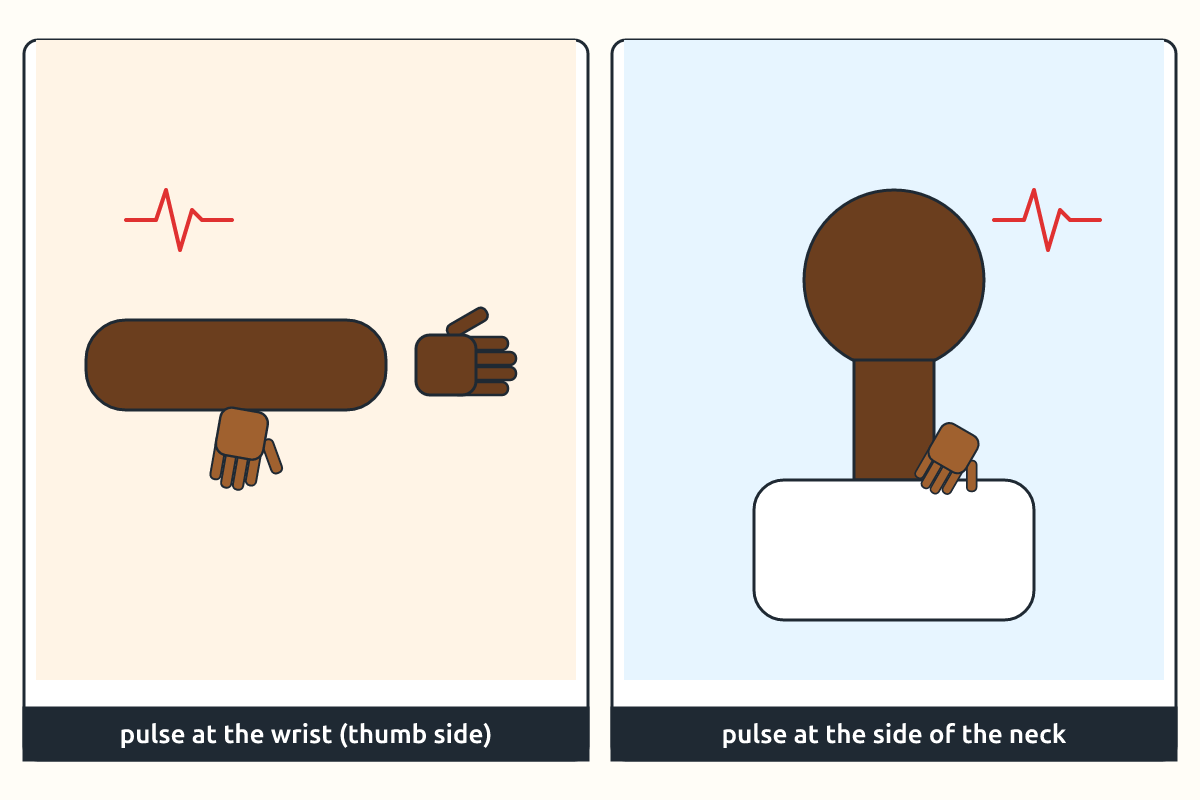
- Find your pulse on your wrist (thumb side) or neck.
- Use two fingers, not your thumb.
- Count the beats for 15 seconds.
- Multiply by 4 to get beats per minute (bpm).
Example
Ama counts 24 beats in 15 seconds. What is her heart rate?
- 24 × 4 = 96
Answer: 96 beats per minute.
2. Target Heart Rate
Maximum heart rate ≈ 220 − your age.
To improve aerobic fitness, exercise at about 60%–85% of your maximum heart rate.
| Measure | Calculation | Result |
|---|---|---|
| maximum heart rate | 220 − 10 | about 210 bpm |
| 60% | 210 × 0.6 | about 126 bpm |
| 85% | 210 × 0.85 | about 179 bpm |
So a 10-year-old's target zone is about 126–179 beats per minute.
New words
- heart rate
- The number of heartbeats per minute.
- pulse
- The beat felt where an artery is near the skin.
- bpm
- Beats per minute.
- maximum heart rate
- The highest safe heart rate, about 220 minus age.
- target zone
- The heart rate range that improves fitness.
- intensity
- How hard you are working.
Summary
- Count your pulse for 15 seconds and multiply by 4.
- Maximum heart rate is about 220 minus your age.
- Aim for 60–85% of your maximum to improve aerobic fitness.
- Heart rate shows exercise intensity.
Class activity: Pulse Lab
- Measure your resting heart rate.
- Skip or jog for 3 minutes, then measure again.
- Check if you reached your target zone.
You need: Skipping rope, Locally made ball, Personal activity record cards
Exercises
Answer in your exercise book first, then check your answers.
1. Where can you find your pulse?
- A. Wrist
- B. Elbow
- C. Knee
- D. Ear
Show answer
Answer: WristOn the thumb side.2. 20 beats in 15 seconds is how many bpm?
- A. 80
- B. 20
- C. 60
- D. 100
Show answer
Answer: 8020 × 4 = 80.3. The maximum heart rate of a 10-year-old is about…
- A. 210 bpm
- B. 100 bpm
- C. 300 bpm
- D. 50 bpm
Show answer
Answer: 210 bpm220 − 10.4. The heart beats faster during exercise.
- A. True
- B. False
Show answer
Answer: TrueIt pumps more blood.5. We should use the thumb to find the pulse.
- A. True
- B. False
Show answer
Answer: FalseThe thumb has its own pulse; use two fingers.6. bpm means beats per ______.
Show answer
Answer: minuteThat is bpm.7. Calculate the heart rate if you count 30 beats in 15 seconds.
Show answer
Answer: 120 bpm30 × 4 = 120.8. Find the target zone (60–85%) for an 11-year-old.
Show answer
Answer: Max ≈ 209; 60% ≈ 125 bpm; 85% ≈ 178 bpm.220 − 11 = 209.
Homework
- Measure your heart rate before and after a 5-minute activity at home.