Basic 4 · Mathematics · Counting, Representation and Cardinality
Rounding Numbers
In this topic you will round whole numbers to the nearest ten, hundred and thousand.
By the end of these notes you should be able to:
- Explain why we round numbers
- Round to the nearest 10, 100 and 1,000
- Use rounding to estimate
What you already know
- Comparing and ordering numbers
Copy everything that has a blue line on its left into your notebook. The other parts are for reading.
- Strand
- Number
- Sub-strand
- Counting, Representation and Cardinality
- Indicator
- B4.1.1.1.5 – Round (off up down) whole numbers up to 100,000 to the nearest thousands hundreds and tens
Introduction
A newspaper says "About 47,000 people watched the match." The real number was 46,835. The writer rounded the number to make it easy to read.
1. Why Round?
Rounding gives a number that is close to the real one but easier to use. We use it to estimate.
2. The Rounding Rule
- Find the place you are rounding to.
- Look at the digit just to its right.
- If that digit is 5 or more, round up (add 1 to the place).
- If it is 4 or less, round down (keep the place the same).
- Change all digits to the right into zeros.
Example 1
Round 46,835 to the nearest thousand.
- Thousands digit: 6
- Digit to its right (hundreds): 8, which is 5 or more, so round up.
Answer: 47,000
Example 2
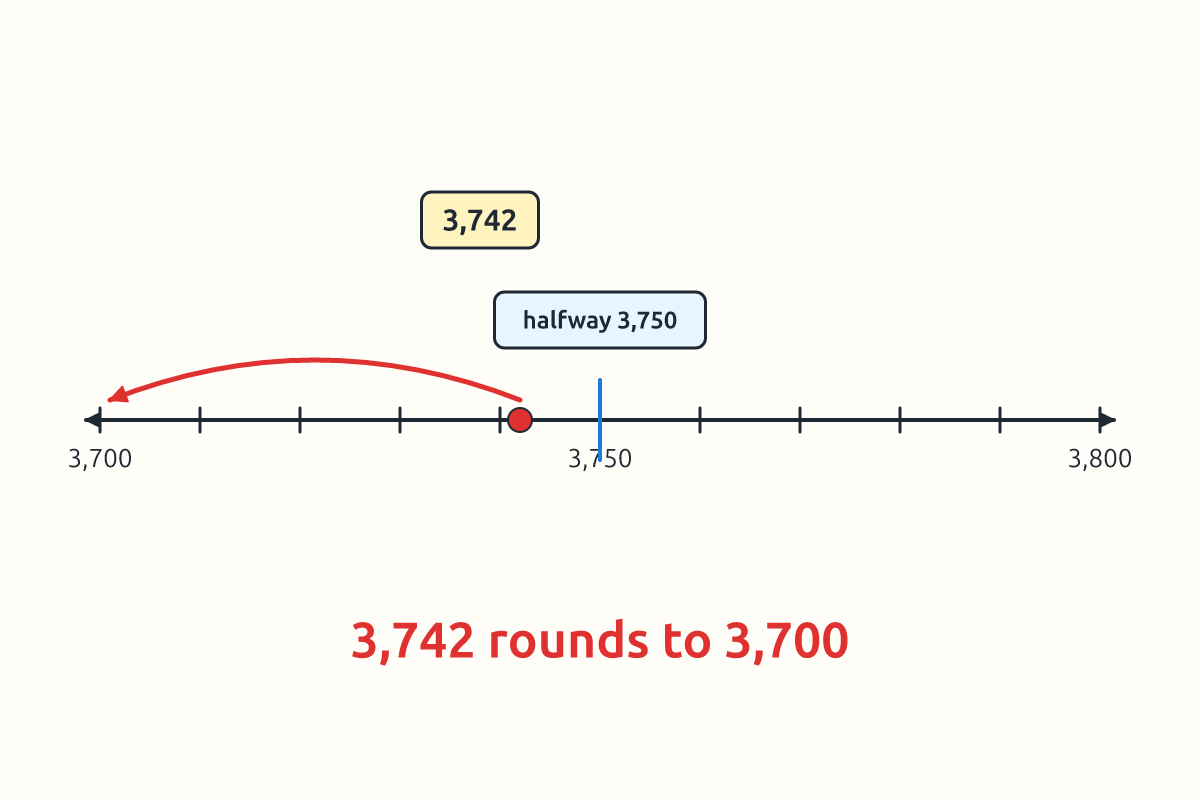
Round 3,742 to the nearest hundred.
- Hundreds digit: 7
- Digit to its right (tens): 4, which is less than 5, so round down.
Answer: 3,700
| Round to the nearest | Answer |
|---|---|
| ten | 58,370 |
| hundred | 58,400 |
| thousand | 58,000 |
Common mistake: When rounding 58,367 to the nearest thousand, look only at the hundreds digit (3), not the 6 or 7.
New words
- round
- To change a number to a nearby simpler number.
- estimate
- A close guess.
- nearest
- Closest.
- round up
- To go to the next higher ten, hundred or thousand.
- round down
- To keep the same ten, hundred or thousand.
- halfway
- Exactly in the middle.
Summary
- Rounding makes numbers easier to use.
- Look at the digit to the right of the rounding place.
- 5 or more: round up; 4 or less: round down.
- Change the digits to the right into zeros.
Class activity: Rounding Race
- Pick a 5-digit number card.
- Round it to the nearest 10, 100 and 1,000.
- Check your partner's answers with a number line.
You need: Locally made number-line chart, Locally made number cards, Exercise books
Exercises
Answer in your exercise book first, then check your answers.
1. Round 64 to the nearest ten.
- A. 60
- B. 70
- C. 65
- D. 100
Show answer
Answer: 604 is less than 5.2. Round 2,850 to the nearest hundred.
- A. 2,900
- B. 2,800
- C. 3,000
- D. 2,850
Show answer
Answer: 2,900The tens digit is 5, so round up.3. Round 73,499 to the nearest thousand.
- A. 73,000
- B. 74,000
- C. 73,500
- D. 70,000
Show answer
Answer: 73,000The hundreds digit is 4.4. 95 rounded to the nearest ten is 100.
- A. True
- B. False
Show answer
Answer: True5 means round up.5. 41,620 rounded to the nearest thousand is 41,000.
- A. True
- B. False
Show answer
Answer: FalseThe hundreds digit is 6, so it is 42,000.6. 568 rounded to the nearest hundred is ______.
Show answer
Answer: 600The tens digit 6 means round up.7. Round 9,451 to the nearest ten, hundred and thousand.
Show answer
Answer: 9,450; 9,500; 9,000Use the digit to the right each time.8. A school has 1,836 pupils. About how many is that to the nearest hundred?
Show answer
Answer: About 1,800The tens digit is 3, so round down.
Homework
- Find three prices or numbers in a newspaper or advert. Round each to the nearest hundred.