Basic 4 · Mathematics · Counting, Representation and Cardinality
Roman Numerals up to 30
In this topic you will read and write Roman numerals from 1 to 30.
By the end of these notes you should be able to:
- Name the Roman symbols I, V and X
- Use the rules for writing Roman numerals
- Change between Roman and Hindu-Arabic numerals up to 30
What you already know
- Place value
Copy everything that has a blue line on its left into your notebook. The other parts are for reading.
- Strand
- Number
- Sub-strand
- Counting, Representation and Cardinality
- Indicator
- B4.1.1.1.6 – Develop an understanding of the Roman numeral system up to XXX (30)
Introduction
Look at some clocks and at chapter numbers in books. You may see I, V and X instead of 1, 5 and 10. These are Roman numerals, used by the ancient Romans.
1. The Symbols
| Roman | Value |
|---|---|
| I | 1 |
| V | 5 |
| X | 10 |
2. The Rules
- Add when a symbol is followed by an equal or smaller one: VI = 5 + 1 = 6; XX = 10 + 10 = 20.
- Subtract when a smaller symbol comes before a larger one: IV = 5 − 1 = 4; IX = 10 − 1 = 9.
- Do not repeat a symbol more than three times: 4 is IV, not IIII.
- V is never repeated.
3. Numbers 1 to 30
| 1 I | 2 II | 3 III | 4 IV | 5 V |
|---|---|---|---|---|
| 6 VI | 7 VII | 8 VIII | 9 IX | 10 X |
| 11 XI | 12 XII | 13 XIII | 14 XIV | 15 XV |
| 16 XVI | 17 XVII | 18 XVIII | 19 XIX | 20 XX |
| 21 XXI | 22 XXII | 23 XXIII | 24 XXIV | 25 XXV |
| 26 XXVI | 27 XXVII | 28 XXVIII | 29 XXIX | 30 XXX |
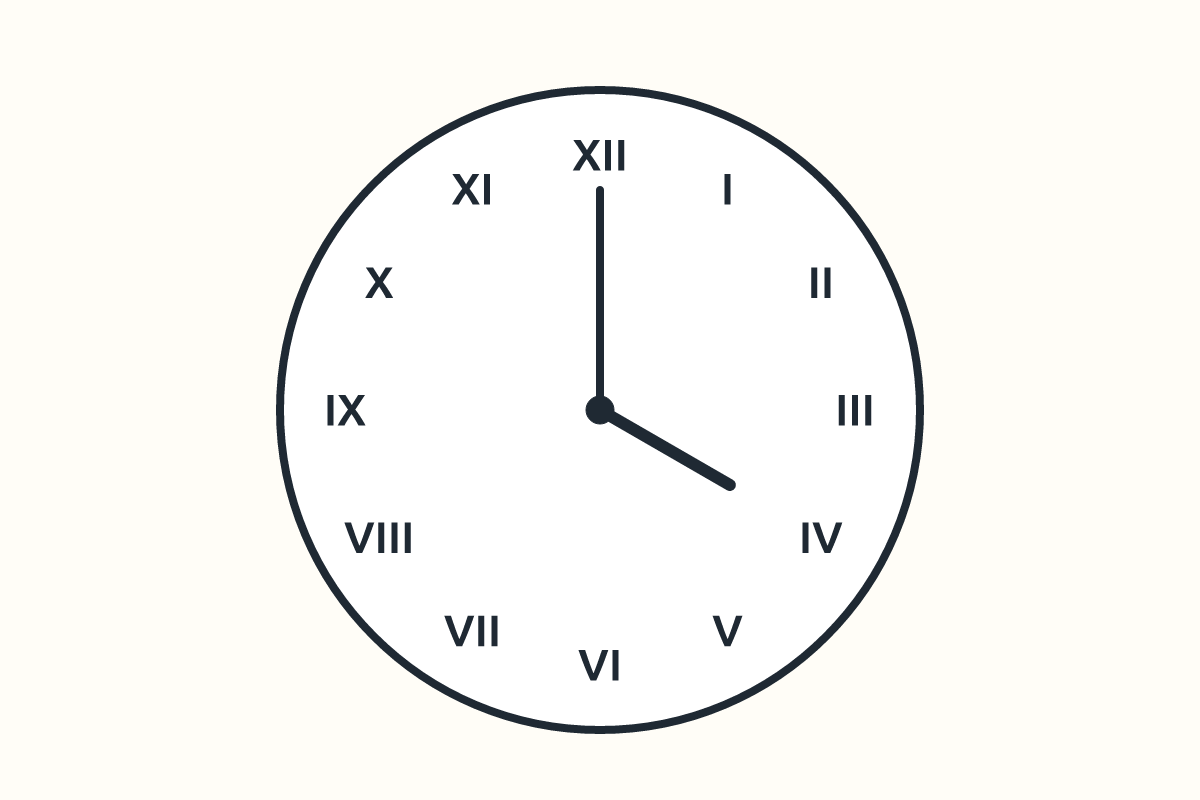
Example
Write 24 in Roman numerals.
- 24 = 20 + 4
- 20 = XX
- 4 = IV
Answer: XXIV
Example
Write XIX as a number.
- X = 10
- IX = 9
Answer: 19
New words
- Roman numerals
- Number symbols used by the ancient Romans.
- Hindu-Arabic numerals
- The digits 0–9 we use every day.
- symbol
- A sign that stands for something.
- subtract
- To take away.
- repeat
- To use again.
- ancient
- Very old.
Summary
- I = 1, V = 5, X = 10.
- Add when a smaller or equal symbol follows; subtract when a smaller one comes first.
- A symbol is never repeated more than three times.
- Example: 24 = XXIV and 19 = XIX.
Class activity: Roman Match
- Make cards with numbers 1–30 and their Roman numerals.
- Mix them and match each pair.
- Write your age and the date in Roman numerals.
You need: Bundles of sticks, Locally made Roman numeral cards, Exercise books
Exercises
Answer in your exercise book first, then check your answers.
1. What is VII?
- A. 7
- B. 6
- C. 8
- D. 12
Show answer
Answer: 75 + 1 + 1 = 7.2. Which is 14 in Roman numerals?
- A. XIV
- B. XIIII
- C. IVX
- D. XVI
Show answer
Answer: XIV10 + (5 − 1) = 14.3. What is XXIX?
- A. 29
- B. 31
- C. 21
- D. 19
Show answer
Answer: 2920 + 9 = 29.4. X stands for 10.
- A. True
- B. False
Show answer
Answer: TrueX = 10.5. IIII is the correct way to write 4.
- A. True
- B. False
Show answer
Answer: False4 is IV.6. 30 in Roman numerals is ______.
Show answer
Answer: XXX10 + 10 + 10.7. Write 18 and 26 in Roman numerals.
Show answer
Answer: XVIII and XXVI10 + 8 and 20 + 6.8. Why is 9 written as IX and not VIIII?
Show answer
Answer: A symbol cannot be repeated more than three times, so we subtract: 10 − 1.That is the Roman rule.
Homework
- Find Roman numerals on a clock, watch or book. Write what number each one stands for.