Basic 4 · Mathematics · Counting, Representation and Cardinality
Factors
In this topic you will find the factors of numbers up to 50.
By the end of these notes you should be able to:
- Explain what a factor is
- List all the factors of a number using factor pairs
- Identify prime numbers
What you already know
- Multiplication facts (Basic 3)
Copy everything that has a blue line on its left into your notebook. The other parts are for reading.
- Strand
- Number
- Sub-strand
- Counting, Representation and Cardinality
- Indicator
- B4.1.1.3.1 – Determine the set of factors of a given number up to 50
Introduction
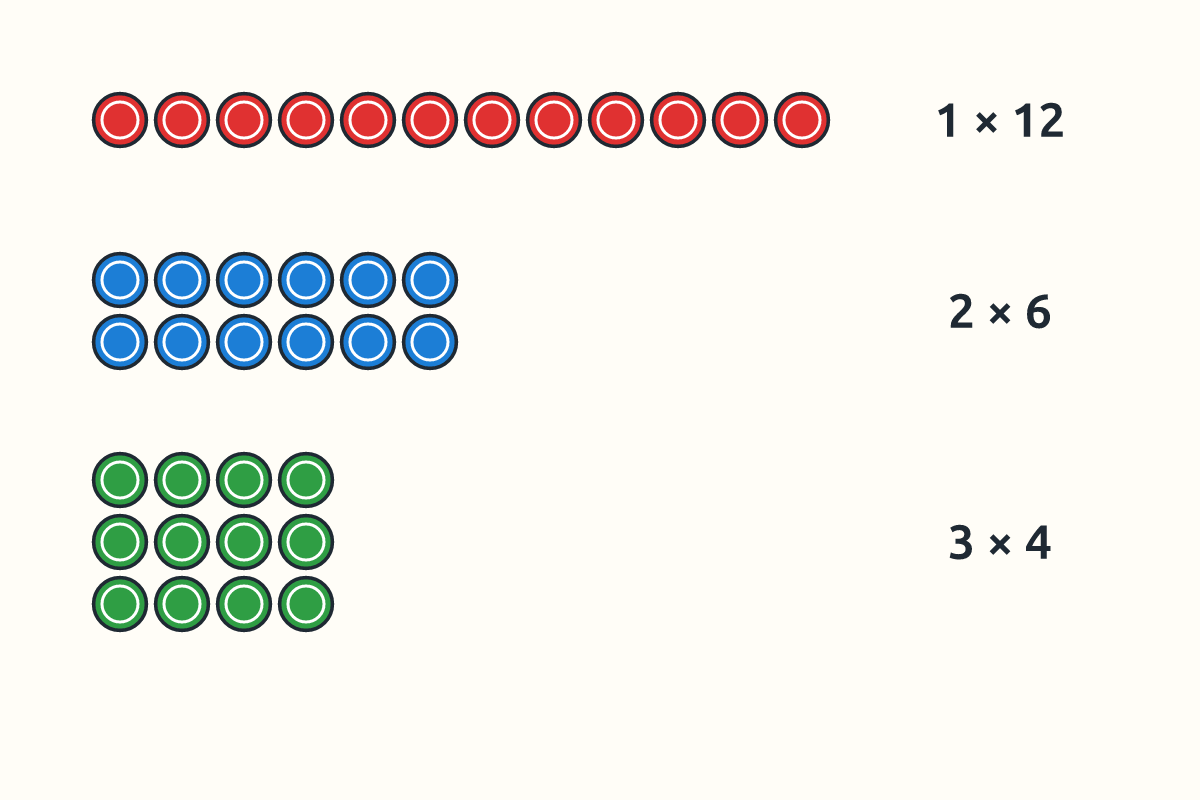
Mother wants to arrange 12 oranges in equal rows. She can make 1 row of 12, 2 rows of 6, 3 rows of 4, 4 rows of 3, 6 rows of 2 or 12 rows of 1. The numbers 1, 2, 3, 4, 6 and 12 are the factors of 12.
1. What is a Factor?
Factor: A whole number that divides another number exactly, with no remainder.
3 is a factor of 12 because 12 ÷ 3 = 4 exactly.
5 is not a factor of 12 because 12 ÷ 5 = 2 remainder 2.
2. Finding Factors in Pairs
Example
Find all the factors of 24.
- 1 × 24 = 24
- 2 × 12 = 24
- 3 × 8 = 24
- 4 × 6 = 24
- 5 does not divide 24 exactly; the next pair would repeat (6 × 4).
Answer: Factors of 24: {1, 2, 3, 4, 6, 8, 12, 24}
| Number | Factors |
|---|---|
| 10 | 1, 2, 5, 10 |
| 16 | 1, 2, 4, 8, 16 |
| 30 | 1, 2, 3, 5, 6, 10, 15, 30 |
| 36 | 1, 2, 3, 4, 6, 9, 12, 18, 36 |
3. Prime Numbers
Prime number: A number with exactly two factors: 1 and itself.
Prime numbers up to 50: 2, 3, 5, 7, 11, 13, 17, 19, 23, 29, 31, 37, 41, 43, 47.
Remember: 1 is not a prime number because it has only one factor.
New words
- factor
- A number that divides another exactly.
- factor pair
- Two numbers that multiply to give a number.
- remainder
- What is left over after dividing.
- prime number
- A number with exactly two factors.
- set
- A group of things listed in braces { }.
- divide
- To share into equal groups.
Summary
- A factor divides a number exactly with no remainder.
- Find factors in pairs that multiply to the number.
- Every number has 1 and itself as factors.
- A prime number has exactly two factors.
Class activity: Bottle Top Arrays
- Take 18 bottle tops.
- Arrange them in as many different rectangles as you can.
- List all the factors of 18 from your arrays.
You need: Bottle tops, Locally made number cards, Exercise books
Exercises
Answer in your exercise book first, then check your answers.
1. Which is a factor of 15?
- A. 5
- B. 4
- C. 6
- D. 7
Show answer
Answer: 515 ÷ 5 = 3.2. Which list shows all the factors of 20?
- A. 1, 2, 4, 5, 10, 20
- B. 1, 2, 5, 10, 20
- C. 2, 4, 5, 10
- D. 1, 20
Show answer
Answer: 1, 2, 4, 5, 10, 20Pairs: 1×20, 2×10, 4×5.3. Which is a prime number?
- A. 13
- B. 15
- C. 21
- D. 9
Show answer
Answer: 13Its only factors are 1 and 13.4. 1 is a factor of every whole number.
- A. True
- B. False
Show answer
Answer: TrueEvery number divided by 1 is itself.5. 8 is a factor of 30.
- A. True
- B. False
Show answer
Answer: False30 ÷ 8 leaves a remainder.6. The factors of 9 are 1, 3 and ______.
Show answer
Answer: 9Every number is a factor of itself.7. List all the factors of 28.
Show answer
Answer: 1, 2, 4, 7, 14, 28Pairs: 1×28, 2×14, 4×7.8. Why is 2 the only even prime number?
Show answer
Answer: Every other even number has 2 as a factor, so it has more than two factors.Even numbers are divisible by 2.
Homework
- List the factors of every number from 40 to 50. Circle the prime numbers.