Basic 4 · Mathematics · Counting, Representation and Cardinality
Comparing and Ordering Numbers up to 100,000
In this topic you will compare and order numbers up to 100,000 using <, = and >.
By the end of these notes you should be able to:
- Compare numbers using place value
- Use the symbols <, = and >
- Order numbers in ascending and descending order
What you already know
- Numbers up to 100,000
Copy everything that has a blue line on its left into your notebook. The other parts are for reading.
- Strand
- Number
- Sub-strand
- Counting, Representation and Cardinality
- Indicator
- B4.1.1.1.3 – Compare and order whole numbers up to 100,000 and represent comparisons using the symbols <, = and >
Introduction
Two cocoa farmers sold 45,320 kg and 45,230 kg of cocoa. Who sold more? We compare the numbers place by place.
1. Comparing Numbers
- Line the numbers up by place value.
- Compare the digits from the left (the biggest place).
- The first place where the digits differ decides which number is greater.
Example
Compare 45,320 and 45,230.
- Ten thousands: 4 = 4
- Thousands: 5 = 5
- Hundreds: 3 > 2
Answer: 45,320 > 45,230. The first farmer sold more.
| Symbol | Meaning |
|---|---|
| > | is greater than |
| < | is less than |
| = | is equal to |
Tip: A number with more digits is always greater: 10,000 > 9,999.
2. Ordering Numbers
Ascending order: From smallest to largest.
Descending order: From largest to smallest.
Example
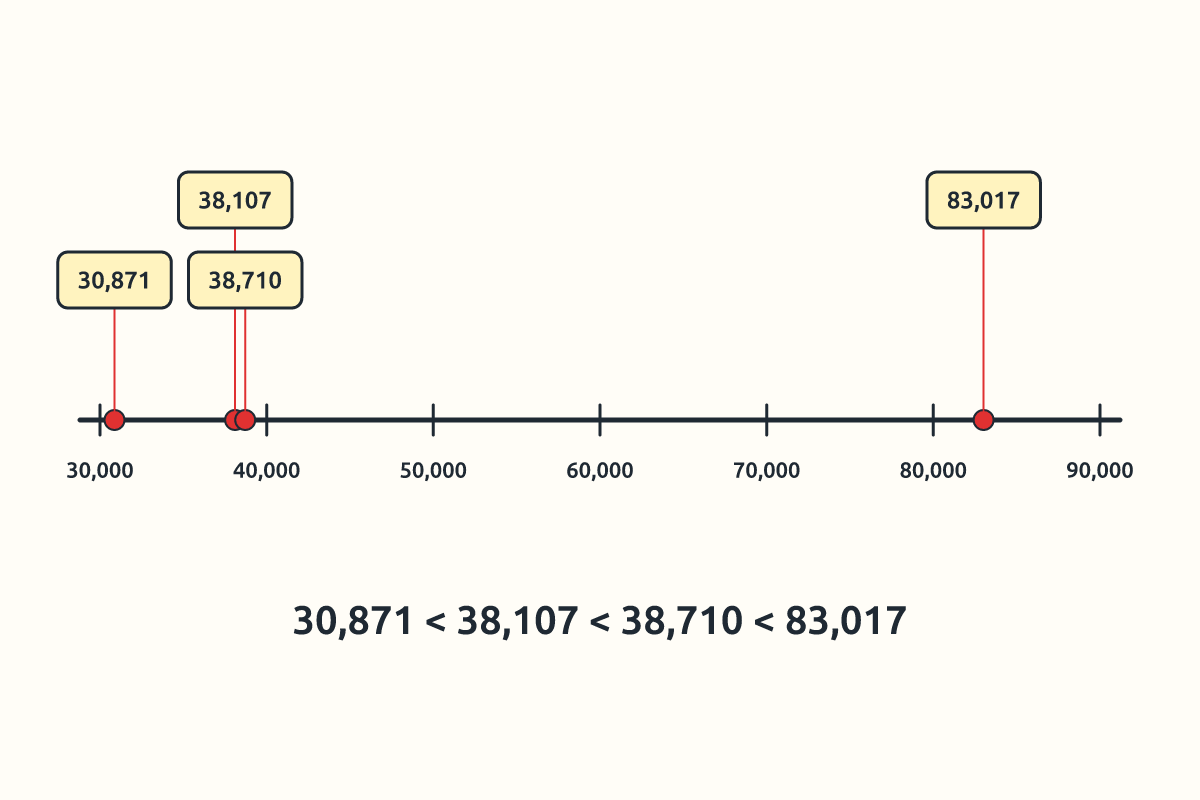
Arrange 38,107; 83,017; 38,710; 30,871 in ascending order.
- Compare ten thousands: 3, 8, 3, 3. 83,017 is largest.
- Compare thousands of the rest: 8, 8, 0. 30,871 is smallest.
- Compare 38,107 and 38,710: hundreds 1 < 7.
Answer: 30,871; 38,107; 38,710; 83,017
New words
- compare
- To find which is greater or smaller.
- greater than
- Larger than (>).
- less than
- Smaller than (<).
- ascending
- Going up from smallest to largest.
- descending
- Going down from largest to smallest.
- order
- To arrange in sequence.
Summary
- Compare numbers from the biggest place value.
- > means greater than; < means less than; = means equal.
- Ascending order goes from smallest to largest.
- Descending order goes from largest to smallest.
Class activity: Order Line
- Each member picks a 5-digit number card.
- Line up in ascending order, then descending order.
- Write the comparison of two neighbours using < or >.
You need: Place-value chart on manila card, Locally made large-number cards, Exercise books
Exercises
Answer in your exercise book first, then check your answers.
1. Which symbol makes this true? 72,450 ___ 72,540
- A. <
- B. >
- C. =
- D. +
Show answer
Answer: <4 hundreds < 5 hundreds.2. Which number is the greatest?
- A. 59,999
- B. 60,001
- C. 9,999
- D. 60,000
Show answer
Answer: 60,001Compare 59,999, 60,000 and 60,001.3. Which list is in descending order?
- A. 54,000 → 45,000 → 40,500
- B. 40,500 → 45,000 → 54,000
- C. 45,000 → 54,000 → 40,500
- D. 54,000 → 40,500 → 45,000
Show answer
Answer: 54,000 → 45,000 → 40,500Largest to smallest.4. 99,999 < 100,000
- A. True
- B. False
Show answer
Answer: True100,000 is one more.5. 70,070 > 70,700
- A. True
- B. False
Show answer
Answer: False70,700 has more hundreds.6. 34,000 ______ 34 thousands (write <, > or =)
Show answer
Answer: =They are the same value.7. Arrange in ascending order: 12,089; 12,980; 12,908.
Show answer
Answer: 12,089; 12,908; 12,980Compare hundreds then tens.8. Write a number between 49,950 and 50,000 that ends in 5.
Show answer
Answer: Any of 49,955; 49,965; 49,975; 49,985; 49,995.It must be greater than 49,950 and less than 50,000.
Homework
- Look up the capacities of three stadiums or the populations of three towns in Ghana. Arrange them in descending order.