Basic 4 · Ghanaian Language · Penmanship and Handwriting
Full Stops, Commas and Question Marks
In this topic you will recognise and use full stops, commas and question marks.
By the end of these notes you should be able to:
- Recognise full stops, commas and question marks
- Explain when each mark is used
- Punctuate sentences correctly
What you already know
- Full stops and commas (Basic 3)
Copy everything that has a blue line on its left into your notebook. The other parts are for reading.
- Strand
- Writing
- Sub-strand
- Penmanship and Handwriting
- Indicator
- B4.3.1.1.1-3 – Recognize the use of full stops, commas and question mark
Introduction
Punctuation marks are signals. A full stop says "stop", a comma says "pause", and a question mark says "this is a question".
1. The Three Marks
| Mark | Name | Use | Example |
|---|---|---|---|
| . | full stop | ends a statement | The farm is big. |
| , | comma | separates items or shows a pause | We grow yam, maize and cassava. |
| ? | question mark | ends a question | Where is the farm? |
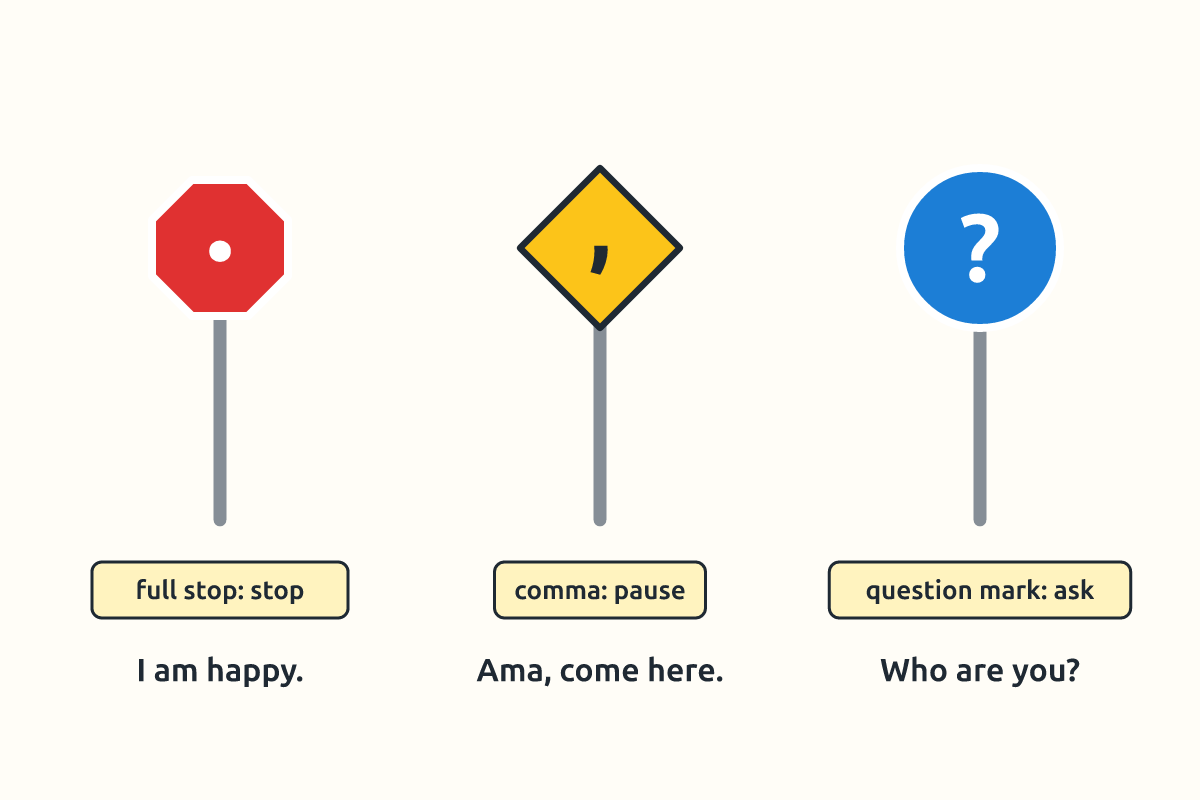
2. Questions
Questions often begin with question words: who, what, where, when, why, how.
They end with a question mark, not a full stop.
Common mistake: "Where are you going." is wrong. Write "Where are you going?"
Tip: The same marks are used when writing your Ghanaian language.
New words
- punctuation
- Marks that make writing clear.
- statement
- A sentence that tells something.
- question
- A sentence that asks something.
- full stop
- The mark that ends a statement.
- comma
- The mark that shows a pause.
- question mark
- The mark that ends a question.
Summary
- A full stop ends a statement.
- A comma separates items in a list or shows a pause.
- A question mark ends a question.
- Correct punctuation makes meaning clear.
Class activity: Punctuation Sort
- Read the sentence strips about local life.
- Add the correct punctuation using the punctuation cards.
- Sort the sentences into statements and questions.
You need: Locally made punctuation cards, Sentence strips about local life, Exercise books, Pencils
Exercises
Answer in your exercise book first, then check your answers.
1. Which mark ends a question?
- A. ?
- B. .
- C. ,
- D. !
Show answer
Answer: ?Questions end with ?.2. Which sentence is punctuated correctly?
- A. Where is my bag?
- B. Where is my bag.
- C. where is my bag
- D. Where, is my bag
Show answer
Answer: Where is my bag?It is a question.3. Which mark separates items in a list?
- A. Comma
- B. Full stop
- C. Question mark
- D. Colon
Show answer
Answer: CommaCommas separate items.4. A statement ends with a full stop.
- A. True
- B. False
Show answer
Answer: TrueIt tells something.5. "Who are you." is punctuated correctly.
- A. True
- B. False
Show answer
Answer: FalseIt needs a question mark.6. A sentence that asks something is a ______.
Show answer
Answer: questionIt ends with ?.7. Punctuate: "do you like yam beans and plantain"
Show answer
Answer: Do you like yam, beans and plantain?Capital, commas, question mark.8. Write one statement and one question about your school.
Show answer
Answer: E.g. My school is big. Where is the library?Use . and ?.
Homework
- Write five sentences using full stops, commas and question marks.