Basic 4 · English Language
Moral Values in Sketches, Skimming, Conjunctions, Family Information and Sentences
In this topic you will identify moral values in sketches, skim texts for main ideas, use conjunctions, write about family and construct correct sentences.
By the end of these notes you should be able to:
- Identify moral values in sketches
- Skim texts for main ideas
- Use conjunctions correctly
- Construct simple sentences correctly
What you already know
- Persuasion and subjects and verbs
Copy everything that has a blue line on its left into your notebook. The other parts are for reading.
Lesson 1
- Strand
- Oral Language
- Sub-strand
- Dramatization and Role Play
- Indicator
- B4.1.5.2.1 – Identify moral values in sketches and relate them to real life situations
Introduction
Short sketches (plays) often teach moral lessons.
Moral Values in Sketches
Sketch: Kofi finds a phone in the classroom. His friend says, "Keep it!" Kofi says, "No, it belongs to someone." He gives it to the teacher. The owner thanks him.
| Question | Answer |
|---|---|
| What did Kofi find? | a phone |
| What did his friend suggest? | to keep it |
| What value did Kofi show? | honesty |
| How does this relate to real life? | we should return lost items |

New words
- moral value
- A good principle for behaviour.
- honesty
- Telling the truth and not stealing.
- sketch
- A short play.
Summary
- Sketches teach moral values.
- Kofi showed honesty.
Exercises
Answer in your exercise book first, then check your answers.
1. Which value did Kofi show?
- A. Honesty
- B. Greed
- C. Laziness
- D. Pride
Show answer
Answer: HonestyHe returned the phone.2. Kofi kept the phone.
- A. True
- B. False
Show answer
Answer: FalseHe gave it to the teacher.3. A short play is a ______.
Show answer
Answer: sketchThat is a sketch.4. How can you show honesty at school?
Show answer
Answer: E.g. return lost items, tell the truth.Real-life application.
Lesson 2
- Strand
- Reading
- Sub-strand
- Comprehension
- Indicator
- B4.2.7.1.3 – Skim for main ideas in texts
Introduction
Skimming means reading quickly to get the main idea.
Skimming
How to skim
- Read the title.
- Read the first and last sentences of each paragraph.
- Look at key words and pictures.
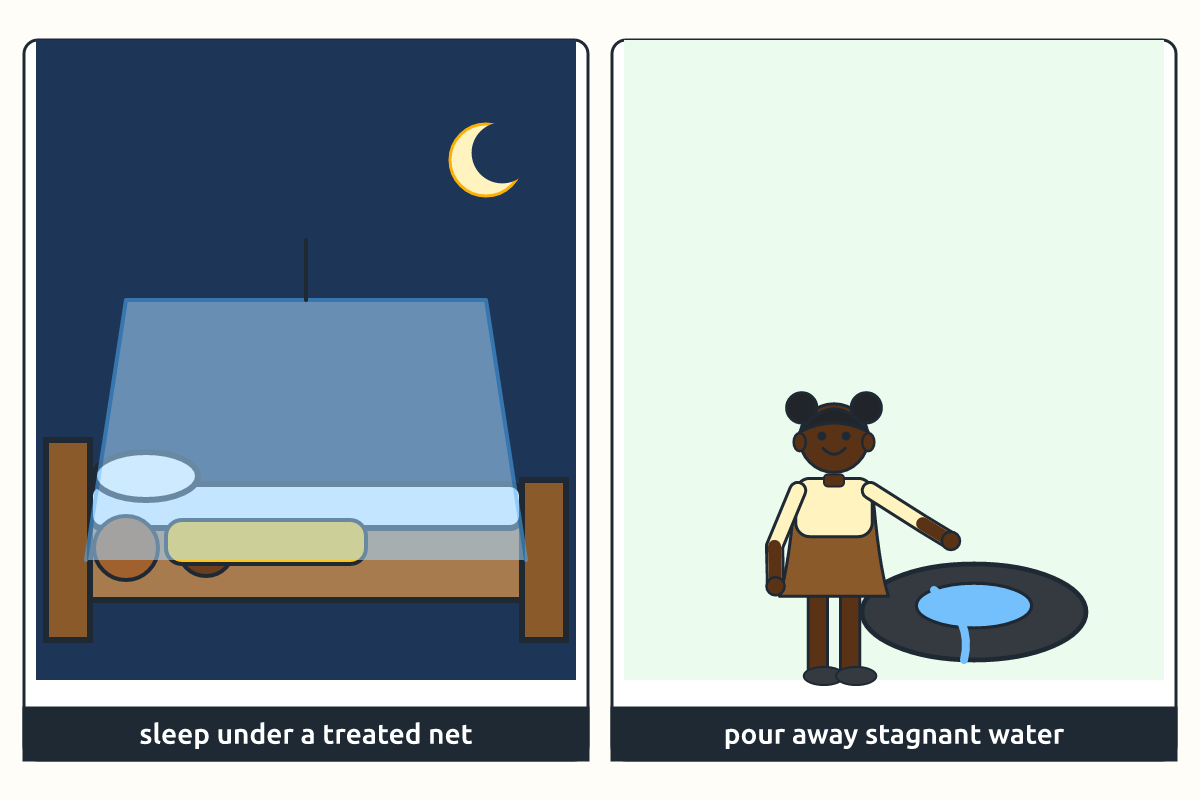
Passage: "Malaria is a disease spread by female Anopheles mosquitoes. It causes fever, headaches and body pains. People can prevent malaria by sleeping under treated nets, clearing stagnant water and seeking early treatment at a clinic."
Main idea: Malaria is spread by mosquitoes and can be prevented.
New words
- skim
- To read quickly for the main idea.
- main idea
- What a passage is mostly about.
- key word
- An important word.
Summary
- Skim by reading titles, first and last sentences and key words.
- Skimming finds the main idea quickly.
Exercises
Answer in your exercise book first, then check your answers.
1. Reading quickly for the main idea is…
- A. Skimming
- B. Copying
- C. Spelling
- D. Writing
Show answer
Answer: SkimmingThat is skimming.2. Malaria is spread by mosquitoes.
- A. True
- B. False
Show answer
Answer: TrueFrom the passage.3. An important word is a ______ word.
Show answer
Answer: keyThat is a key word.4. State the main idea of the passage.
Show answer
Answer: Malaria is spread by mosquitoes and can be prevented.The key point.
Lesson 3
- Strand
- Grammar
- Sub-strand
- Conjunctions
- Indicator
- B4.3.8.1.1 – Identify and use simple conjunctions
Introduction
Let us practise choosing the right conjunction.
Choosing Conjunctions
| Sentence | Conjunction |
|---|---|
| I am tired ___ I will finish my work. | but |
| She studied hard, ___ she passed. | so |
| We can walk ___ take a taxi. | or |
| He laughed ___ the joke was funny. | because |
New words
- choose
- To pick.
- contrast
- Difference.
- choice
- An option.
Summary
- Choose conjunctions by meaning.
- But (contrast), so (result), or (choice), because (reason).
Exercises
Answer in your exercise book first, then check your answers.
1. We can walk ___ take a taxi.
- A. or
- B. but
- C. so
- D. because
Show answer
Answer: orIt gives a choice.2. "So" shows a result.
- A. True
- B. False
Show answer
Answer: TrueShe passed as a result.3. He laughed ______ the joke was funny.
Show answer
Answer: becauseIt gives a reason.4. Write a sentence using "but".
Show answer
Answer: E.g. The road is bumpy but short.Contrast.
Lesson 4
- Strand
- Composition Writing
- Sub-strand
- Informative Writing
- Indicator
- B4.4.14.1.1 – Write words giving information about family
Introduction
Informative writing gives facts. Let us write about our family members.
Information About Family
| Member | Age | Occupation | Hobby |
|---|---|---|---|
| Father | 45 | mechanic | listening to radio |
| Mother | 40 | trader | singing |
| Brother | 12 | pupil | football |
Example: "My father is a 45-year-old mechanic who enjoys listening to the radio."
New words
- informative
- Giving facts.
- hobby
- Something you enjoy doing in free time.
- chart
- Information arranged in rows and columns.
Summary
- Informative writing gives facts.
- A chart helps organise information.
Exercises
Answer in your exercise book first, then check your answers.
1. What is the father's occupation?
- A. Mechanic
- B. Trader
- C. Pupil
- D. Teacher
Show answer
Answer: MechanicFrom the chart.2. A hobby is done in free time.
- A. True
- B. False
Show answer
Answer: TrueThat is a hobby.3. Giving facts means ______.
Show answer
Answer: informativeThat is informative.4. Write one sentence about a family member using the chart.
Show answer
Answer: E.g. My mother is a 40-year-old trader who loves singing.Use facts.
Lesson 5
- Strand
- Writing Conventions/ Extensive Reading
- Sub-strand
- Using Simple and Complex Sentences, Building the Love and Culture of Reading
- Indicator
- B4.5.9.1.1 – Construct simple sentences correctly
Introduction
A correct simple sentence starts with a capital letter, has a subject and verb, and ends with a punctuation mark.
Constructing Simple Sentences
| Check | Example |
|---|---|
| capital letter at the start | The |
| subject | The fisherman |
| verb | caught |
| end punctuation | . |
Reading passage: "The fisherman caught many fish. His wife smoked them. They sold the fish at the market. Their children went to school with the money."
New words
- construct
- To build.
- complete
- Having all its parts.
- punctuation
- Marks like . ? !
Summary
- A simple sentence has a subject and a verb.
- It begins with a capital letter and ends with punctuation.
Exercises
Answer in your exercise book first, then check your answers.
1. Which is a correct simple sentence?
- A. The fisherman caught fish.
- B. the fisherman caught fish
- C. Caught fish.
- D. Fisherman the.
Show answer
Answer: The fisherman caught fish.It is complete.2. A sentence ends with punctuation.
- A. True
- B. False
Show answer
Answer: TrueLike a full stop.3. His wife ______ the fish.
Show answer
Answer: smokedVerb from the passage.4. Correct: "they sold the fish at the market"
Show answer
Answer: They sold the fish at the market.Capital and full stop.
Homework
- Make a family information chart and write a paragraph from it.