Basic 4 · English Language
Pace, Stress and Tone; Silent Reading; Conjunctions; Persuasion and Sentences
In this topic you will convey meaning with pace, stress and tone, read silently for meaning, use conjunctions, support opinions and identify subjects and verbs.
By the end of these notes you should be able to:
- Convey meaning through pace, stress and tone
- Read silently for meaning
- Support opinions with reasons
- Identify subjects and verbs in sentences
What you already know
- Role-play and conjunctions
Copy everything that has a blue line on its left into your notebook. The other parts are for reading.
Lesson 1
- Strand
- Oral Language
- Sub-strand
- Presentation
- Indicator
- B4.1.10.1.3 – Demonstrate awareness of how meaning is conveyed through appropriate pace stress tone
Introduction
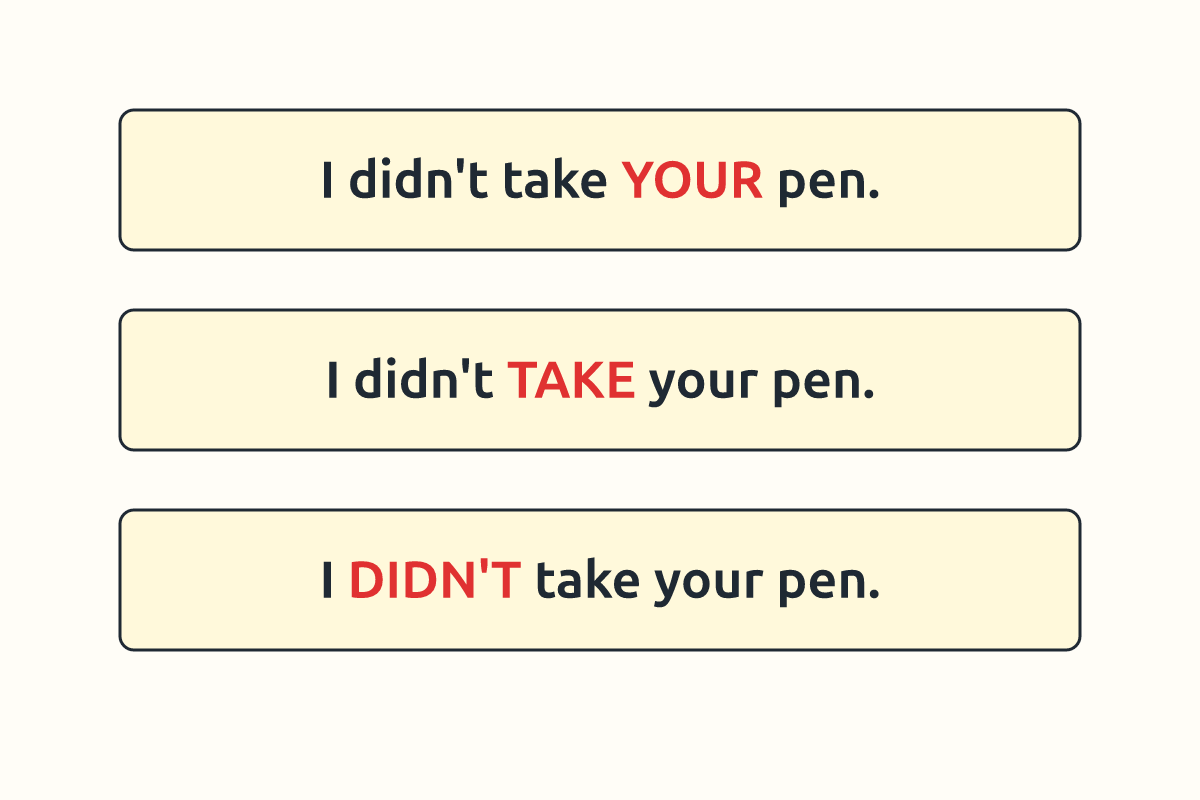
The same sentence can mean different things depending on how you say it.
Pace, Stress and Tone
| Sentence | Meaning |
|---|---|
| I didn't take YOUR pen. | I took someone else's. |
| I didn't TAKE your pen. | I only borrowed or touched it. |
| I DIDN'T take your pen. | I deny taking it. |
New words
- stress
- Saying a word more strongly.
- tone
- The feeling in the voice.
- pace
- Speed of speaking.
Summary
- Stress on different words changes meaning.
- Tone and pace express feelings.
Exercises
Answer in your exercise book first, then check your answers.
1. Saying a word more strongly is…
- A. Stress
- B. Pace
- C. Silence
- D. Volume only
Show answer
Answer: StressThat is stress.2. Stress can change meaning.
- A. True
- B. False
Show answer
Answer: TrueAs in the examples.3. The feeling in the voice is ______.
Show answer
Answer: toneThat is tone.4. Say "I like rice" with stress on "I". What does it mean?
Show answer
Answer: I (not others) like rice.Stress focuses meaning.
Lesson 2
- Strand
- Reading
- Sub-strand
- Fluency
- Indicator
- B4.2.8.1.1 – Read silently and reasonably for meaning from level-appropriate texts
Introduction
Silent reading helps us understand quickly.
Silent Reading for Meaning
Tips
- Read without moving your lips.
- Read in phrases, not word by word.
- Ask yourself questions as you read.
- Re-read hard parts.
Passage: "The Kakum canopy walkway hangs about 40 metres above the forest floor. Visitors walk across seven bridges and see birds, butterflies and monkeys. It was opened in 1995 to help protect the forest and attract tourists."

New words
- silent reading
- Reading without speaking aloud.
- phrase
- A small group of words.
- canopy
- The top layer of a forest.
Summary
- Read silently in phrases and ask questions.
- The Kakum walkway is about 40 metres high.
Exercises
Answer in your exercise book first, then check your answers.
1. How high is the walkway?
- A. About 40 metres
- B. 4 metres
- C. 400 metres
- D. 1 metre
Show answer
Answer: About 40 metresFrom the passage.2. The walkway was opened in 1995.
- A. True
- B. False
Show answer
Answer: TrueFrom the passage.3. The top layer of a forest is the ______.
Show answer
Answer: canopyThat is the canopy.4. Why was the walkway built?
Show answer
Answer: To help protect the forest and attract tourists.From the passage.
Lesson 3
- Strand
- Grammar
- Sub-strand
- Conjunctions
- Indicator
- B4.3.8.1.1 – Identify and use simple conjunctions
Introduction
Simple conjunctions join words, phrases and sentences.
Simple Conjunctions in Use
| Two sentences | Joined |
|---|---|
| I was hungry. I ate kenkey. | I was hungry, so I ate kenkey. |
| The road is long. It is safe. | The road is long but safe. |
| Do you want water? Do you want juice? | Do you want water or juice? |
New words
- join
- To connect.
- simple conjunction
- A short joining word like and, but, or.
- compound sentence
- Two sentences joined by a conjunction.
Summary
- Conjunctions join two sentences into one.
- The result is a compound sentence.
Exercises
Answer in your exercise book first, then check your answers.
1. Join: "It is late. I will sleep."
- A. It is late, so I will sleep.
- B. It is late or I will sleep.
- C. Late it is.
- D. I sleep late it.
Show answer
Answer: It is late, so I will sleep.So shows result.2. "But" joins contrasting ideas.
- A. True
- B. False
Show answer
Answer: TrueIt shows contrast.3. Two sentences joined by a conjunction make a ______ sentence.
Show answer
Answer: compoundThat is compound.4. Join with "and": "Esi sings. Esi dances."
Show answer
Answer: Esi sings and dances.And adds.
Lesson 4
- Strand
- Composition Writing
- Sub-strand
- Persuasive Writing
- Indicator
- B4.4.13.1.1 – Support opinions with simple sentences
Introduction
Persuasive writing tries to make readers agree with you.
Supporting Opinions
| Part | Example |
|---|---|
| opinion | Every pupil should drink enough water. |
| reason 1 | Water keeps the body healthy. |
| reason 2 | It helps us concentrate in class. |
| reason 3 | It prevents headaches. |
| conclusion | So, bring a water bottle every day! |
New words
- persuade
- To make someone agree.
- opinion
- What you think.
- reason
- Why you think it.
Summary
- State your opinion clearly.
- Support it with reasons.
Exercises
Answer in your exercise book first, then check your answers.
1. Persuasive writing tries to…
- A. Make readers agree
- B. Tell a story
- C. List items
- D. Draw
Show answer
Answer: Make readers agreeIt persuades.2. Reasons support an opinion.
- A. True
- B. False
Show answer
Answer: TrueThey explain why.3. To make someone agree is to ______.
Show answer
Answer: persuadeThat is persuading.4. Give one reason why pupils should read books.
Show answer
Answer: E.g. Reading builds vocabulary.A supporting reason.
Lesson 5
- Strand
- Writing Conventions/ Extensive Reading
- Sub-strand
- Using Simple and Complex Sentences, Building the Love and Culture of Reading
- Indicator
- B4.5.9.1.1 – Identify subjects and verbs in simple sentences
Introduction
Every simple sentence has a subject and a verb.
Subjects and Verbs
| Sentence | Subject | Verb |
|---|---|---|
| The goat ate the cassava leaves. | The goat | ate |
| Our teacher smiles. | Our teacher | smiles |
| Rain fell heavily. | Rain | fell |
Reading passage: "The market women arrived early. They arranged their goods neatly. Buyers came from nearby towns. By noon, the market was full."
New words
- subject
- Who or what the sentence is about.
- verb
- The action or state word.
- simple sentence
- A sentence with one subject and verb.
Summary
- A simple sentence has a subject and a verb.
- Find the subject by asking "who or what?".
Exercises
Answer in your exercise book first, then check your answers.
1. In "Our teacher smiles", the verb is…
- A. smiles
- B. Our
- C. teacher
- D. none
Show answer
Answer: smilesIt is the action.2. "The market women" is a subject.
- A. True
- B. False
Show answer
Answer: TrueIt tells who.3. Buyers ______ from nearby towns.
Show answer
Answer: cameVerb from the passage.4. Find the subject and verb: "Rain fell heavily."
Show answer
Answer: Subject: Rain; verb: fell.Who/what + action.
Homework
- Write a persuasive paragraph on why we should keep our environment clean.