Basic 4 · English Language
Role-Play, Wide Reading, Simple Present Tense, Free Writing and Conjunctions
In this topic you will role-play a story, build vocabulary through reading, use the simple present tense, write freely and use conjunctions.
By the end of these notes you should be able to:
- Role-play a story or play
- Build vocabulary through extensive reading
- Use the simple present tense
- Write freely about topics in your environment
- Identify and use conjunctions
What you already know
- Friendly letters and prepositions
Copy everything that has a blue line on its left into your notebook. The other parts are for reading.
Lesson 1
- Strand
- Oral Language
- Sub-strand
- Dramatization and Role Play
- Indicator
- B4.1.5.1.1 – Role-play a story/play
Introduction
Role-play helps us understand characters and practise speaking.
Role-Playing a Play
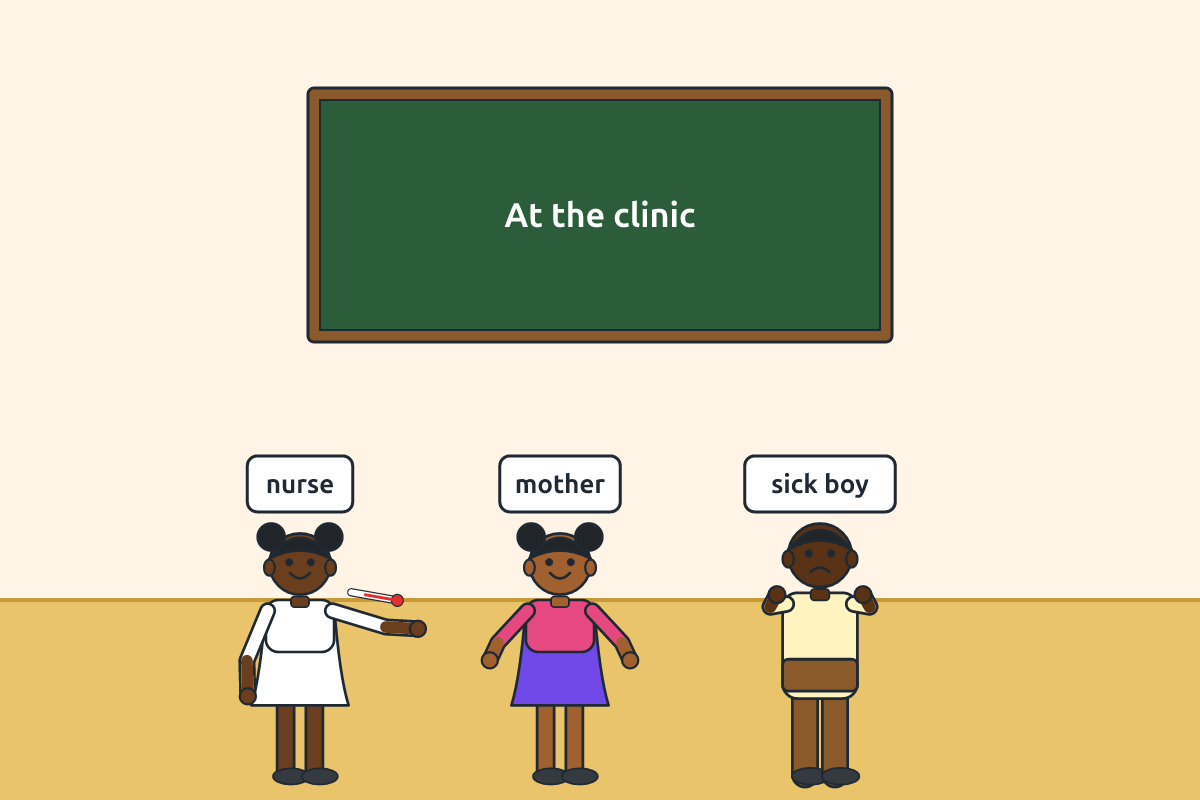
Scene: At the clinic.
Nurse: "Good morning. What is wrong?"
Mother: "My son has a fever and a headache."
Nurse: "Let me check his temperature. Please sit down."
Boy: "Thank you, Nurse."
New words
- role-play
- Acting out a situation.
- character
- A person in a play.
- dialogue
- Conversation between characters.
Summary
- Role-play uses dialogue and actions.
- It helps us practise real-life speech.
Exercises
Answer in your exercise book first, then check your answers.
1. Acting out a situation is…
- A. Role-play
- B. Reading
- C. Writing
- D. Drawing
Show answer
Answer: Role-playThat is role-play.2. The boy had a fever.
- A. True
- B. False
Show answer
Answer: TrueFrom the scene.3. Conversation between characters is ______.
Show answer
Answer: dialogueThat is dialogue.4. Write one line the nurse could say next.
Show answer
Answer: E.g. "Please open your mouth."Fits the scene.
Lesson 2
- Strand
- Reading
- Sub-strand
- Vocabulary
- Indicator
- B4.2.6.2.1 – Develop a rich vocabulary stock through extensive reading of age-appropriate texts
Introduction
Reading many books helps us learn new words.
Building Vocabulary Through Reading
A word journal
- Write the new word.
- Copy the sentence where you found it.
- Guess its meaning from context.
- Check in a dictionary.
- Use it in your own sentence.
| Word | Meaning | My sentence |
|---|---|---|
| enormous | very big | The elephant was enormous. |
| ancient | very old | Elmina Castle is ancient. |
New words
- vocabulary
- All the words a person knows.
- dictionary
- A book of words and meanings.
- extensive reading
- Reading many books for pleasure.
Summary
- Reading widely builds vocabulary.
- A word journal records new words.
Exercises
Answer in your exercise book first, then check your answers.
1. "Enormous" means…
- A. very big
- B. very small
- C. very fast
- D. very cold
Show answer
Answer: very bigFrom the journal.2. A dictionary gives word meanings.
- A. True
- B. False
Show answer
Answer: TrueThat is its use.3. All the words a person knows is their ______.
Show answer
Answer: vocabularyThat is vocabulary.4. Use "ancient" in a sentence.
Show answer
Answer: E.g. The ancient pot was found underground.Correct use.
Lesson 3
- Strand
- Grammar
- Sub-strand
- Verbs
- Indicator
- B4.3.5.1.3 – Use the simple present form of verbs in sentences
Introduction
The simple present tense describes habits and facts.
Simple Present Tense
| Use | Example |
|---|---|
| habits | I brush my teeth every morning. |
| facts | The sun rises in the east. |
| timetables | The bus leaves at 6 a.m. |
Add -s or -es for he, she, it: she walks, he washes.
New words
- simple present
- A tense for habits and facts.
- habit
- Something done regularly.
- fact
- Something true.
Summary
- Use the simple present for habits, facts and timetables.
- Add -s or -es with he, she or it.
Exercises
Answer in your exercise book first, then check your answers.
1. The sun ___ in the east.
- A. rises
- B. rise
- C. rising
- D. rose
Show answer
Answer: risesFact; singular.2. "I brush my teeth every morning." shows a habit.
- A. True
- B. False
Show answer
Answer: TrueIt is regular.3. He ______ (wash) his uniform every Saturday.
Show answer
Answer: washesAdd -es.4. Write one fact using the simple present.
Show answer
Answer: E.g. Water boils at 100°C.It is always true.
Lesson 4
- Strand
- Composition Writing
- Sub-strand
- Creative Writing
- Indicator
- B4.4.11.1.1 – Write freely about topics of choice in their immediate environment
Introduction
Free writing lets you express your ideas about things around you.
Free Writing
Topic ideas
- My favourite place in my community
- A day at the market
- How we celebrate Christmas or Eid
- My dream job
Tips: write freely first, then read and improve.
New words
- free writing
- Writing your ideas without stopping.
- topic
- What you write about.
- improve
- To make better.
Summary
- Choose a topic from your environment.
- Write freely, then edit.
Exercises
Answer in your exercise book first, then check your answers.
1. Writing ideas without stopping is…
- A. Free writing
- B. Copying
- C. Spelling
- D. Drawing
Show answer
Answer: Free writingThat is free writing.2. We should read and improve after free writing.
- A. True
- B. False
Show answer
Answer: TrueEditing improves work.3. What you write about is the ______.
Show answer
Answer: topicThat is the topic.4. Write two sentences about your favourite place.
Show answer
Answer: Answers will differ.Free expression.
Lesson 5
- Strand
- Writing Conventions/ Extensive Reading
- Sub-strand
- Using, Building the Love and Culture of Reading
- Indicator
- B4.5.8.1.1 – Identify and use conjunctions
Introduction
Conjunctions join words and sentences.
Conjunctions
| Conjunction | Use | Example |
|---|---|---|
| and | adds | I like mango and pawpaw. |
| but | contrasts | It was hot but windy. |
| because | gives a reason | I stayed home because I was sick. |
| so | shows a result | It rained, so we stayed inside. |
| or | gives a choice | Do you want tea or cocoa? |
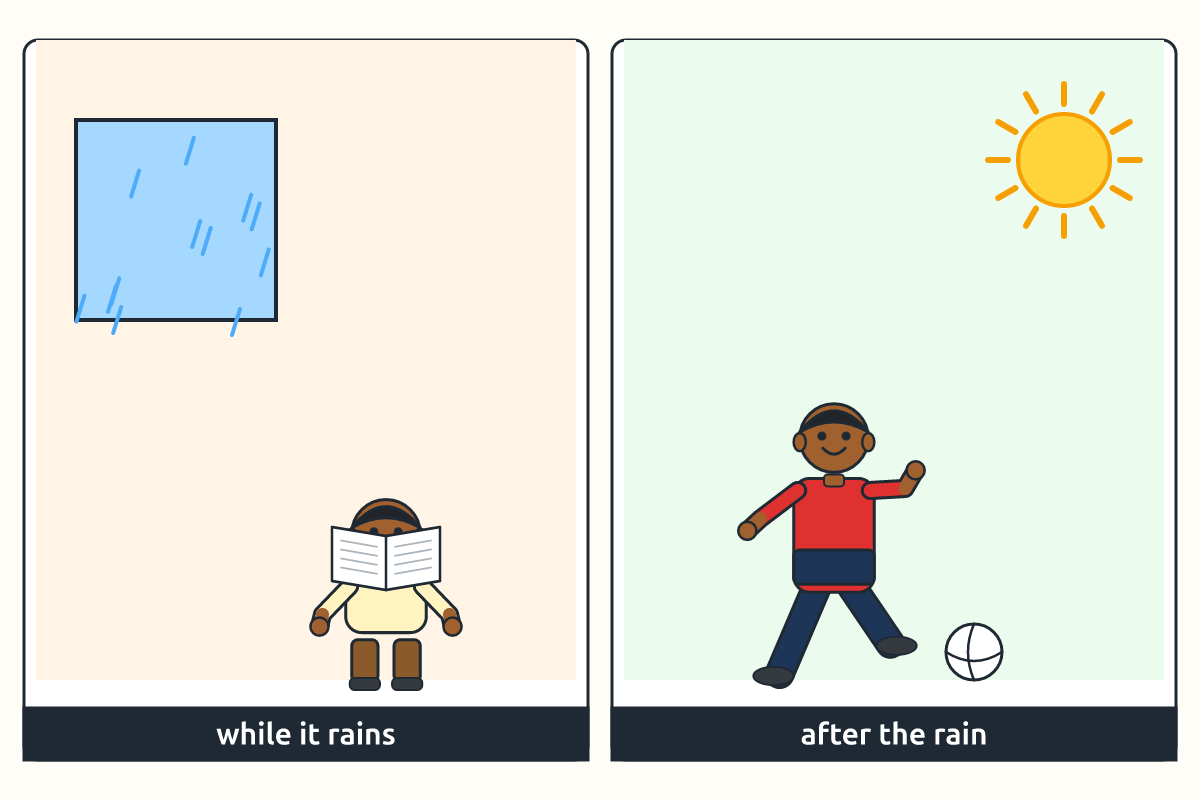
Reading passage: "Yaw wanted to play football, but it was raining. He stayed inside and read a book because he loved stories. When the rain stopped, he went out, so he could still play."
New words
- conjunction
- A joining word.
- reason
- Why something happens.
- result
- What happens because of something.
Summary
- Conjunctions join ideas.
- "Because" gives reasons; "so" shows results.
Exercises
Answer in your exercise book first, then check your answers.
1. Which conjunction gives a reason?
- A. because
- B. and
- C. or
- D. but
Show answer
Answer: becauseIt explains why.2. "But" shows contrast.
- A. True
- B. False
Show answer
Answer: TrueIt joins opposite ideas.3. It rained, ______ we stayed inside. (so / or)
Show answer
Answer: soIt shows a result.4. Find two conjunctions in the passage.
Show answer
Answer: but, and, because, soJoining words.
Homework
- Write a free-writing piece about your community using four conjunctions.