Basic 4 · English Language
Spoken Language, Blends, Verb Agreement, Letters and Prepositions
In this topic you will practise features of spoken language, produce words with blends, use subject–verb agreement, write friendly letters and use prepositions.
By the end of these notes you should be able to:
- Use features of spoken language in presentations
- Produce words with consonant blends
- Use correct subject–verb agreement
- Write a friendly letter in the correct format
- Use prepositions to convey meaning
What you already know
- Narratives and adverbs
Copy everything that has a blue line on its left into your notebook. The other parts are for reading.
Lesson 1
- Strand
- Oral Language
- Sub-strand
- Presentation
- Indicator
- B4.1.10.1.2 – Demonstrate awareness of the features of spoken language
Introduction
Good speakers change their pace and volume to keep listeners interested.
Using Spoken Language Features
- Slow down for important points.
- Pause before key words.
- Raise your volume to show excitement.
- Lower your voice for something serious.
Practice line: "Ladies and gentlemen... (pause) our school has WON the quiz!"
New words
- emphasis
- Making a word stand out.
- pause
- A short stop.
- presentation
- A talk to an audience.
Summary
- Change pace and volume for effect.
- Pause to add emphasis.
Exercises
Answer in your exercise book first, then check your answers.
1. A short stop in speech is a…
- A. Pause
- B. Shout
- C. Song
- D. Gesture
Show answer
Answer: PauseThat is a pause.2. Slowing down helps important points stand out.
- A. True
- B. False
Show answer
Answer: TrueIt adds emphasis.3. Making a word stand out is ______.
Show answer
Answer: emphasisThat is emphasis.4. Say one sentence with a pause for effect and write it.
Show answer
Answer: E.g. And the winner is... (pause) Basic 4!Pause adds drama.
Lesson 2
- Strand
- Reading
- Sub-strand
- Blends and Consonant Clusters
- Indicator
- B4.2.5.1.1 – Orally produce single-syllable words
Introduction
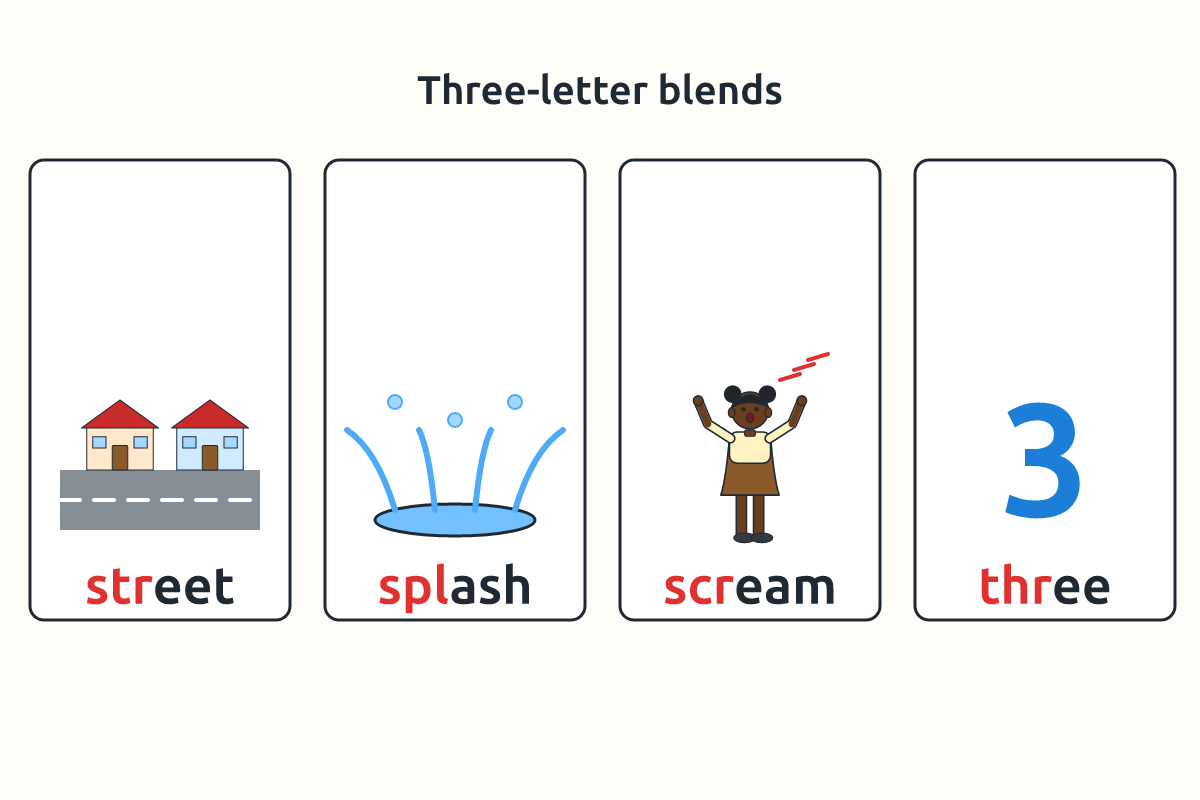
Consonant blends combine two or three consonant sounds.
Consonant Blends and Clusters
| Blend | Words |
|---|---|
| str | street, string, strong |
| spl | splash, split |
| scr | scream, scratch |
| thr | three, throw |
| gr | green, grass |
New words
- blend
- Consonant sounds said together.
- cluster
- A group of consonants together.
- syllable
- A part of a word.
Summary
- Blends combine consonant sounds.
- Each sound in a blend is heard.
Exercises
Answer in your exercise book first, then check your answers.
1. Which word starts with "str"?
- A. street
- B. seat
- C. sit
- D. tree
Show answer
Answer: streets-t-r.2. "Splash" has the blend "spl".
- A. True
- B. False
Show answer
Answer: Trues-p-l.3. thr + ee = ______
Show answer
Answer: threeBlend the sounds.4. Write two words starting with "scr".
Show answer
Answer: E.g. scream, scratch.They start with scr.
Lesson 3
- Strand
- Grammar
- Sub-strand
- Verbs
- Indicator
- B4.3.5.1.2 – Use appropriate subject-verb agreement − singular/plural
Introduction
Subjects and verbs must agree in number.
Agreement Practice
| Incorrect | Correct |
|---|---|
| The boys plays football. | The boys play football. |
| She go to school. | She goes to school. |
| My friends is here. | My friends are here. |
New words
- agree
- To match.
- number
- Singular or plural.
- correct
- Without mistakes.
Summary
- Singular subjects take singular verbs.
- Plural subjects take plural verbs.
Exercises
Answer in your exercise book first, then check your answers.
1. She ___ to school.
- A. goes
- B. go
- C. going
- D. gone
Show answer
Answer: goesSingular subject.2. "My friends are here." is correct.
- A. True
- B. False
Show answer
Answer: TruePlural agrees.3. The boys ______ football. (play / plays)
Show answer
Answer: playPlural subject.4. Correct: "He have a pen."
Show answer
Answer: He has a pen.Singular takes has.
Lesson 4
- Strand
- Composition Writing
- Sub-strand
- Letter Writing
- Indicator
- B4.4.15.1.1 – Write to friends about personal experiences using appropriate letter formats
Introduction
A friendly letter is written to someone you know well.
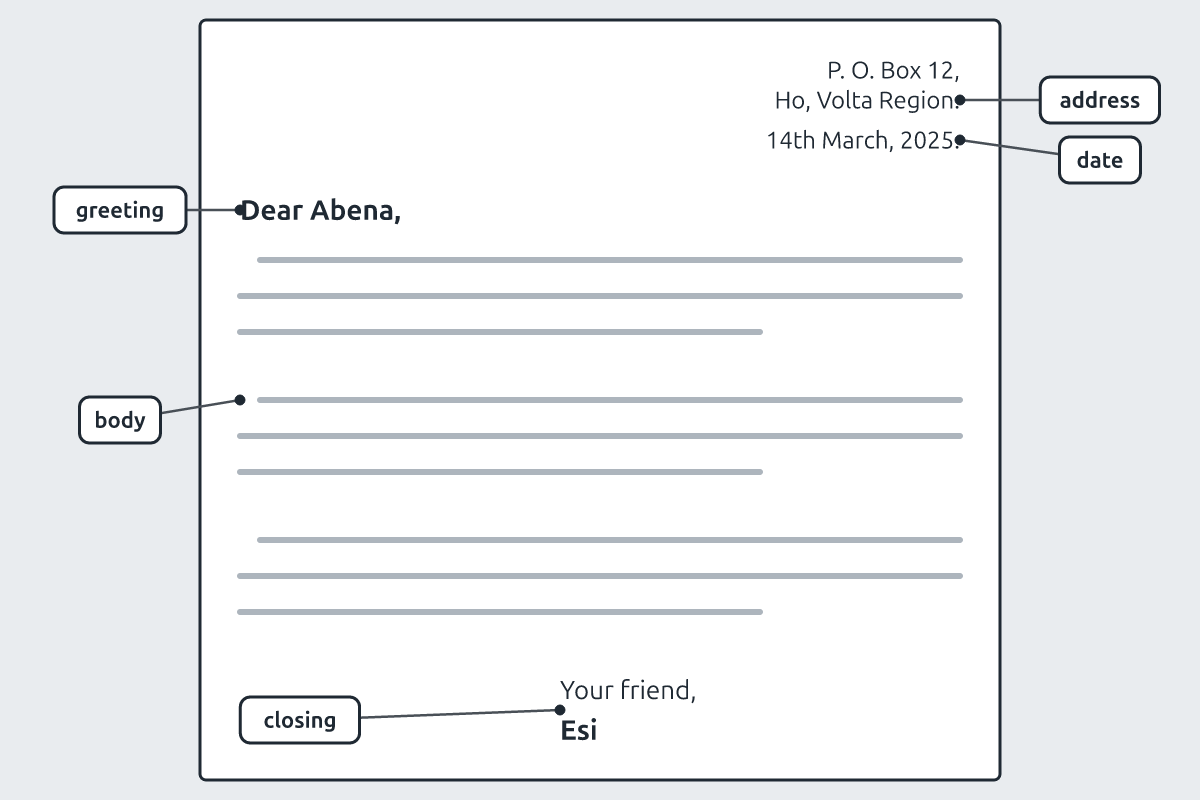
Writing a Friendly Letter
| Part | Example |
|---|---|
| address and date | P.O. Box 12, Ho. 15th March, 2024. |
| greeting | Dear Abena, |
| introduction | How are you? I hope you are well. |
| body | news and experiences |
| conclusion | I hope to hear from you soon. |
| closing | Your friend, Esi |
New words
- greeting
- The opening, like "Dear Abena,".
- body
- The main part of a letter.
- closing
- The ending, like "Your friend,".
Summary
- A friendly letter has an address, date, greeting, body and closing.
- Write in a friendly, informal style.
Exercises
Answer in your exercise book first, then check your answers.
1. Which is a greeting in a friendly letter?
- A. Dear Abena,
- B. Yours faithfully
- C. The End
- D. Goodbye forever
Show answer
Answer: Dear Abena,It opens the letter.2. The address goes at the top of a friendly letter.
- A. True
- B. False
Show answer
Answer: TrueUsually top right.3. The main part of a letter is the ______.
Show answer
Answer: bodyThat is the body.4. Write the closing for a letter to your friend.
Show answer
Answer: E.g. Your friend, KofiInformal closing.
Lesson 5
- Strand
- Writing Conventions/ Extensive Reading
- Sub-strand
- Using Prepositions, Building the Love and Culture of Reading
- Indicator
- B4.5.7.1.1 – Use prepositions to convey a variety of meanings
Introduction
Prepositions show position, direction and time. Read and find them.
Prepositions with Different Meanings
| Meaning | Prepositions |
|---|---|
| position | on, under, beside, between |
| direction | to, from, into, across |
| time | at, on, in, during, before, after |
Reading passage: "During the holidays, Ama travelled from Accra to Kumasi. She stayed with her aunt beside the market. Every morning, she walked across the road to buy bread before breakfast."
New words
- preposition
- A word showing relationship of position, direction or time.
- direction
- The way something moves.
- position
- Where something is.
Summary
- Prepositions show position, direction and time.
- They link nouns to other words.
Exercises
Answer in your exercise book first, then check your answers.
1. Which preposition shows direction?
- A. to
- B. on
- C. beside
- D. under
Show answer
Answer: toIt shows movement towards.2. "During" is a preposition of time.
- A. True
- B. False
Show answer
Answer: TrueIt tells when.3. She walked ______ the road. (across / during)
Show answer
Answer: acrossIt shows direction.4. Find two prepositions of direction in the passage.
Show answer
Answer: from, to, acrossThey show movement.
Homework
- Write a friendly letter to a friend about your holiday.