Basic 4 · English Language
Retelling, Main Ideas, Verbs, Narratives and Adverbs
In this topic you will retell stories with key details, recall main ideas, use different verbs, write narratives and use adverbs of time and place.
By the end of these notes you should be able to:
- Retell stories with key details
- Note and recall main ideas in sequence
- Use different types of verbs
- Use adverbs of time and place
What you already know
- Comparing adjectives
Copy everything that has a blue line on its left into your notebook. The other parts are for reading.
Lesson 1
- Strand
- Oral Language
- Sub-strand
- Story Telling
- Indicator
- B4.1.4.1.1 – Retell stories sequentially including key details
Introduction
Retelling with details makes a story come alive.
Retelling with Details
Story: "On a hot afternoon, a tired hunter rested under a baobab tree. A snake slid towards him. A small bird saw it and sang loudly. The hunter woke up, saw the snake and escaped. He thanked the bird."
| Detail | Example |
|---|---|
| when | a hot afternoon |
| where | under a baobab tree |
| who | the hunter, a snake, a small bird |
| what happened | the bird's song woke the hunter |
New words
- detail
- A small important fact.
- baobab
- A large tree with a thick trunk.
- escape
- To get away from danger.
Summary
- Include when, where, who and what.
- Details make retelling clear.
Exercises
Answer in your exercise book first, then check your answers.
1. Who warned the hunter?
- A. A small bird
- B. A lion
- C. A snake
- D. A child
Show answer
Answer: A small birdIt sang loudly.2. The hunter rested under a baobab tree.
- A. True
- B. False
Show answer
Answer: TrueFrom the story.3. To get away from danger is to ______.
Show answer
Answer: escapeThat is escaping.4. Retell the story in two sentences with details.
Show answer
Answer: A small bird saw a snake near a sleeping hunter and sang to wake him. He escaped and thanked the bird.Include details.
Lesson 2
- Strand
- Reading
- Sub-strand
- Comprehension
- Indicator
- B4.2.7.1.2 – Note and recall main ideas in a sequence
Introduction
The main idea is what a passage is mostly about.
Main Ideas in Sequence
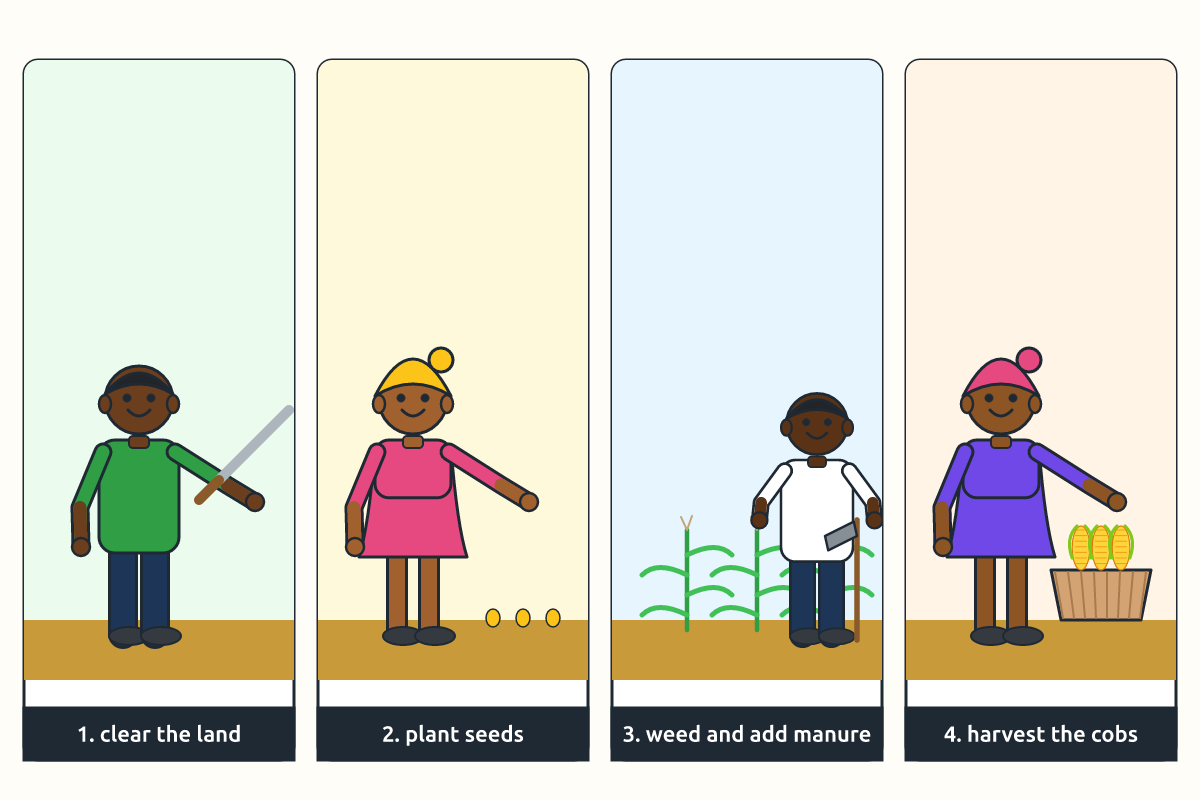
Passage: "First, the farmer clears the land. Then he plants maize seeds after the first rains. Next, he weeds the farm and adds manure. Finally, he harvests the maize after about three months."
| Step | Main idea |
|---|---|
| 1 | clear the land |
| 2 | plant seeds |
| 3 | weed and add manure |
| 4 | harvest |
New words
- main idea
- What a passage is mostly about.
- sequence
- The order of events.
- harvest
- To gather crops.
Summary
- The main idea is the key point.
- Recall main ideas in order.
Exercises
Answer in your exercise book first, then check your answers.
1. What does the farmer do first?
- A. Clears the land
- B. Harvests
- C. Weeds
- D. Sells
Show answer
Answer: Clears the landFrom the passage.2. Maize is harvested after about three months.
- A. True
- B. False
Show answer
Answer: TrueFrom the passage.3. To gather crops is to ______.
Show answer
Answer: harvestThat is harvesting.4. List the main ideas in order.
Show answer
Answer: Clear, plant, weed and manure, harvest.Sequence matters.
Lesson 3
- Strand
- Grammar
- Sub-strand
- Verbs
- Indicator
- B4.3.5.1.1 – Use different types of verbs
Introduction
Verbs show actions or states. There are different types.
Types of Verbs
| Type | Examples | Sentence |
|---|---|---|
| action verbs | run, cook, write | She cooks rice. |
| helping verbs | is, are, was, have, will | He is singing. |
| linking verbs | be, seem, become | The soup seems hot. |
New words
- verb
- A word for an action or state.
- helping verb
- A verb that helps the main verb.
- linking verb
- A verb that links the subject to a description.
Summary
- Action verbs show actions.
- Helping and linking verbs support meaning.
Exercises
Answer in your exercise book first, then check your answers.
1. Which is an action verb?
- A. write
- B. is
- C. seem
- D. the
Show answer
Answer: writeIt is an action.2. "Is" can be a helping verb.
- A. True
- B. False
Show answer
Answer: TrueAs in "is singing".3. The soup ______ hot. (seems / runs)
Show answer
Answer: seemsLinking verb.4. Find the helping verb: "They are playing football."
Show answer
Answer: areIt helps "playing".
Lesson 4
- Strand
- Composition Writing
- Sub-strand
- Narrative Writing
- Indicator
- B4.4.10.1.1 – Write about real or imagined experiences or events
Introduction
Let us write a narrative about an exciting event.
Narrative Writing Practice
Writing frame:
- Last ______, I ______. (beginning)
- Suddenly, ______. (problem)
- Then, ______. (action)
- In the end, ______. (ending and feeling)
Example: "Last Saturday, I went to the beach. Suddenly, a big wave took my slipper. Then, a fisherman swam and caught it. In the end, I thanked him and felt relieved."
New words
- suddenly
- Quickly and unexpectedly.
- relieved
- Happy that a worry has ended.
- frame
- A guide for writing.
Summary
- Use a frame to write narratives.
- Include a problem and its solution.
Exercises
Answer in your exercise book first, then check your answers.
1. Which word shows a sudden event?
- A. Suddenly
- B. Slowly
- C. Always
- D. Never
Show answer
Answer: SuddenlyIt shows surprise.2. A narrative can include a problem.
- A. True
- B. False
Show answer
Answer: TrueStories often have problems.3. Happy that a worry has ended means ______.
Show answer
Answer: relievedThat is relieved.4. Complete: "Suddenly, ______."
Show answer
Answer: E.g. Suddenly, the lights went off.Add an event.
Lesson 5
- Strand
- Writing Conventions/ Extensive Reading
- Sub-strand
- Using Adverbs, Building the Love and Culture of Reading
- Indicator
- B4.5.6.1.1 – Use adverbs to talk about when and where the action of a verb took place
Introduction
Adverbs can tell when and where an action happens.
Adverbs of Time and Place
| Time | Place |
|---|---|
| today | here |
| tomorrow | there |
| yesterday | everywhere |
| now | outside |
| soon | upstairs |
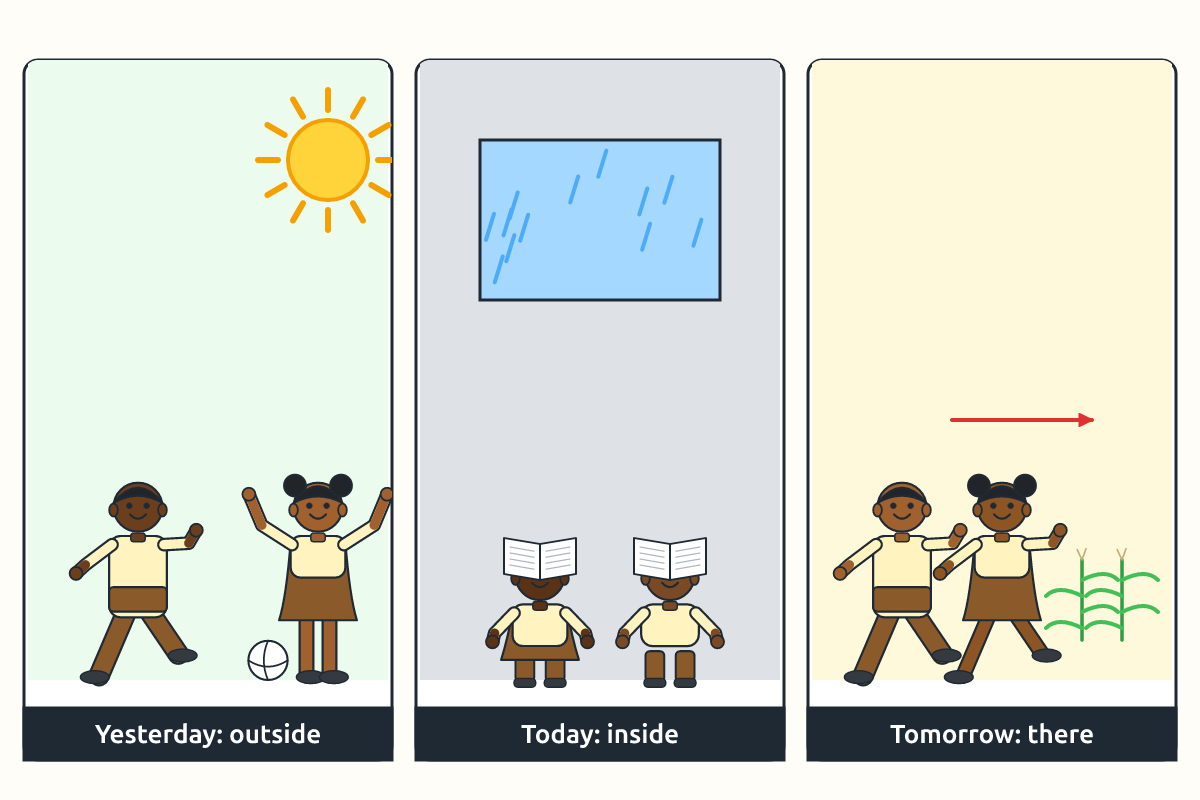
Reading passage: "Yesterday, the children played outside. Today, they are reading inside because it is raining. Tomorrow, they will go there to clean the garden."
New words
- adverb
- A word that tells more about a verb.
- time
- When something happens.
- place
- Where something happens.
Summary
- Adverbs of time tell when.
- Adverbs of place tell where.
Exercises
Answer in your exercise book first, then check your answers.
1. Which is an adverb of place?
- A. outside
- B. today
- C. soon
- D. yesterday
Show answer
Answer: outsideIt tells where.2. "Tomorrow" is an adverb of time.
- A. True
- B. False
Show answer
Answer: TrueIt tells when.3. The children played ______ yesterday. (outside / soon)
Show answer
Answer: outsideAdverb of place.4. Find two adverbs of time in the passage.
Show answer
Answer: Yesterday, Today, TomorrowThey tell when.
Homework
- Write a narrative using the writing frame.