Basic 4 · English Language
Retelling Stories, Diphthongs, Pronouns, Narratives and Verb Agreement
In this topic you will retell stories in sequence, use diphthongs, use pronouns, write narratives and practise subject–verb agreement.
By the end of these notes you should be able to:
- Retell stories in sequence with key details
- Use closing diphthongs in sentences
- Identify and use different types of pronouns
- Write about real or imagined experiences
What you already know
- Subject–verb agreement
Copy everything that has a blue line on its left into your notebook. The other parts are for reading.
Lesson 1
- Strand
- Oral Language
- Sub-strand
- Story Telling
- Indicator
- B4.1.4.1.1 – Retell stories sequentially including key details
Introduction
When we retell a story, we keep the events in order and include key details.
Retelling in Sequence
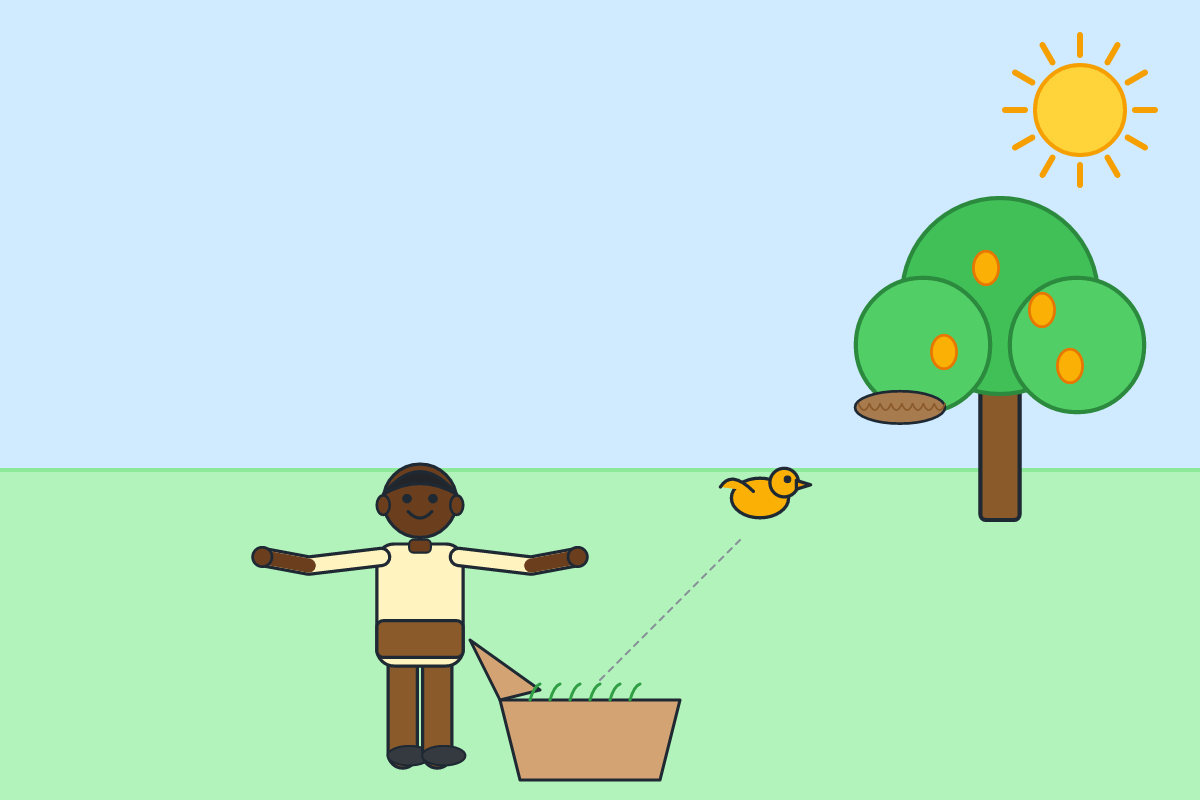
Story: "Kwaku found a baby bird under a tree. He put it in a box with soft grass. He fed it with small insects. After a week, the bird could fly. Kwaku opened the box and the bird flew away happily."
| Order | Event |
|---|---|
| first | Kwaku found a baby bird |
| next | he made it a home in a box |
| then | he fed it insects |
| finally | the bird flew away |
New words
- sequence
- The order of events.
- detail
- A small piece of information.
- retell
- To tell again.
Summary
- Retell stories in the correct order.
- Include key details.
Exercises
Answer in your exercise book first, then check your answers.
1. What did Kwaku find?
- A. A baby bird
- B. A cat
- C. A ball
- D. A book
Show answer
Answer: A baby birdFrom the story.2. The bird flew away at the end.
- A. True
- B. False
Show answer
Answer: TrueIt could fly.3. Kwaku fed the bird with small ______.
Show answer
Answer: insectsFrom the story.4. Retell the story in three sentences.
Show answer
Answer: Kwaku found a baby bird. He cared for it. It flew away.Keep the order.
Lesson 2
- Strand
- Reading
- Sub-strand
- Diphthongs
- Indicator
- B4.2.4.1.1 – Use closing diphthongs to make meaningful sentences
Introduction
A diphthong is a sound that glides from one vowel to another.
Closing Diphthongs
| Diphthong | Words |
|---|---|
| /aɪ/ (as in "my") | my, time, high |
| /eɪ/ (as in "day") | day, rain, cake |
| /ɔɪ/ (as in "boy") | boy, coin, toy |
| /aʊ/ (as in "cow") | cow, house, now |
| /əʊ/ (as in "go") | go, boat, home |
Sentence: "The boy found a coin in the house by the road."
New words
- diphthong
- A sound that glides from one vowel to another.
- glide
- To move smoothly.
- vowel sound
- A sound made with an open mouth.
Summary
- Diphthongs glide between two vowel sounds.
- Words like boy, cow and day have diphthongs.
Exercises
Answer in your exercise book first, then check your answers.
1. Which word has the /ɔɪ/ sound?
- A. coin
- B. cat
- C. cut
- D. cot
Show answer
Answer: coinc-oi-n.2. "House" has a diphthong.
- A. True
- B. False
Show answer
Answer: TrueThe ou sound glides.3. The /aʊ/ sound is in "c______". (an animal)
Show answer
Answer: cowc-ow.4. Write a sentence with two diphthong words.
Show answer
Answer: E.g. The boy rode home in the rain.Use diphthongs.
Lesson 3
- Strand
- Grammar
- Sub-strand
- Pronouns
- Indicator
- B4.3.3.1.1 – Identify and use different types of pronouns
Introduction
Pronouns take the place of nouns so we do not repeat them.
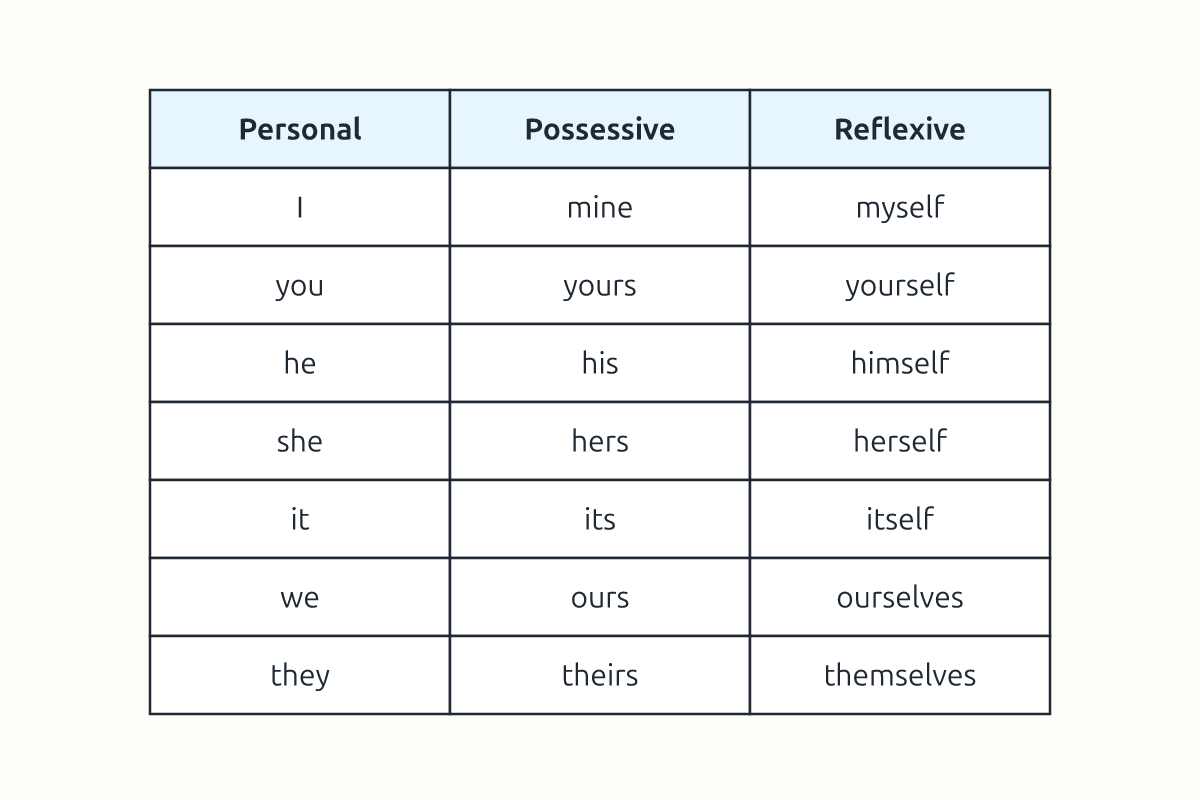
Types of Pronouns
| Type | Examples | Sentence |
|---|---|---|
| personal | I, you, he, she, it, we, they | She is my sister. |
| possessive | mine, yours, his, hers, ours, theirs | The book is mine. |
| reflexive | myself, yourself, himself, herself | He hurt himself. |
| demonstrative | this, that, these, those | This is my bag. |
New words
- pronoun
- A word used instead of a noun.
- personal pronoun
- A pronoun for people or things.
- possessive
- Showing ownership.
Summary
- Pronouns replace nouns.
- There are personal, possessive, reflexive and demonstrative pronouns.
Exercises
Answer in your exercise book first, then check your answers.
1. Which is a possessive pronoun?
- A. mine
- B. me
- C. I
- D. myself
Show answer
Answer: mineIt shows ownership.2. "Herself" is a reflexive pronoun.
- A. True
- B. False
Show answer
Answer: TrueIt refers back to "she".3. Ama dressed ______. (herself / hers)
Show answer
Answer: herselfReflexive.4. Replace the nouns: "Kofi and Ama went home."
Show answer
Answer: They went home.They replaces both names.
Lesson 4
- Strand
- Composition Writing
- Sub-strand
- Narrative Writing
- Indicator
- B4.4.10.1.1 – Write about real or imagined experiences
Introduction
A narrative tells about a real or imagined experience.
Writing a Narrative
| Part | What to include |
|---|---|
| beginning | who, where, when |
| middle | what happened; a problem |
| end | how it was solved; feelings |
Example opening: "Last holiday, I visited my uncle's farm in Techiman. I had never seen so many mango trees."
New words
- narrative
- A story.
- experience
- Something that happened to you.
- imagined
- Made up in your mind.
Summary
- A narrative has a beginning, middle and end.
- It can be real or imagined.
Exercises
Answer in your exercise book first, then check your answers.
1. A narrative is a…
- A. Story
- B. List
- C. Notice
- D. Poster
Show answer
Answer: StoryThat is a narrative.2. A narrative can be imagined.
- A. True
- B. False
Show answer
Answer: TrueIt can be made up.3. Something that happened to you is an ______.
Show answer
Answer: experienceThat is an experience.4. Write the first sentence of a narrative about a trip.
Show answer
Answer: E.g. Last Easter, my family travelled to Cape Coast.It sets the scene.
Lesson 5
- Strand
- Writing Conventions/ Extensive Reading
- Sub-strand
- Using Action Words, Building the Love and Culture of Reading
- Indicator
- B4.5.4.1.1 – Use the singular and plural subjects and the verb forms that go with them
Introduction
Let us practise verb agreement and read a passage.
More Subject–Verb Agreement
Reading passage: "My brother and I walk to school every morning. Our school starts at seven. The teacher greets us at the gate. Each pupil carries a water bottle."
| Subject | Verb |
|---|---|
| My brother and I | walk |
| Our school | starts |
| The teacher | greets |
| Each pupil | carries |
Tip: "Each" and "every" take a singular verb.
New words
- agreement
- When subject and verb match.
- compound subject
- Two subjects joined by "and".
- each
- Every one taken separately.
Summary
- Subjects joined by "and" take a plural verb.
- "Each" takes a singular verb.
Exercises
Answer in your exercise book first, then check your answers.
1. Kofi and Ama ___ friends.
- A. are
- B. is
- C. be
- D. was
Show answer
Answer: areCompound subject.2. "Each pupil carries a bottle." is correct.
- A. True
- B. False
Show answer
Answer: TrueEach takes singular.3. The teacher ______ us at the gate. (greet / greets)
Show answer
Answer: greetsSingular subject.4. Correct: "Every child have a book."
Show answer
Answer: Every child has a book.Every takes singular.
Homework
- Write a narrative of two paragraphs about a real experience.