Basic 4 · English Language
Values in Poems, Comprehension, Quantifiers, Planning and Subject–Verb Agreement
In this topic you will discuss values in poems, construct meaning from texts, use quantifiers, plan writing on local issues and match subjects with verbs.
By the end of these notes you should be able to:
- Identify values in poems
- Construct meaning from a text
- Use quantifiers to show quantity
- Use singular and plural subjects with the correct verbs
What you already know
- Poems and determiners
Copy everything that has a blue line on its left into your notebook. The other parts are for reading.
Lesson 1
- Strand
- Oral Language
- Sub-strand
- Poems
- Indicator
- B4.1.3.1.2 – Identify and discuss values in poems
Introduction
Poems often teach values such as kindness, respect and honesty.
Values in Poems
"Kindness" (a short poem)
A smile, a hand, a kindly word,
The softest sounds the world has heard,
Give what you can, and you will find,
The best of friends are good and kind.
| Question | Answer |
|---|---|
| What value is taught? | kindness |
| What can we give? | a smile, a hand, a kind word |
| What is the reward? | good friends |
New words
- value
- Something important for good behaviour.
- kindness
- Being friendly and helpful.
- reward
- Something good you receive.
Summary
- Poems can teach values like kindness.
- Kindness brings good friends.
Exercises
Answer in your exercise book first, then check your answers.
1. Which value does the poem teach?
- A. Kindness
- B. Greed
- C. Anger
- D. Laziness
Show answer
Answer: KindnessThe title says so.2. A kind word is something we can give.
- A. True
- B. False
Show answer
Answer: TrueThe poem says so.3. Being friendly and helpful is ______.
Show answer
Answer: kindnessThat is kindness.4. Write one way you can show kindness at school.
Show answer
Answer: E.g. help a friend with homework.Kindness is shown in actions.
Lesson 2
- Strand
- Reading
- Sub-strand
- Comprehension
- Indicator
- B4.2.7.1.1 – Construct meaning from texts read
Introduction
To understand a text, ask questions as you read.
Constructing Meaning
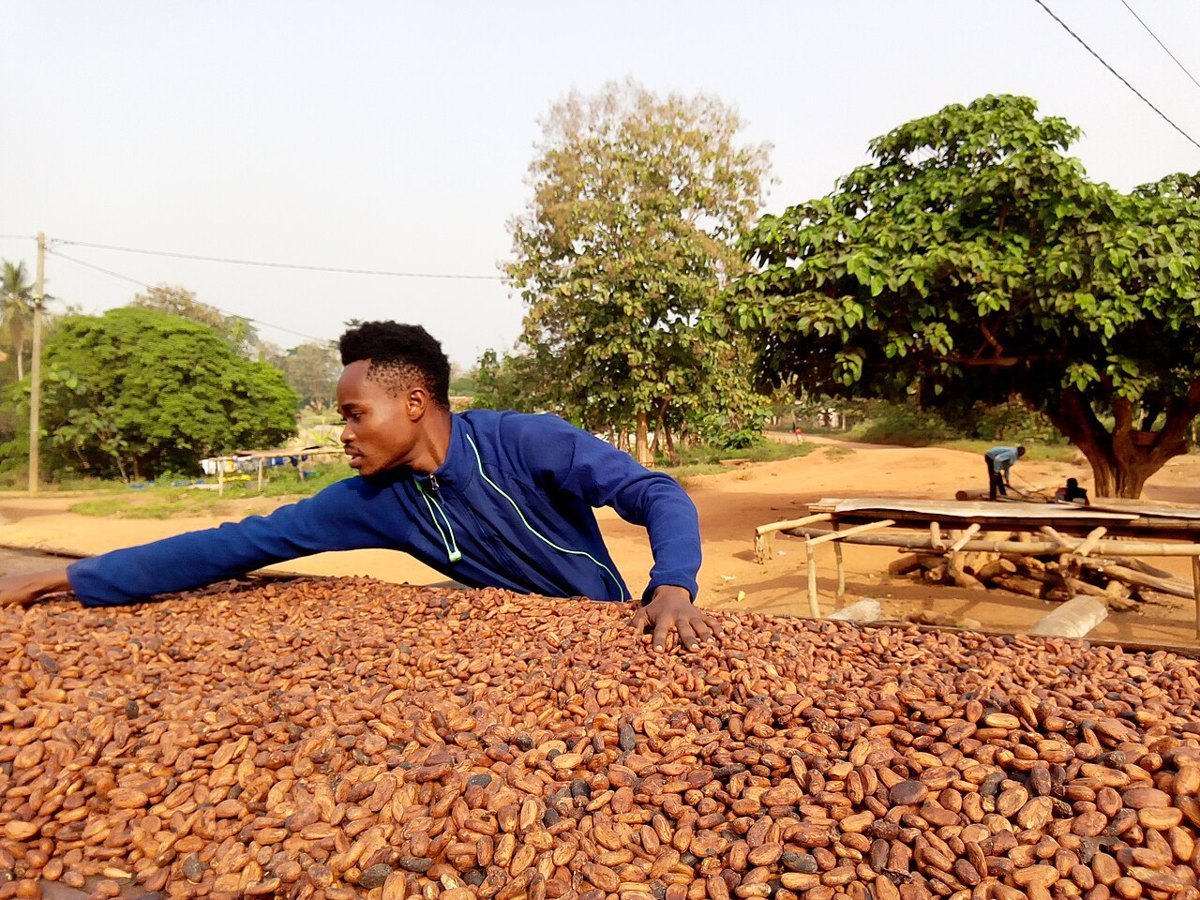
Passage: "Ghana's cocoa is among the best in the world. Farmers dry the beans in the sun for about a week. Then the beans are bagged and sold. Much of Ghana's cocoa is sent to other countries to make chocolate."
| Question | Answer |
|---|---|
| How long are beans dried? | about a week |
| What is made from cocoa abroad? | chocolate |
| Why is cocoa important to Ghana? | it is sold to other countries and earns money |
New words
- construct
- To build.
- meaning
- What something means.
- export
- To send goods to other countries.
Summary
- We build meaning by asking questions.
- Ghana's cocoa is dried, sold and exported.
Exercises
Answer in your exercise book first, then check your answers.
1. What is made from cocoa?
- A. Chocolate
- B. Bread
- C. Rice
- D. Milk
Show answer
Answer: ChocolateFrom the passage.2. Cocoa beans are dried in the sun.
- A. True
- B. False
Show answer
Answer: TrueFor about a week.3. To send goods to other countries is to ______.
Show answer
Answer: exportThat is exporting.4. Why is cocoa important to Ghana?
Show answer
Answer: It is sold to other countries and earns money.Inferred from the text.
Lesson 3
- Strand
- Grammar
- Sub-strand
- Determiners
- Indicator
- B4.3.2.1.2 – Identify and use quantifiers to show quantities
Introduction
Quantifiers tell us how much or how many.
Quantifiers
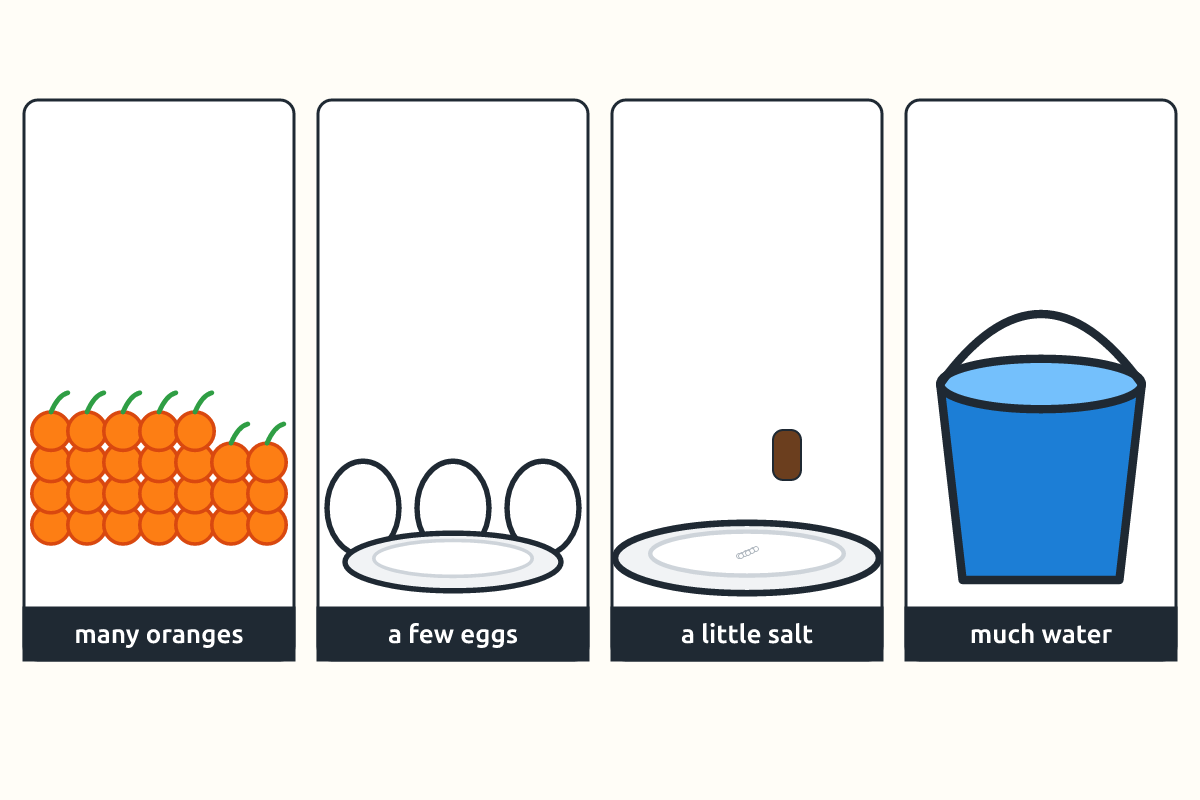
| Quantifier | Used with | Example |
|---|---|---|
| many | countable nouns | many oranges |
| much | uncountable nouns | much water |
| a few | countable nouns | a few eggs |
| a little | uncountable nouns | a little salt |
| some | both | some rice, some books |
| all | both | all the pupils |
New words
- quantifier
- A word that shows quantity.
- countable
- Can be counted (books).
- uncountable
- Cannot be counted (water).
Summary
- Quantifiers show how much or how many.
- Use many and a few with countable nouns; much and a little with uncountable nouns.
Exercises
Answer in your exercise book first, then check your answers.
1. ___ eggs
- A. a few
- B. a little
- C. much
- D. less
Show answer
Answer: a fewEggs are countable.2. "Water" is uncountable.
- A. True
- B. False
Show answer
Answer: TrueWe cannot count water.3. There is ______ salt in the soup. (a little / a few)
Show answer
Answer: a littleSalt is uncountable.4. Use "many" in a sentence.
Show answer
Answer: E.g. There are many pupils in our school.Countable noun.
Lesson 4
- Strand
- Composition Writing
- Sub-strand
- Writing As a Process
- Indicator
- B4.4.9.1.1 – Select a topic of choice on issues in the immediate environment brainstorm and organize ideas before writing
Introduction
Let us plan writing about an issue in our environment.
Planning Writing on a Local Issue
| Part | Ideas |
|---|---|
| beginning | plastic waste is everywhere |
| middle | causes (littering), effects (floods, sick animals) |
| end | solutions (bins, recycling) |
New words
- issue
- A problem people discuss.
- cause
- What makes something happen.
- effect
- What happens as a result.
Summary
- Choose a local issue and brainstorm ideas.
- Plan a beginning, middle and end.
Exercises
Answer in your exercise book first, then check your answers.
1. Which is a local issue?
- A. Plastic waste
- B. A happy party
- C. Good roads
- D. Clean water
Show answer
Answer: Plastic wasteIt is a problem.2. Effects are the results of causes.
- A. True
- B. False
Show answer
Answer: TrueCauses lead to effects.3. What makes something happen is a ______.
Show answer
Answer: causeThat is a cause.4. Give one cause and one effect of plastic waste.
Show answer
Answer: Cause: littering; effect: floods.Cause and effect.
Lesson 5
- Strand
- Writing Conventions/ Extensive Reading
- Sub-strand
- Using Actions Words, Building the Love and Culture of Reading
- Indicator
- B4.5.4.1.1 – Use the singular and plural subjects and the verb forms that go with them
Introduction
The verb must agree with the subject. Read the passage and check the verbs.
Subject–Verb Agreement
| Singular subject | Verb | Plural subject | Verb |
|---|---|---|---|
| The boy | runs | The boys | run |
| She | is | They | are |
| The dog | barks | The dogs | bark |
Reading passage: "The girls sing in the choir. Their teacher plays the keyboard. The audience claps at the end. The pupils are happy."
New words
- subject
- Who or what the sentence is about.
- singular
- One.
- plural
- More than one.
Summary
- A singular subject takes a singular verb.
- A plural subject takes a plural verb.
Exercises
Answer in your exercise book first, then check your answers.
1. The dogs ___ loudly.
- A. bark
- B. barks
- C. barking
- D. is bark
Show answer
Answer: barkPlural subject.2. "The teacher plays the keyboard." is correct.
- A. True
- B. False
Show answer
Answer: TrueSingular subject and verb.3. They ______ happy. (is / are)
Show answer
Answer: arePlural subject.4. Correct: "The pupils is singing."
Show answer
Answer: The pupils are singing.Plural takes are.
Homework
- Write five sentences with singular and five with plural subjects.