Basic 4 · English Language
Poems, Vocabulary, Determiners, Planning Writing and Nouns
In this topic you will recite poems, build vocabulary, use determiners, plan your writing and use nouns in sentences.
By the end of these notes you should be able to:
- Recite and discuss a poem by a Ghanaian writer
- Find meanings of new words from context
- Use determiners such as a, an and the
- Brainstorm and organise ideas before writing
What you already know
- Proper nouns and purposes of writing
Copy everything that has a blue line on its left into your notebook. The other parts are for reading.
Lesson 1
- Strand
- Oral Language
- Sub-strand
- Poems
- Indicator
- B4.1.3.1.1 – Identify and discuss values in songs
Introduction
Poems use few words to express big ideas. Let us recite a poem about Ghana.
Reciting a Poem
"My Ghana" (a short poem)
Green forests, golden sands,
Rivers running through the lands,
Hard-working people, proud and true,
Ghana, my heart belongs to you.
| Question | Answer |
|---|---|
| What is the poem about? | love for Ghana |
| Which things does the poet admire? | forests, sands, rivers and people |
| Which words rhyme? | sands/lands, true/you |

New words
- poem
- Writing in lines with rhythm.
- recite
- To say aloud from memory.
- poet
- A person who writes poems.
Summary
- Poems express feelings in few words.
- "My Ghana" shows love for the country.
Exercises
Answer in your exercise book first, then check your answers.
1. What is the poem about?
- A. Love for Ghana
- B. Football
- C. Rain
- D. School fees
Show answer
Answer: Love for GhanaThe poet admires Ghana.2. "Sands" and "lands" rhyme.
- A. True
- B. False
Show answer
Answer: TrueThey end the same.3. A person who writes poems is a ______.
Show answer
Answer: poetThat is a poet.4. Name two things the poet admires.
Show answer
Answer: Any two: forests, sands, rivers, people.From the poem.
Lesson 2
- Strand
- Reading
- Sub-strand
- Vocabulary
- Indicator
- B4.2.6.1.1 – Use common rhyming/ending words to decode words
Introduction
When you meet a new word, the words around it can help you guess its meaning.
Vocabulary from Context
"The farmer was exhausted after weeding all day, so he slept early."
Clue: weeding all day + slept early → "exhausted" means very tired.
| Sentence | New word | Meaning |
|---|---|---|
| The market was crowded; there was no space to walk. | crowded | full of people |
| Esi was delighted with her gift and smiled widely. | delighted | very happy |
New words
- context
- The words around a word.
- clue
- Something that helps you guess.
- meaning
- What a word means.
Summary
- Context clues help us find meanings.
- Look at the words before and after.
Exercises
Answer in your exercise book first, then check your answers.
1. "Exhausted" means…
- A. very tired
- B. very happy
- C. very fast
- D. very small
Show answer
Answer: very tiredThe farmer worked all day.2. Context means the words around a word.
- A. True
- B. False
Show answer
Answer: TrueThat is context.3. Something that helps you guess is a ______.
Show answer
Answer: clueThat is a clue.4. Guess the meaning of "drenched": "Kofi was drenched after walking in the heavy rain."
Show answer
Answer: Very wetRain is the clue.
Lesson 3
- Strand
- Grammar
- Sub-strand
- Determiners
- Indicator
- B4.3.2.1.1 – Proper nouns
Introduction
Determiners come before nouns. They tell us which one or how many.
Determiners
| Determiner | Use | Example |
|---|---|---|
| a | before a consonant sound | a calabash |
| an | before a vowel sound | an orange |
| the | a particular thing | the basket on the table |
| this / that | pointing to one thing | this book, that goat |
| these / those | pointing to many | these mangoes |
New words
- determiner
- A word before a noun that tells which or how many.
- article
- The determiners a, an and the.
- vowel sound
- A sound like a, e, i, o, u.
Summary
- Determiners come before nouns.
- Use "an" before vowel sounds and "a" before consonant sounds.
Exercises
Answer in your exercise book first, then check your answers.
1. ___ orange
- A. an
- B. a
- C. these
- D. those
Show answer
Answer: anOrange begins with a vowel sound.2. "The" points to a particular thing.
- A. True
- B. False
Show answer
Answer: TrueIt is definite.3. I saw ______ elephant. (a / an)
Show answer
Answer: anElephant begins with a vowel sound.4. Use "these" in a sentence.
Show answer
Answer: E.g. These mangoes are sweet.It points to many.
Lesson 4
- Strand
- Composition Writing
- Sub-strand
- Writing As a Process
- Indicator
- B4.4.9.1.1 – Choose appropriate ways and modes of writing for a variety of purposes
Introduction
Good writing starts with planning.
Planning Your Writing
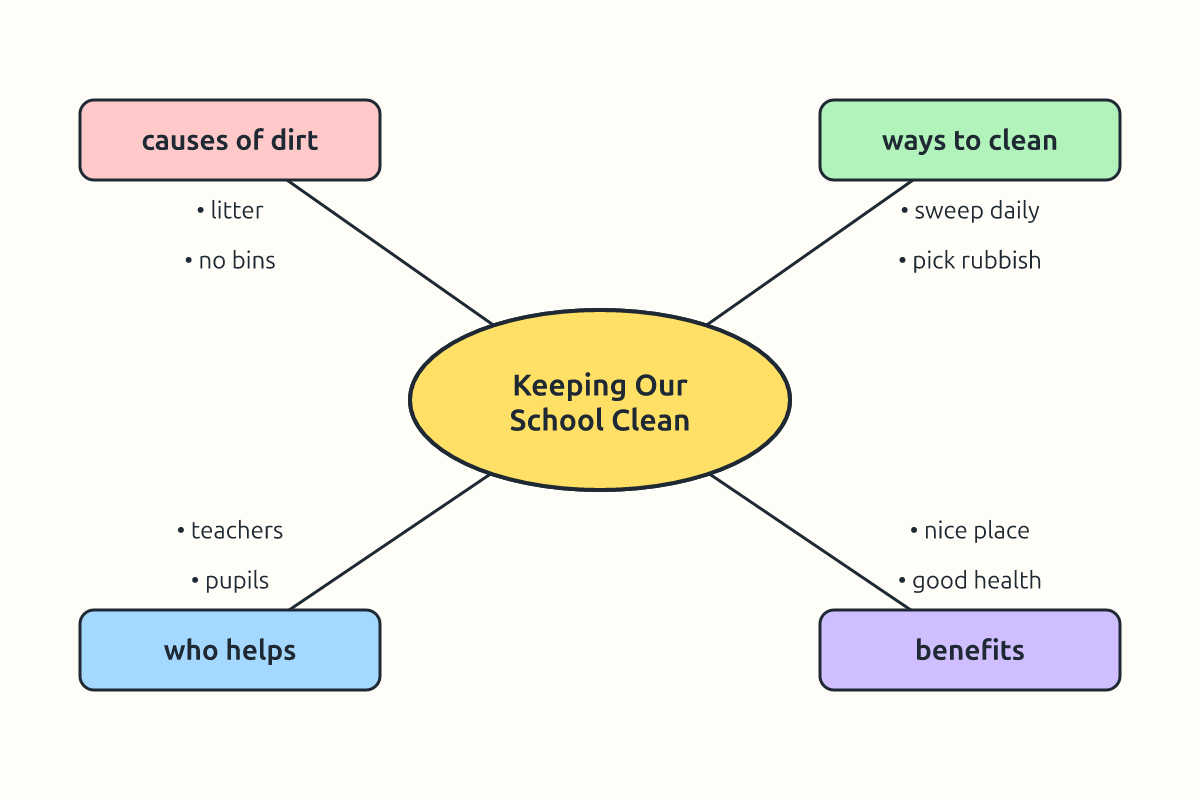
- Choose a topic, e.g. "Keeping Our School Clean".
- Brainstorm ideas quickly.
- Group similar ideas together.
- Put the groups in order.
- Write a plan with a beginning, middle and end.
New words
- brainstorm
- To list many ideas quickly.
- organise
- To arrange in order.
- mind map
- A diagram of ideas around a topic.
Summary
- Brainstorm, group, then order your ideas.
- A mind map helps planning.
Exercises
Answer in your exercise book first, then check your answers.
1. Listing many ideas quickly is…
- A. Brainstorming
- B. Erasing
- C. Copying
- D. Sleeping
Show answer
Answer: BrainstormingThat is brainstorming.2. Planning makes writing better.
- A. True
- B. False
Show answer
Answer: TrueIt organises ideas.3. A diagram of ideas around a topic is a mind ______.
Show answer
Answer: mapThat is a mind map.4. Brainstorm three ideas for "My Favourite Food".
Show answer
Answer: E.g. what it is, how it is cooked, why I like it.Ideas for planning.
Lesson 5
- Strand
- Writing Conventions/ Extensive Reading
- Sub-strand
- Using Naming Words, Building the Love and Culture of Reading
- Indicator
- B4.5.3.1.1 – Identify and use nouns in sentences to identify people animals events and objects
Introduction
Nouns help us name things clearly in sentences. Read the passage and find the nouns.
Nouns in a Passage
Reading passage: "The headteacher of Asafo Primary School called an assembly. She announced a cleaning exercise for Friday. Every class brought brooms, rakes and buckets. By noon, the compound was clean and the pupils were proud."
| Type | Nouns |
|---|---|
| people | headteacher, pupils |
| places | Asafo Primary School, compound |
| things | brooms, rakes, buckets |
| events | assembly, cleaning exercise |
New words
- announce
- To tell people publicly.
- assembly
- A meeting of the whole school.
- compound
- The open area around buildings.
Summary
- Nouns name people, places, things and events.
- We can sort nouns from a passage.
Exercises
Answer in your exercise book first, then check your answers.
1. What did the headteacher announce?
- A. A cleaning exercise
- B. A holiday
- C. A football match
- D. A test
Show answer
Answer: A cleaning exerciseFrom the passage.2. "Brooms" is a noun.
- A. True
- B. False
Show answer
Answer: TrueIt names things.3. The cleaning exercise was on ______.
Show answer
Answer: FridayFrom the passage.4. Name two events in the passage.
Show answer
Answer: assembly, cleaning exerciseThey are events.
Homework
- Plan a piece of writing about your home using a mind map.