Basic 3 · English Language
Composing Rhymes, Spelling Patterns, Writing Letters and Titles
In this topic you will compose rhymes and tongue-twisters, use letter-sound patterns, capitalise titles and summarise a story.
By the end of these notes you should be able to:
- Compose and recite short rhymes and tongue-twisters
- Use letter-sound relationships to spell
- Capitalise titles of books and stories
- Summarise a short story
What you already know
- Songs and initials
Copy everything that has a blue line on its left into your notebook. The other parts are for reading.
Lesson 1
- Strand
- Oral Language
- Sub-strand
- Rhymes
- Indicator
- B3.1.2.1.1 – Compose short rhymes and tongue- twisters and recite them
Introduction
You can make your own rhymes and tongue-twisters. All you need are rhyming words and words that start with the same sound.
Composing Rhymes and Tongue-Twisters
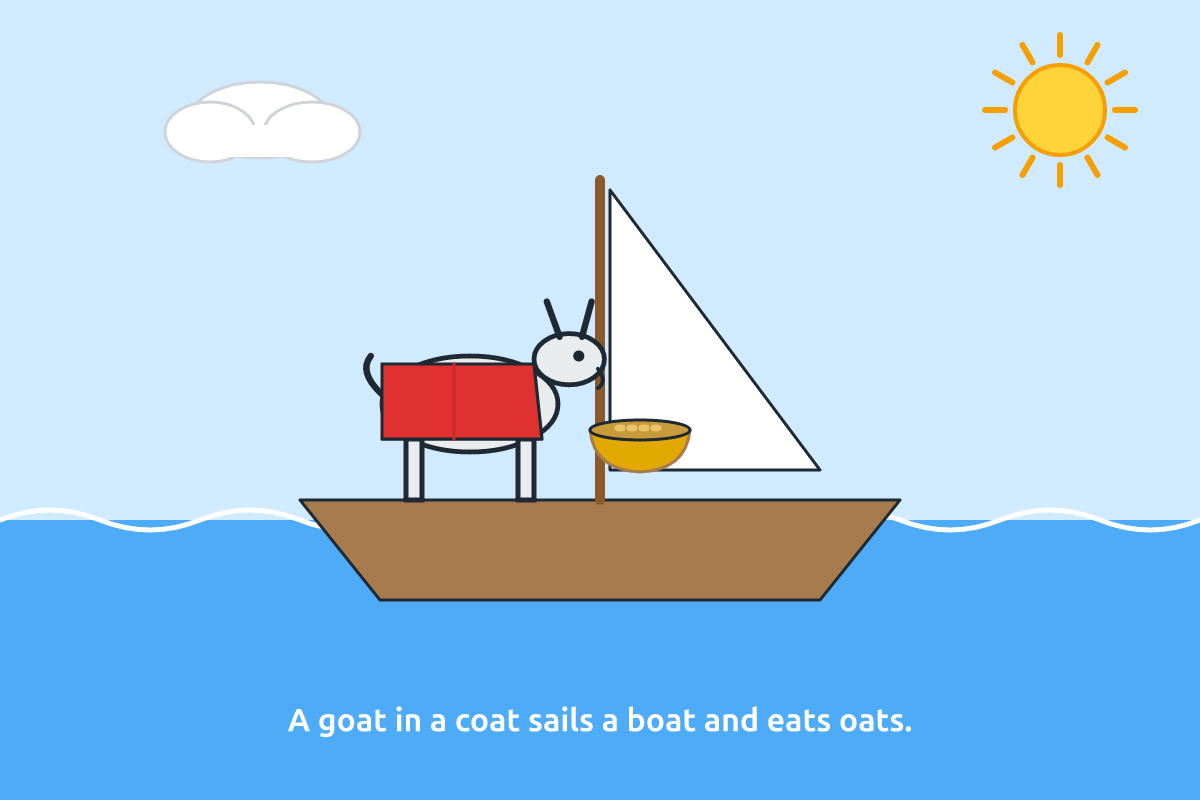
My rhyme: "I have a goat, it wears a coat, it sails a boat, and eats oat!"
My tongue-twister: "Big brown birds bring bread to Bimbilla."
Tip: For a tongue-twister, use many words that start with the same sound.
New words
- compose
- To make up something new.
- rhyme
- Words with the same ending sound.
- tongue-twister
- A sentence hard to say quickly.
Summary
- We compose rhymes using words that sound alike.
- Tongue-twisters use many words with the same first sound.
Exercises
Answer in your exercise book first, then check your answers.
1. Which word rhymes with "goat"?
- A. coat
- B. cat
- C. gate
- D. got
Show answer
Answer: coatBoth end in -oat.2. Tongue-twisters use many words starting with the same sound.
- A. True
- B. False
Show answer
Answer: TrueThat makes them tricky.3. To make up something new is to ______.
Show answer
Answer: composeThat is composing.4. Compose a two-line rhyme.
Show answer
Answer: E.g. "I see a bee, up in a tree."Lines should end with rhyming words.
Lesson 2
- Strand
- Reading
- Sub-strand
- Phonics
- Indicator
- B3.2.2.1.1 – Understand the relationship between spelling of words and sounds of speech
Introduction
Knowing the sounds of letters helps us spell words correctly.
More Spelling Patterns
| Pattern | Sound | Words |
|---|---|---|
| sh | /sh/ | ship, shop |
| ch | /ch/ | chair, lunch |
| igh | long "i" | night, light |
| oo | /oo/ | moon, food |
New words
- letter-sound
- The sound a letter or letters make.
- pattern
- Letters that go together.
- represent
- To stand for.
Summary
- Letter patterns represent sounds.
- Use patterns to spell words correctly.
Exercises
Answer in your exercise book first, then check your answers.
1. Which pattern spells the sound in "moon"?
- A. oo
- B. ee
- C. igh
- D. ch
Show answer
Answer: oom-oo-n.2. "igh" makes the long "i" sound.
- A. True
- B. False
Show answer
Answer: TrueAs in "night".3. The sun gives us l____. (long "i" with igh)
Show answer
Answer: lightl-igh-t.4. Write two words with "sh".
Show answer
Answer: E.g. ship, shop, fish.sh makes /sh/.
Lesson 3
- Strand
- Writing
- Sub-strand
- Writing Letters
- Indicator
- B3.4.3.1.1 – Use letter-sound relationships to represent most letters in words correctly
Introduction
Spell words by listening for each sound and writing the matching letters.
Spelling by Sounds
- Say the word slowly: "f-r-o-g".
- Write a letter for each sound.
- Check the word.
| Say | Write |
|---|---|
| s-t-o-p | stop |
| c-l-a-p | clap |
| d-r-u-m | drum |
New words
- stretch
- To say a word slowly.
- check
- To look for mistakes.
- sound out
- To say each sound.
Summary
- Say the word slowly and write each sound.
- Check your spelling.
Exercises
Answer in your exercise book first, then check your answers.
1. s-t-o-p spells…
- A. stop
- B. spot
- C. post
- D. pots
Show answer
Answer: stopWrite the sounds in order.2. We should say a word slowly to spell it.
- A. True
- B. False
Show answer
Answer: TrueIt helps hear each sound.3. c-l-a-p spells ______
Show answer
Answer: clapWrite the sounds in order.4. Sound out and write the word for a musical instrument you beat.
Show answer
Answer: drumd-r-u-m.
Lesson 4
- Strand
- Grammar Usage
- Sub-strand
- Using Capitalization
- Indicator
- B3.5.1.1.2 – Demonstrate the ability to capitalize titles of texts
Introduction
The important words in a title begin with capital letters.
Capitalising Titles
| Wrong | Correct |
|---|---|
| the lion and the mouse | The Lion and the Mouse |
| my first day at school | My First Day at School |
| ananse and the pot of wisdom | Ananse and the Pot of Wisdom |
Tip: Always capitalise the first word. Small words like "and", "the", "at" in the middle stay small.
New words
- title
- The name of a book, story or poem.
- capitalise
- To start with a capital letter.
- important word
- A main word in a title.
Summary
- Capitalise the first word and important words in a title.
- Small middle words like "and" and "the" stay small.
Exercises
Answer in your exercise book first, then check your answers.
1. Which title is correct?
- A. The Lion and the Mouse
- B. the lion and the mouse
- C. THE lion AND mouse
- D. The lion and The Mouse
Show answer
Answer: The Lion and the MouseImportant words capitalised.2. The first word of a title is capitalised.
- A. True
- B. False
Show answer
Answer: TrueAlways.3. The name of a book is its ______.
Show answer
Answer: titleThat is a title.4. Capitalise this title: "the brave little goat"
Show answer
Answer: The Brave Little GoatCapitalise main words.
Lesson 5
- Strand
- Extensive Reading
- Sub-strand
- Reading
- Indicator
- B3.6.1.1.1 – Read a variety of age and level- appropriate books and summarize them
Introduction
Today we read and summarise a story about a football match.
Reading and Summarising
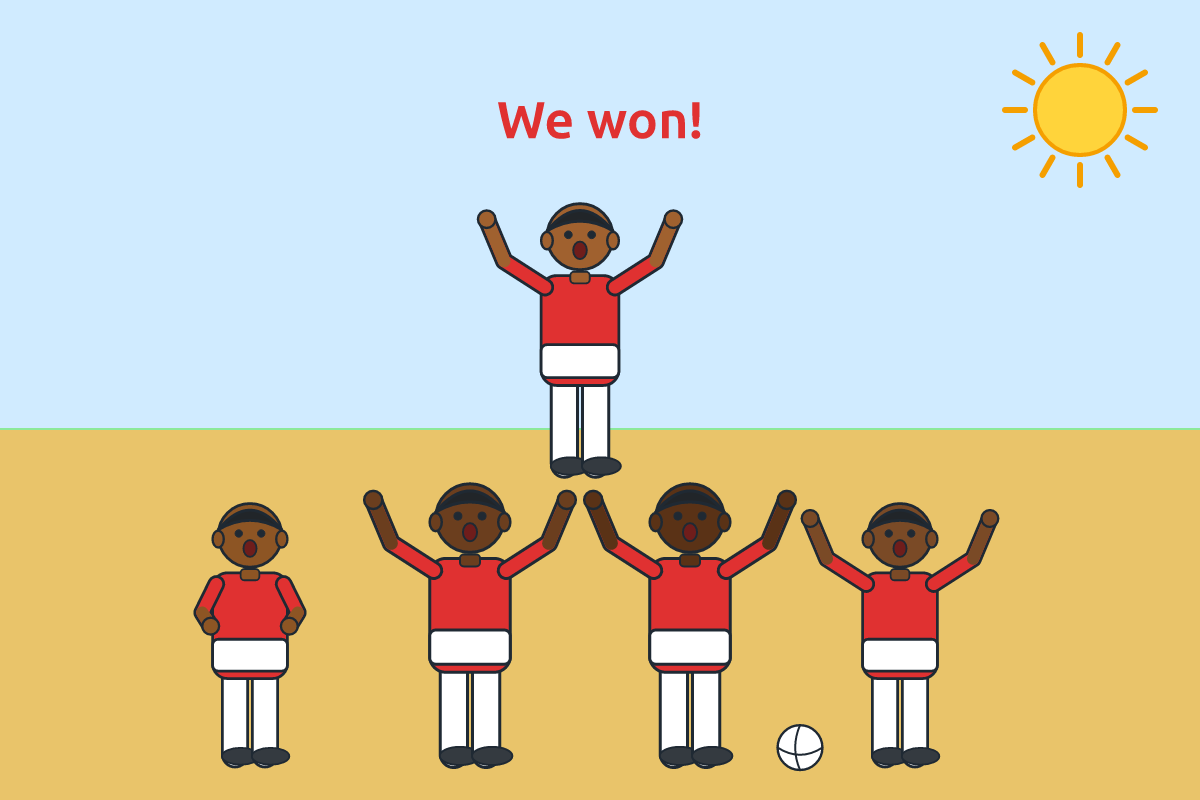
"Kwesi's team was losing 1–0. In the last five minutes, Kwesi passed the ball to Yaw, who scored. Then Kwesi scored the winning goal. The team carried Kwesi on their shoulders and sang happily."
Summary: Kwesi's team came from behind to win the match 2–1.
New words
- losing
- Behind in a game.
- winning goal
- The goal that wins the match.
- celebrate
- To show happiness about something.
Summary
- Kwesi's team scored two late goals.
- They won 2–1 and celebrated.
Exercises
Answer in your exercise book first, then check your answers.
1. Who scored the winning goal?
- A. Kwesi
- B. Yaw
- C. The goalkeeper
- D. Nobody
Show answer
Answer: KwesiThe story says so.2. The team was losing at first.
- A. True
- B. False
Show answer
Answer: TrueThey were behind 1–0.3. The final score was ______.
Show answer
Answer: 2–1They came back to win.4. Write a one-sentence summary of the story.
Show answer
Answer: Kwesi's team came from behind to win 2–1.Main points only.
Homework
- Compose a rhyme of four lines and recite it to your family.