Basic 3 · English Language
Songs, Spelling Sounds, Copying Paragraphs and Initials
In this topic you will talk about the benefits of songs, link spelling to sounds, copy a paragraph, use capitals for initials and abbreviations, and summarise a story.
By the end of these notes you should be able to:
- Talk about the benefits of songs
- Link letter patterns to the sounds they make
- Copy a short paragraph clearly
- Write initials and abbreviations with capitals
- Summarise a short story
What you already know
- English Basic 2
Copy everything that has a blue line on its left into your notebook. The other parts are for reading.
Lesson 1
- Strand
- Oral Language
- Sub-strand
- Songs
- Indicator
- B3.1.1.1.1 – Talk about the benefits of songs
Introduction
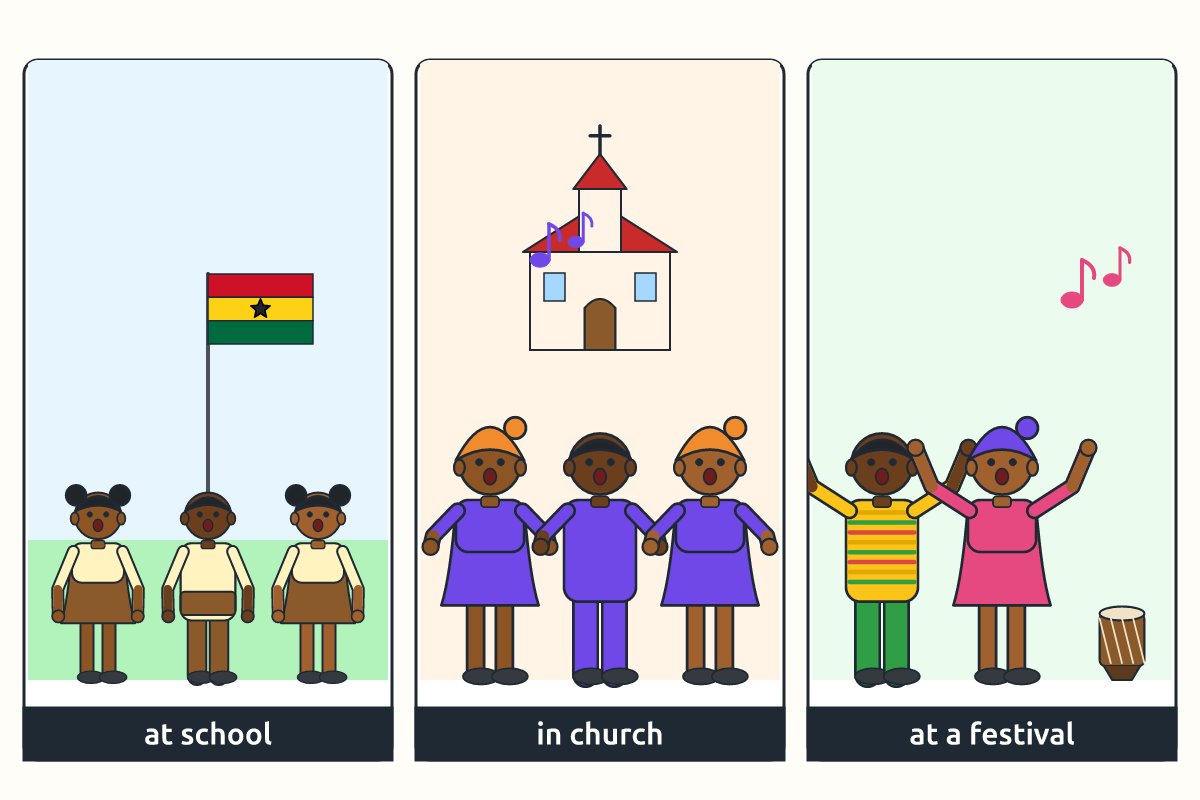
Songs are sung at church, school, funerals and festivals. They do much more than entertain us.
Benefits of Songs
| Benefit | Example |
|---|---|
| teach lessons | songs about honesty or obeying parents |
| help us learn words | alphabet and number songs |
| bring people together | national anthem, church songs |
| make work easier | work songs on farms |
| comfort us | songs at funerals |
New words
- benefit
- Something good that comes from something.
- occasion
- A special event.
- comfort
- To make someone feel better.
Summary
- Songs teach lessons, words and values.
- Songs bring people together and comfort them.
Exercises
Answer in your exercise book first, then check your answers.
1. Which song brings all Ghanaians together?
- A. The national anthem
- B. A lullaby only
- C. A jingle
- D. A birthday song
Show answer
Answer: The national anthemAll Ghanaians sing it.2. Songs can help us learn new words.
- A. True
- B. False
Show answer
Answer: TrueAlphabet songs are an example.3. A special event is an ______.
Show answer
Answer: occasionThat is an occasion.4. Write two benefits of songs.
Show answer
Answer: Any two: teach lessons, help learning, bring people together, make work easier, comfort.Songs are useful.
Lesson 2
- Strand
- Reading
- Sub-strand
- Phonics
- Indicator
- B3.2.2.1.1 – Understand the relationship between spelling of words and sounds of speech
Introduction
In English, the same sound can be spelt in different ways.
Sounds and Spellings
| Sound | Spellings | Examples |
|---|---|---|
| long "a" | a-e, ai, ay | cake, rain, play |
| long "e" | ee, ea | tree, sea |
| long "o" | o-e, oa, ow | home, boat, snow |
| "f" | f, ph | fish, phone |
Tip: Say the word slowly, then think of the spelling pattern.
New words
- spelling
- The letters in a word in the right order.
- sound
- What we hear.
- pattern
- Letters that often go together.
Summary
- One sound can be spelt in different ways.
- Learn common spelling patterns.
Exercises
Answer in your exercise book first, then check your answers.
1. Which word has the "ai" pattern?
- A. rain
- B. cake
- C. play
- D. snow
Show answer
Answer: rainr-ai-n.2. "ph" can make the "f" sound.
- A. True
- B. False
Show answer
Answer: TrueAs in "phone".3. b___t (a thing that floats; long "o" with oa)
Show answer
Answer: boatb-oa-t.4. Write two words with the long "e" sound.
Show answer
Answer: E.g. tree, sea.ee and ea make long "e".
Lesson 3
- Strand
- Writing
- Sub-strand
- Penmanship
- Indicator
- B3.4.3.1.1 – Copy short paragraph clearly
Introduction
Copying a paragraph helps us practise neat writing and correct spelling.
Copying a Paragraph
Copy this paragraph neatly:
"Our school is in Kintampo. It has six classrooms and a library. We have a big field where we play football. I love my school."
Remember
- indent the first line or start at the margin
- leave spaces between words
- copy capitals and full stops exactly
New words
- paragraph
- A group of sentences about one idea.
- indent
- To start a line a little further in.
- copy
- To write the same as a model.
Summary
- A paragraph is a group of sentences about one idea.
- Copy carefully with spaces, capitals and full stops.
Exercises
Answer in your exercise book first, then check your answers.
1. A group of sentences about one idea is a…
- A. Paragraph
- B. Word
- C. Letter
- D. Line
Show answer
Answer: ParagraphThat is a paragraph.2. We should copy capital letters exactly.
- A. True
- B. False
Show answer
Answer: TrueCopying must be exact.3. To start a line a little further in is to ______.
Show answer
Answer: indentThat is indenting.4. Copy the first sentence of the paragraph.
Show answer
Answer: Our school is in Kintampo.Copied exactly.
Lesson 4
- Strand
- Grammar Usage
- Sub-strand
- Using Capitalization
- Indicator
- B3.5.1.1.1 – Use capital letters to write initials and abbreviations
Introduction
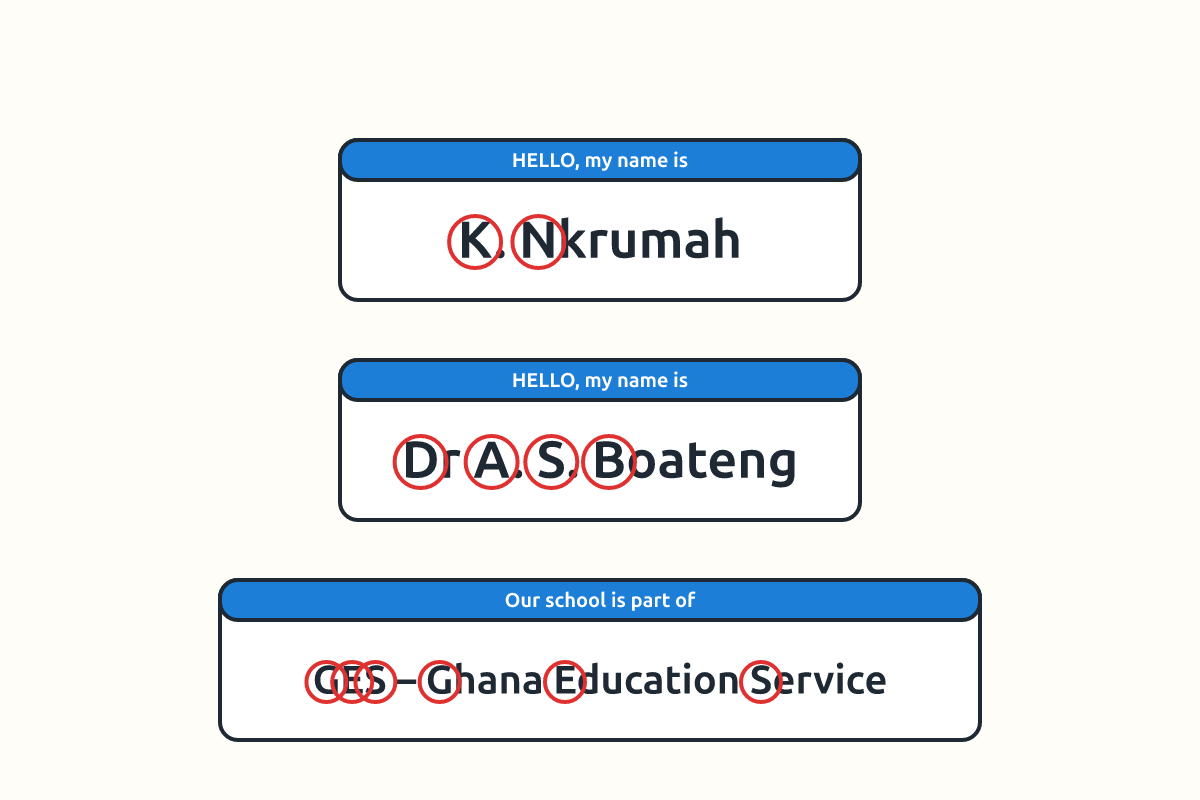
Some names and words are shortened. We use capital letters for initials and many abbreviations.
Initials and Abbreviations
| Full form | Short form |
|---|---|
| Kwame Nkrumah | K. Nkrumah (initial) |
| Ama Serwaa Boateng | A. S. Boateng |
| Ghana Education Service | GES |
| Mister | Mr |
| Doctor | Dr |
New words
- initial
- The first letter of a name.
- abbreviation
- A short form of a word or phrase.
- capital letter
- A big letter.
Summary
- Initials are the first letters of names, written as capitals.
- Many abbreviations use capital letters.
Exercises
Answer in your exercise book first, then check your answers.
1. What is the initial of "Esi"?
- A. E
- B. e
- C. S
- D. I
Show answer
Answer: EInitials are capitals.2. GES stands for Ghana Education Service.
- A. True
- B. False
Show answer
Answer: TrueIt is an abbreviation.3. The short form of Doctor is ______.
Show answer
Answer: DrDr is the abbreviation.4. Write your name using initials for your first name.
Show answer
Answer: E.g. K. Mensah.Use a capital initial.
Lesson 5
- Strand
- Extensive Reading
- Sub-strand
- Reading
- Indicator
- B3.6.1.1.1 – Read a variety of age and level- appropriate books and summarize them
Introduction
When we summarise, we tell the main points of a story in a few words.
Reading and Summarising
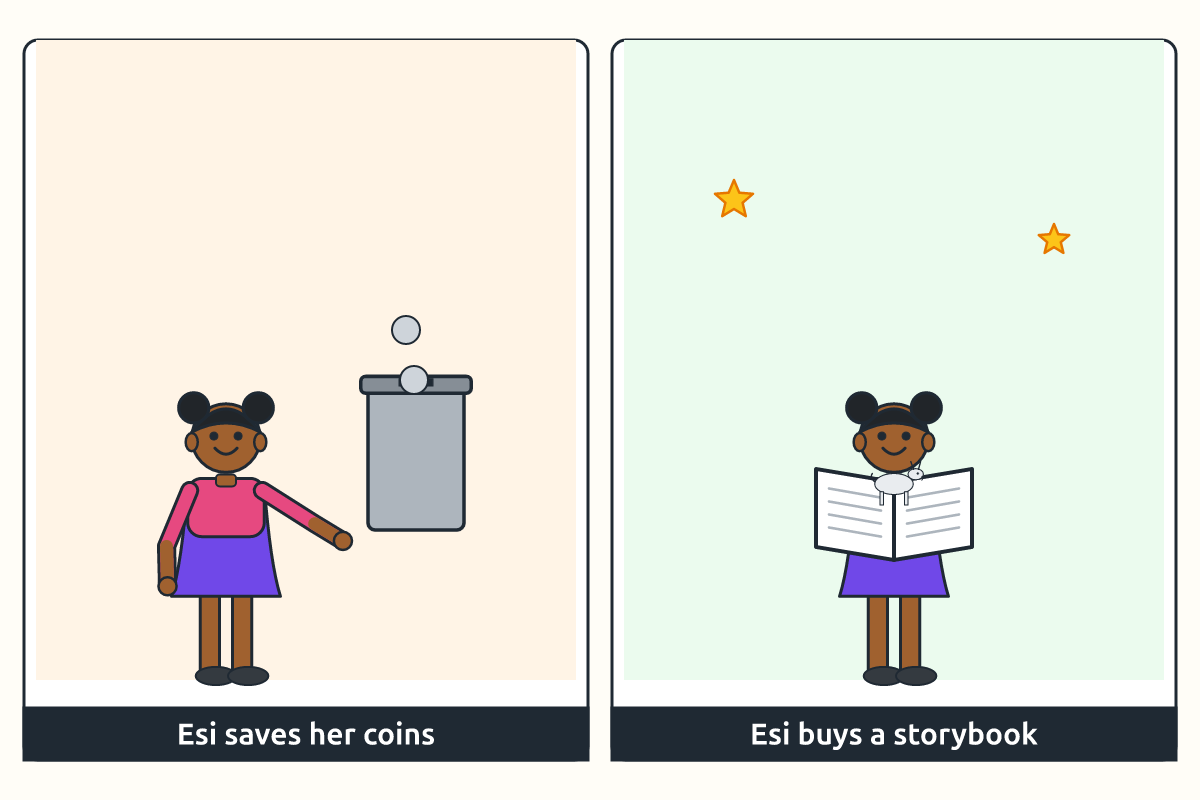
"Esi wanted to buy a book. She saved five pesewas every day in a tin. After two months, she counted her money. She had enough! She went to the bookshop and bought a storybook about animals. She read it every night."
Summary: Esi saved money every day and bought a storybook.
New words
- summarise
- To give the main points in a few words.
- save
- To keep money for later.
- main point
- The most important idea.
Summary
- A summary gives only the main points.
- Esi saved money and bought a book.
Exercises
Answer in your exercise book first, then check your answers.
1. What did Esi buy?
- A. A storybook
- B. A dress
- C. A ball
- D. Food
Show answer
Answer: A storybookThe story says so.2. Esi saved money in a tin.
- A. True
- B. False
Show answer
Answer: TrueThe story says so.3. To give the main points in a few words is to ______.
Show answer
Answer: summariseThat is summarising.4. Write a one-sentence summary of the story.
Show answer
Answer: Esi saved money and bought a storybook.Keep it short.
Homework
- Write your full name with initials, and summarise a story you read in one sentence.