Basic 3 · English Language
Questions on Stories, Word Families, Lists and Full Stops in Abbreviations
In this topic you will ask and answer questions about stories, decode words using endings, list objects and use full stops in initials and abbreviations.
By the end of these notes you should be able to:
- Ask and answer questions about stories
- Decode words using rhyming endings
- Make a list of objects in the environment
- Use full stops in initials and some abbreviations
What you already know
- Rhymes and titles
Copy everything that has a blue line on its left into your notebook. The other parts are for reading.
Lesson 1
- Strand
- Oral Language
- Sub-strand
- Story Telling
- Indicator
- B3.1.4.1.1 – Respond to and ask questions based on stories heard
Introduction
Good listeners ask questions to understand stories better.
Asking and Answering Questions
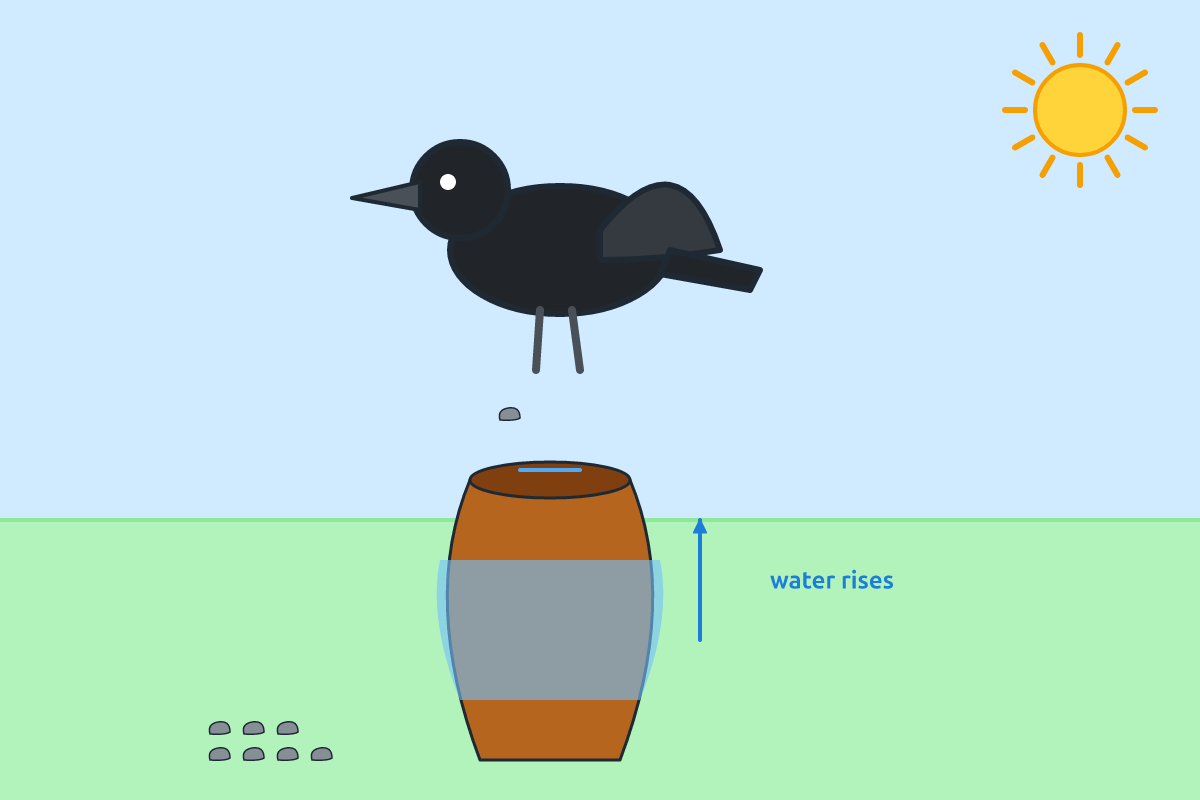
Story: "The crow was thirsty. It found a jar with a little water at the bottom. It dropped pebbles into the jar one by one. The water rose, and the crow drank."
| Question word | Question | Answer |
|---|---|---|
| Who | Who was thirsty? | the crow |
| What | What did it drop? | pebbles |
| Why | Why did the water rise? | the pebbles pushed it up |
| How | How did the crow drink? | it raised the water with pebbles |
New words
- question word
- Who, what, when, where, why or how.
- pebble
- A small smooth stone.
- clever
- Quick to think of good ideas.
Summary
- Question words help us understand stories.
- The crow used pebbles to raise the water.
Exercises
Answer in your exercise book first, then check your answers.
1. What did the crow drop into the jar?
- A. Pebbles
- B. Leaves
- C. Seeds
- D. Sand
Show answer
Answer: PebblesThe story says pebbles.2. "Why" asks for a reason.
- A. True
- B. False
Show answer
Answer: TrueWhy asks for reasons.3. A small smooth stone is a ______.
Show answer
Answer: pebbleThat is a pebble.4. Ask one "how" question about the story.
Show answer
Answer: E.g. How did the crow get the water?It starts with how.
Lesson 2
- Strand
- Reading
- Sub-strand
- Word Families
- Indicator
- B3.2.3.1.1 – Use common rhyming/endings words for decoding of words
Introduction
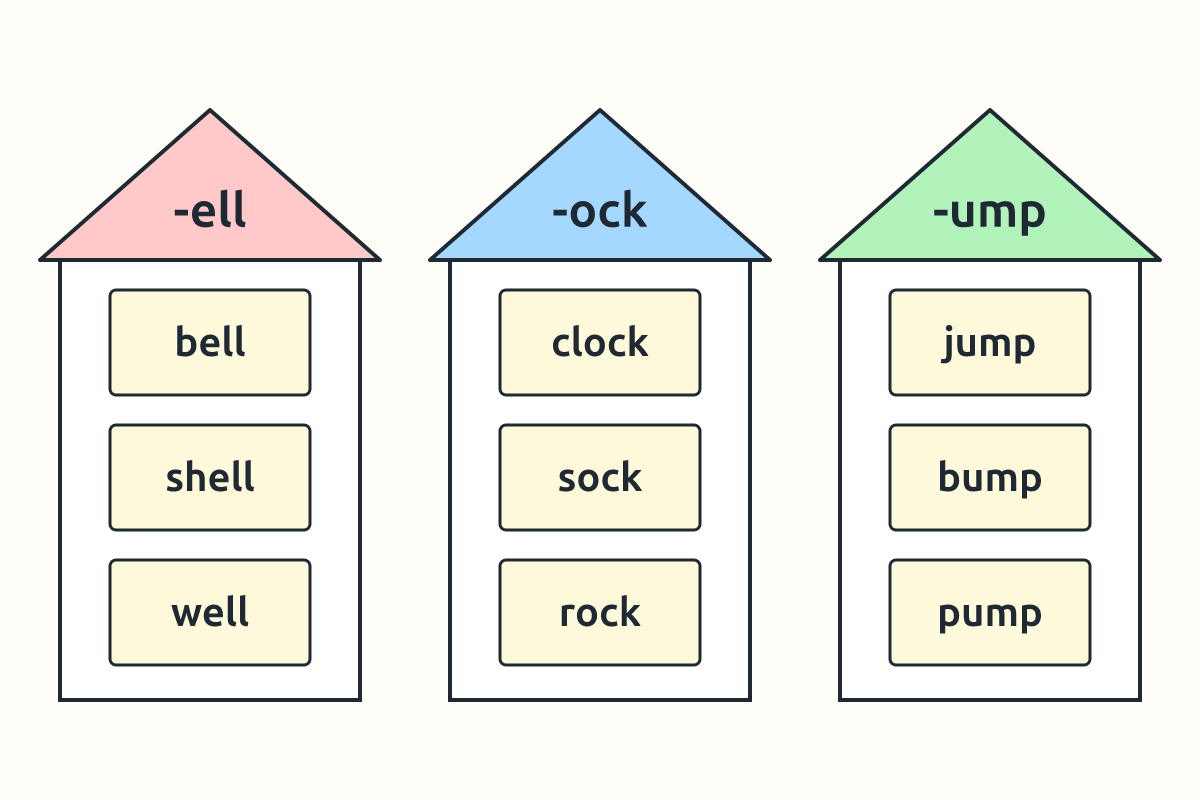
Words with the same endings are word families.
Word Families
| -ell | -ock | -ump |
|---|---|---|
| bell | clock | jump |
| shell | sock | bump |
| well | rock | pump |
New words
- word family
- Words with the same ending.
- decode
- To read a word by its sounds.
- ending
- The last part of a word.
Summary
- Words in a family share an ending.
- Knowing the ending helps us decode new words.
Exercises
Answer in your exercise book first, then check your answers.
1. Which word is in the -ock family?
- A. clock
- B. bell
- C. jump
- D. sun
Show answer
Answer: clockcl + ock.2. "Bump" and "pump" are in the same family.
- A. True
- B. False
Show answer
Answer: TrueBoth end in -ump.3. sh + ell = ______
Show answer
Answer: shellBlend sh and ell.4. Write three words in the -ell family.
Show answer
Answer: E.g. bell, well, shell.They end in -ell.
Lesson 3
- Strand
- Writing
- Sub-strand
- Labeling Items
- Indicator
- B3.4.4.1.1 – Make a list of objects found in the environment
Introduction
A list helps us remember many things.
Listing Objects in the Environment
Things in our environment
- trees
- houses
- roads
- streams
- animals
- cars
Tip: Write one item per line and start each with a capital letter if you wish.
New words
- list
- Items written one under another.
- environment
- Everything around us.
- object
- A thing.
Summary
- A list has one item per line.
- We can list objects in our environment.
Exercises
Answer in your exercise book first, then check your answers.
1. Which is an object in the environment?
- A. Tree
- B. Happiness
- C. Monday
- D. Seven
Show answer
Answer: TreeWe can see trees.2. A list has one item per line.
- A. True
- B. False
Show answer
Answer: TrueThat is a list.3. Items written one under another make a ______.
Show answer
Answer: listThat is a list.4. List four objects you see on your way to school.
Show answer
Answer: Answers will differ.Learners list objects.
Lesson 4
- Strand
- Grammar Usage
- Sub-strand
- Using Punctuation
- Indicator
- B3.5.2.1.1 – Use full stops in initials and abbreviations
Introduction
Full stops can show that a word has been shortened.
Full Stops in Initials and Abbreviations
| Full form | Short form |
|---|---|
| Kwame Nkrumah | K. Nkrumah |
| Post Office | P.O. |
| Saint (in place names) | St. |
| for example | e.g. |
Common mistake: In British English, "Mr" and "Dr" usually have no full stop.
New words
- full stop
- A dot used to end sentences and in some short forms.
- initial
- The first letter of a name.
- short form
- A shortened word.
Summary
- Use a full stop after an initial.
- Some abbreviations use full stops, like P.O. and e.g.
Exercises
Answer in your exercise book first, then check your answers.
1. Which is written correctly?
- A. K. Nkrumah
- B. K Nkrumah
- C. k. nkrumah
- D. K, Nkrumah
Show answer
Answer: K. NkrumahInitial with a full stop.2. "e.g." means "for example".
- A. True
- B. False
Show answer
Answer: TrueIt is an abbreviation.3. Post Office in short form is ______.
Show answer
Answer: P.O.With full stops.4. Write your father's or mother's name with an initial.
Show answer
Answer: E.g. K. Asante.Initial and full stop.
Lesson 5
- Strand
- Extensive Reading
- Sub-strand
- Reading
- Indicator
- B3.6.1.1.1 – Read a variety of age and level- appropriate books and summarize them
Introduction
Today we read and summarise a story about a storm.
Reading and Summarising
"Dark clouds covered the sky over Ho. The wind blew strongly and the rain poured down. A tree fell across the road, and cars could not pass. The next morning, people from the community came together and cut the tree away. The road was open again."
Summary: A storm knocked a tree onto the road, and the community cleared it.
New words
- storm
- Strong wind with heavy rain.
- community
- People who live in the same area.
- clear
- To remove things blocking the way.
Summary
- A storm made a tree fall on the road.
- The community worked together to clear it.
Exercises
Answer in your exercise book first, then check your answers.
1. Where did the storm happen?
- A. Ho
- B. Tamale
- C. Kumasi
- D. Wa
Show answer
Answer: HoThe story says Ho.2. A tree fell across the road.
- A. True
- B. False
Show answer
Answer: TrueThe story says so.3. Strong wind with heavy rain is a ______.
Show answer
Answer: stormThat is a storm.4. Write a one-sentence summary.
Show answer
Answer: A storm made a tree fall and the community cleared the road.Main points only.
Homework
- Write your name and three abbreviations you know with full stops where needed.