Basic 3 · English Language
Important Places, Self-Correction, Writing Ideas and Qualifying Words
In this topic you will talk about important places, correct yourself when reading, write ideas in sentences and identify qualifying words.
By the end of these notes you should be able to:
- Talk about important places in the community
- Use self-correction strategies when reading
- Write ideas on a topic in simple sentences
- Identify qualifying words (adverbs)
What you already know
- Community events and planning writing
Copy everything that has a blue line on its left into your notebook. The other parts are for reading.
Lesson 1
- Strand
- Oral Language
- Sub-strand
- Conversation
- Indicator
- B3.1.6.1.3 – Talk about important places in their communities
Introduction
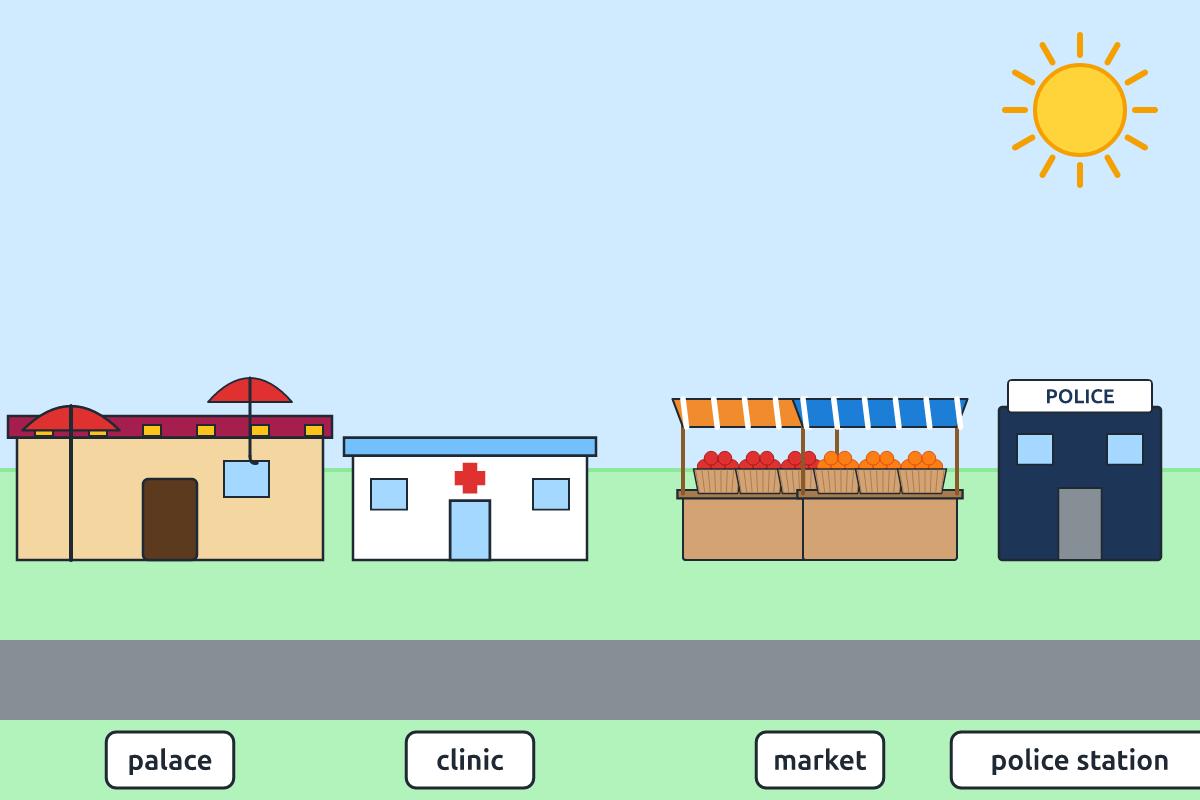
Every community has important places: the palace, clinic, market, school and places of worship.
Important Places
| Place | Importance |
|---|---|
| chief's palace | where the chief rules and settles disputes |
| clinic | where sick people are treated |
| market | where people buy and sell |
| school | where children learn |
| police station | where people report crimes |
New words
- palace
- The home of a chief.
- dispute
- A disagreement.
- report
- To tell someone about something that happened.
Summary
- Communities have important places.
- Each place serves the people.
Exercises
Answer in your exercise book first, then check your answers.
1. Where are sick people treated?
- A. Clinic
- B. Market
- C. Palace
- D. School
Show answer
Answer: ClinicClinics treat the sick.2. People report crimes at the police station.
- A. True
- B. False
Show answer
Answer: TrueThat is its job.3. The home of a chief is a ______.
Show answer
Answer: palaceThat is a palace.4. Name two important places in your community and their uses.
Show answer
Answer: E.g. market – buying and selling; school – learning.Each place has a use.
Lesson 2
- Strand
- Reading
- Sub-strand
- Comprehension
- Indicator
- B3.2.7.1.1 – Use self-correction strategies to make meaning when reading texts
Introduction
Good readers notice when something does not make sense and fix it.
Self-Correction When Reading
| Strategy | What to do |
|---|---|
| re-read | read the sentence again |
| check the picture | does the word match the picture? |
| sound it out | break the word into sounds |
| ask "Does it make sense?" | if not, try again |
Example: You read "The horse ran across the house." Stop! Does it make sense? Re-read: "The horse ran across the field."
New words
- self-correct
- To fix your own mistake.
- re-read
- To read again.
- strategy
- A way of doing something.
Summary
- Check that what you read makes sense.
- Re-read, sound out or use pictures to correct mistakes.
Exercises
Answer in your exercise book first, then check your answers.
1. What should you do if a sentence does not make sense?
- A. Re-read it
- B. Skip the book
- C. Stop reading forever
- D. Guess wildly
Show answer
Answer: Re-read itRe-reading helps.2. Pictures can help us correct reading mistakes.
- A. True
- B. False
Show answer
Answer: TrueThey give clues.3. To read again is to ______.
Show answer
Answer: re-readThat is re-reading.4. Name two self-correction strategies.
Show answer
Answer: Any two: re-read, check the picture, sound it out, ask if it makes sense.These help reading.
Lesson 3
- Strand
- Writing
- Sub-strand
- Writing As a Process
- Indicator
- B3.4.9.2.1 – Write ideas on a topic in simple sentences
Introduction
After brainstorming, we write our ideas as simple sentences.
Writing Ideas in Sentences
Topic: "My Community". Ideas: market, clinic, clean streets.
- My community has a big market.
- There is a clinic near my house.
- We keep our streets clean every Saturday.
New words
- idea
- A thought.
- simple sentence
- A sentence with one subject and one verb.
- topic
- What you write about.
Summary
- Turn each idea into a simple sentence.
- Keep sentences about the topic.
Exercises
Answer in your exercise book first, then check your answers.
1. Which is a simple sentence?
- A. My community has a market.
- B. Market big community.
- C. Has a.
- D. The.
Show answer
Answer: My community has a market.It makes sense.2. Each idea can become a sentence.
- A. True
- B. False
Show answer
Answer: TrueIdeas become sentences.3. A thought is an ______.
Show answer
Answer: ideaThat is an idea.4. Write two sentences about your community.
Show answer
Answer: Answers will differ.They describe the community.
Lesson 4
- Strand
- Grammar Usage
- Sub-strand
- Using Adverbs
- Indicator
- B3.5.6.1.1 – Identify qualifying words
Introduction
Qualifying words tell us more about actions. These are called adverbs.
Qualifying Words (Adverbs)
| Adverb | Example |
|---|---|
| quickly | Ama ran quickly. |
| slowly | The tortoise walked slowly. |
| loudly | The baby cried loudly. |
| carefully | Write carefully. |
| happily | The children sang happily. |
Tip: Many adverbs end in -ly.
New words
- adverb
- A word that tells how an action is done.
- qualify
- To describe or tell more about.
- -ly
- An ending found on many adverbs.
Summary
- Adverbs tell how an action is done.
- Many adverbs end in -ly.
Exercises
Answer in your exercise book first, then check your answers.
1. Which word is an adverb?
- A. quickly
- B. quick
- C. run
- D. Ama
Show answer
Answer: quicklyIt tells how.2. Many adverbs end in -ly.
- A. True
- B. False
Show answer
Answer: TrueLike slowly and loudly.3. The tortoise walked ______. (slow / slowly)
Show answer
Answer: slowlyAdverb tells how.4. Write a sentence with the adverb "carefully".
Show answer
Answer: E.g. She crossed the road carefully.It tells how.
Lesson 5
- Strand
- Extensive Reading
- Sub-strand
- Reading
- Indicator
- B3.6.1.1.1 – Read a variety of age and level- appropriate books and summarize them
Introduction
Today we read and summarise a story about a clinic visit.
Reading and Summarising
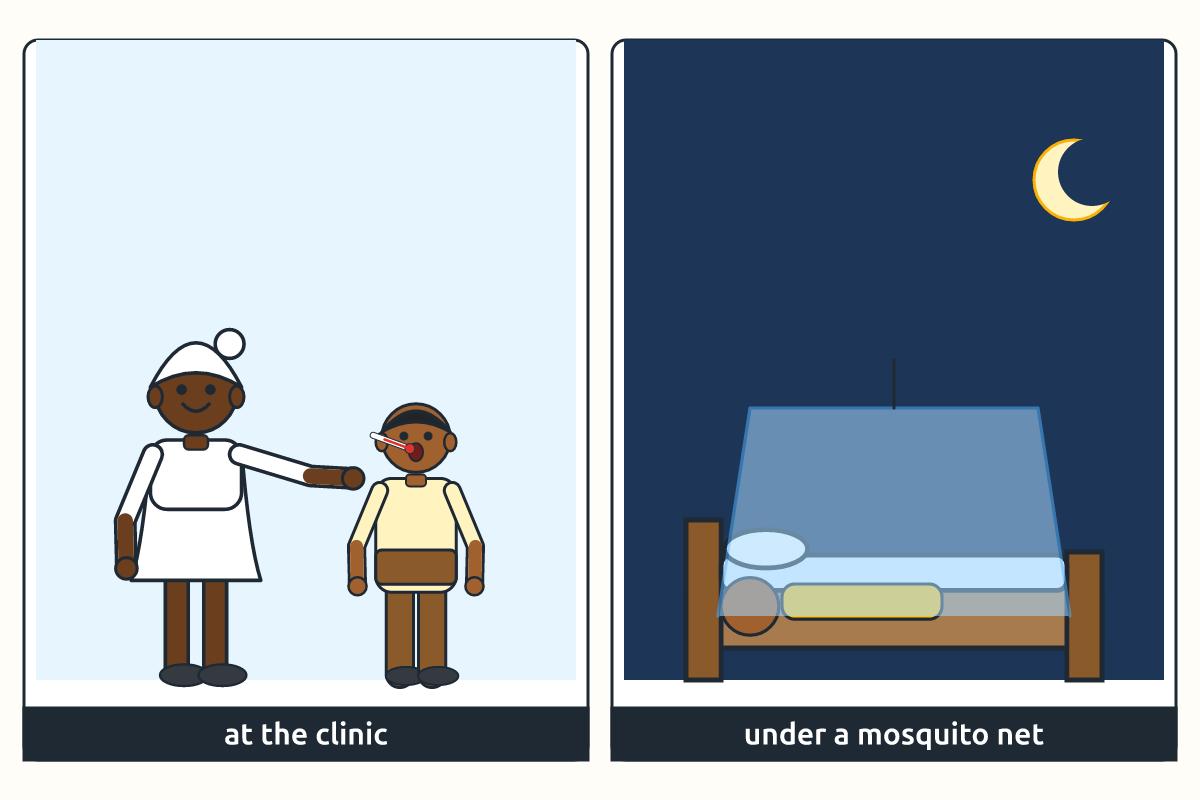
"Kofi had a high fever. His father took him to the clinic. The nurse checked his temperature and the doctor tested his blood. It was malaria. Kofi took his medicine every day and slept under a mosquito net. After a week, he was well again."
Summary: Kofi had malaria, got treatment at the clinic and recovered.
New words
- fever
- A high body temperature.
- malaria
- A disease spread by mosquitoes.
- recover
- To get well again.
Summary
- Kofi had malaria and was treated at the clinic.
- He took his medicine and recovered.
Exercises
Answer in your exercise book first, then check your answers.
1. What illness did Kofi have?
- A. Malaria
- B. Cold
- C. Toothache
- D. Measles
Show answer
Answer: MalariaThe test showed malaria.2. Kofi slept under a mosquito net.
- A. True
- B. False
Show answer
Answer: TrueThe story says so.3. To get well again is to ______.
Show answer
Answer: recoverThat is recovering.4. Write a one-sentence summary.
Show answer
Answer: Kofi had malaria, was treated and recovered.Main points.
Homework
- Write five sentences about your community using adverbs.