Basic 2 · English Language
Characters, Word Endings, Copying and Full Stops
In this topic you will relate story characters to real life, read words with common endings, copy words neatly and use full stops.
By the end of these notes you should be able to:
- Relate story characters to real people
- Decode words using rhyming endings
- Copy words with correct spacing
- Use full stops at the end of sentences
What you already know
- Rhymes and capitals
Copy everything that has a blue line on its left into your notebook. The other parts are for reading.
Lesson 1
- Strand
- Oral Language
- Sub-strand
- Story Telling
- Indicator
- B2.1.4.1.1 – Identify characters in a story and relate them to real life situations
Introduction
Characters in stories are often like people we know. A kind character may remind you of your grandmother.
Characters and Real Life
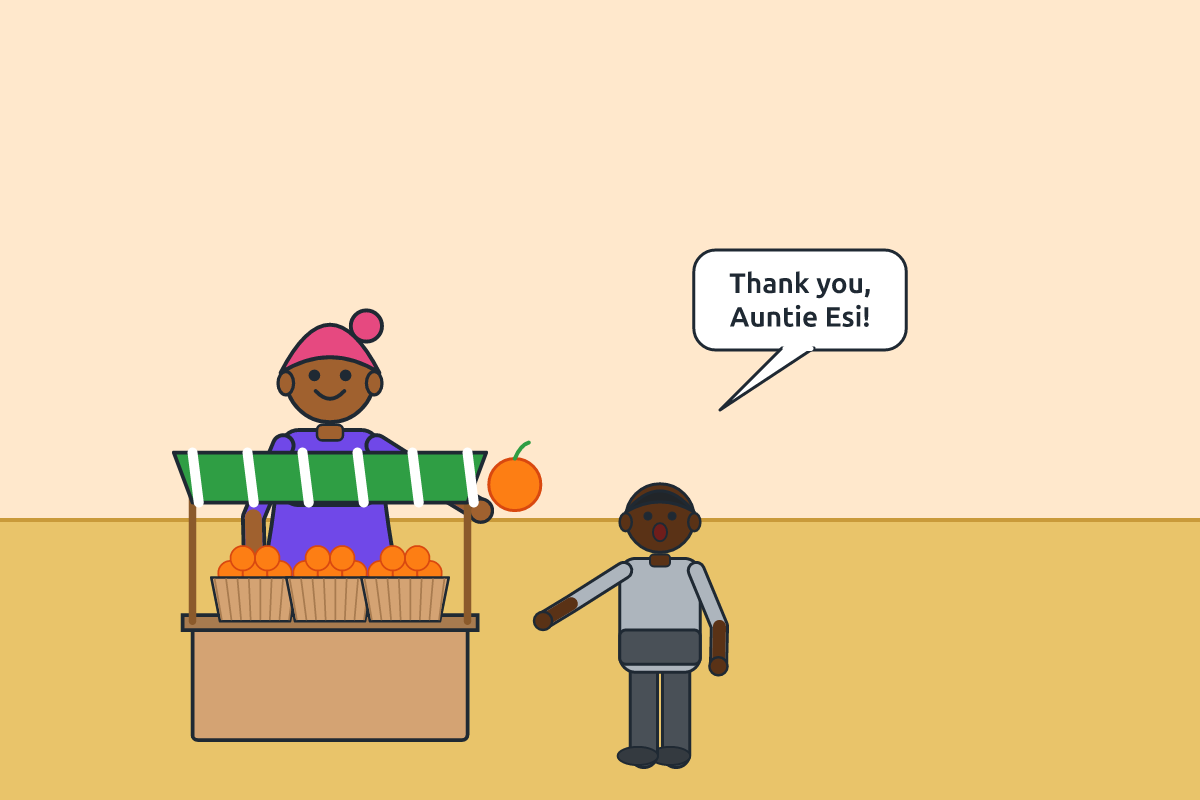
Story: "Auntie Esi sells oranges. A boy had no money but was hungry. Auntie Esi gave him an orange for free. The boy thanked her."
| Character | What she did | Real-life lesson |
|---|---|---|
| Auntie Esi | shared an orange | we should be kind to people in need |
New words
- character
- A person or animal in a story.
- real life
- The world we live in.
- kind
- Good to others.
Summary
- Story characters can be like real people.
- Auntie Esi teaches us to be kind.
Exercises
Answer in your exercise book first, then check your answers.
1. What did Auntie Esi give the boy?
- A. An orange
- B. A bag
- C. A shoe
- D. A pen
Show answer
Answer: An orangeShe shared an orange.2. Auntie Esi was kind.
- A. True
- B. False
Show answer
Answer: TrueShe helped someone in need.3. A person in a story is a ______.
Show answer
Answer: characterThat is a character.4. Name someone in real life who is kind like Auntie Esi.
Show answer
Answer: Answers will differ.Learners relate to real life.
Lesson 2
- Strand
- Reading
- Sub-strand
- Word Families, Rhyming Endings and Common Digraphs
- Indicator
- B2.2.3.1.1 – Use common rhyming/endings to decode simple words
Introduction
Words that end the same way rhyme. Knowing the ending helps us read new words.
Common Endings
| -ake | -ight | -ing |
|---|---|---|
| cake | night | sing |
| lake | light | ring |
| make | right | king |
New words
- ending
- The last part of a word.
- decode
- To read a word by its sounds.
- rhyme
- Words with the same ending sound.
Summary
- Words with the same ending rhyme.
- Know the ending, change the first sound, read a new word.
Exercises
Answer in your exercise book first, then check your answers.
1. Which word ends in -ight?
- A. Light
- B. Lake
- C. Ring
- D. Cake
Show answer
Answer: Lightl + ight.2. "Sing" and "king" rhyme.
- A. True
- B. False
Show answer
Answer: TrueBoth end in -ing.3. m + ake = ______
Show answer
Answer: makeBlend m and ake.4. Write two words ending in -ing.
Show answer
Answer: E.g. sing, ring, king.They share -ing.
Lesson 3
- Strand
- Writing
- Sub-strand
- Writing Letters – Small and Capital
- Indicator
- B2.4.3.1.1 – Copy words in lower and upper case using correct spacing
Introduction
Let us copy words clearly with good spacing.
Copying Words
Copy in lower case: yam, fish, bread, water
Copy in upper case: YAM, FISH, BREAD, WATER
Tip: Make all small letters the same height.
New words
- height
- How tall something is.
- clearly
- In a way that is easy to read.
- space
- A gap between words.
Summary
- Copy words clearly in lower and upper case.
- Keep letters the same height.
Exercises
Answer in your exercise book first, then check your answers.
1. Which is upper case?
- A. FISH
- B. fish
- C. Fish
- D. fiSh
Show answer
Answer: FISHAll capitals.2. Small letters should be the same height.
- A. True
- B. False
Show answer
Answer: TrueIt makes writing neat.3. Write "yam" in upper case: ______
Show answer
Answer: YAMAll capitals.4. Copy "bread" in lower and upper case.
Show answer
Answer: bread, BREADBoth forms.
Lesson 4
- Strand
- Writing Conventions & Grammar Usage
- Sub-strand
- Using Punctuation
- Indicator
- B2.5.2.1.1 – Use full stops at the end of sentences
Introduction
A full stop shows that a sentence has ended.
Full Stops
- My name is Ama.
- I am in Basic 2.
- I like to read.
Common mistake: "I like to read" needs a full stop at the end.
New words
- full stop
- The dot (.) that ends a sentence.
- end
- The last part.
- punctuation
- Marks that help us read.
Summary
- A full stop ends a sentence.
- Each sentence starts with a capital and ends with a full stop.
Exercises
Answer in your exercise book first, then check your answers.
1. Where does a full stop go?
- A. At the end of a sentence
- B. At the start
- C. In the middle of a word
- D. Nowhere
Show answer
Answer: At the end of a sentenceIt shows the end.2. "I am in Basic 2." ends correctly.
- A. True
- B. False
Show answer
Answer: TrueIt has a full stop.3. The dot that ends a sentence is a full ______.
Show answer
Answer: stopIt is a full stop.4. Write two sentences about yourself with full stops.
Show answer
Answer: E.g. I am seven. I like football.Each ends with a full stop.
Lesson 5
- Strand
- Extensive Reading
- Sub-strand
- Building the Love and Culture of Reading
- Indicator
- B2.6.1.1.1 – Read a variety of age and level appropriate books and texts from print
Introduction
Today we read about helping at home.
Reading Time
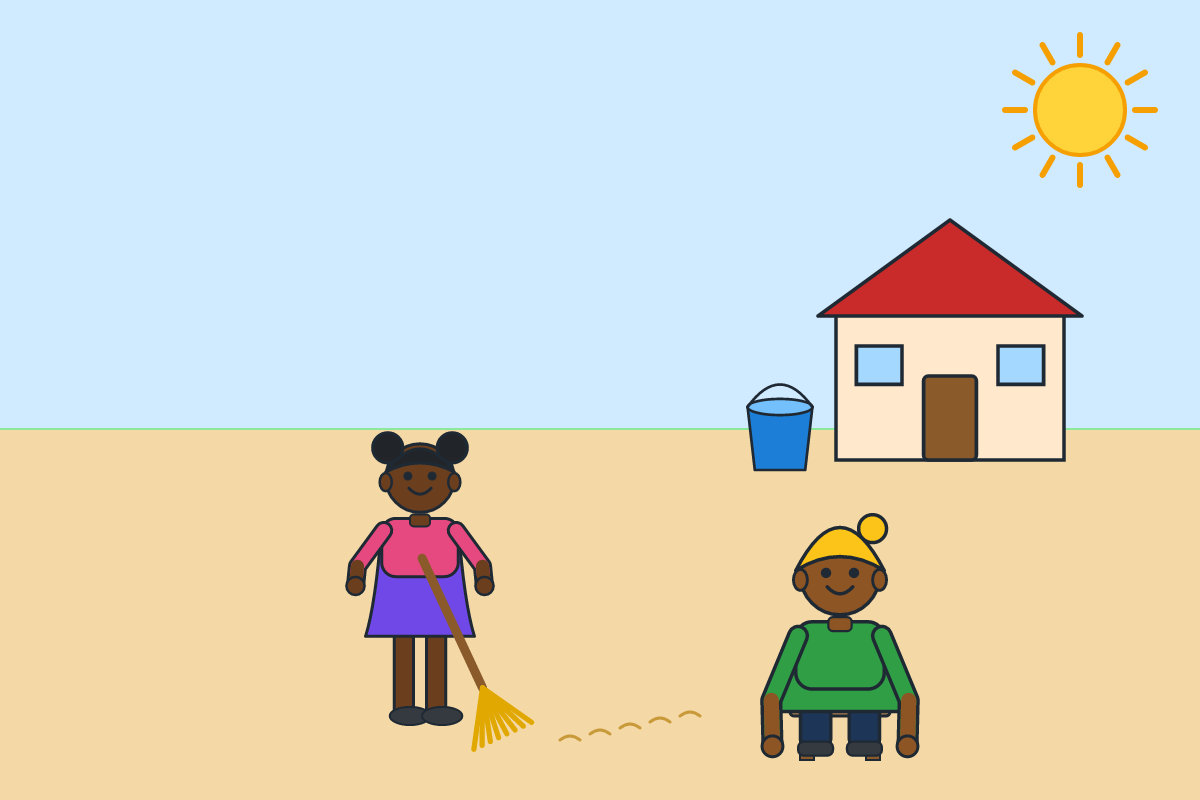
"Every Saturday, Yaa helps her grandmother. She sweeps the compound and fetches water. Grandmother tells her stories in the evening. Yaa loves Saturdays."
Questions
- Who does Yaa help? (her grandmother)
- When does Grandmother tell stories? (in the evening)
New words
- compound
- The open area around a house.
- fetch
- To go and bring back.
- evening
- The time before night.
Summary
- Yaa helps her grandmother every Saturday.
- Grandmother tells her stories in the evening.
Exercises
Answer in your exercise book first, then check your answers.
1. When does Yaa help her grandmother?
- A. Every Saturday
- B. Every Monday
- C. Never
- D. At night only
Show answer
Answer: Every SaturdayThe passage says Saturday.2. Yaa sweeps the compound.
- A. True
- B. False
Show answer
Answer: TrueThe passage says so.3. Yaa loves ______.
Show answer
Answer: SaturdaysThe passage says so.4. Name two things Yaa does.
Show answer
Answer: She sweeps and fetches water.The passage tells us.
Homework
- Read a short story and tell your family which character you liked and why.