Basic 2 · English Language
Drama, Digraphs, Labelling and Daily Actions
In this topic you will act out stories, read words with digraphs, label objects and use the simple present tense.
By the end of these notes you should be able to:
- Dramatise a story
- Read and use words with sh, ch, th and wh
- Draw and label objects
- Use the simple present tense for daily actions
What you already know
- Characters and full stops
Copy everything that has a blue line on its left into your notebook. The other parts are for reading.
Lesson 1
- Strand
- Oral Language
- Sub-strand
- Dramatization and Role-Play
- Indicator
- B2.1.5.1.1 – Dramatize stories heard or read
Introduction
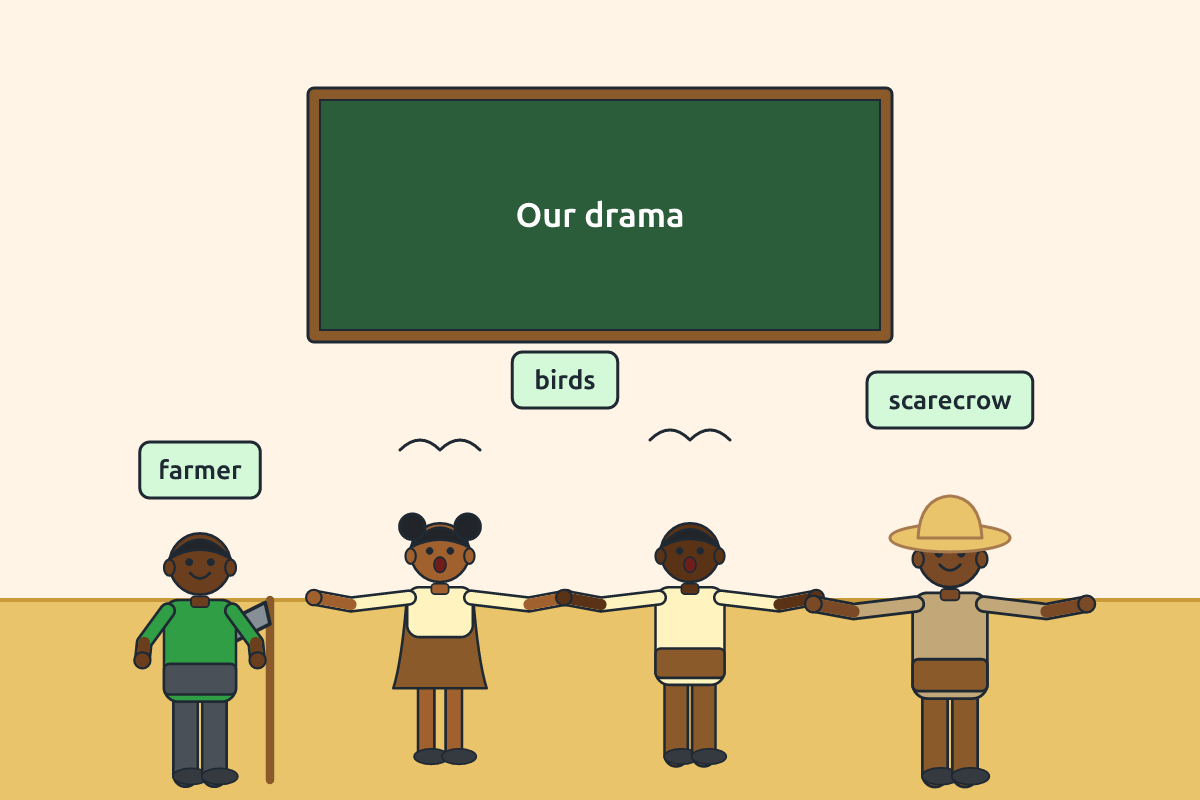
Dramatising a story means acting it out with words and actions.
Dramatising a Story
Story: "The farmer planted maize. Birds came to eat the seeds. His son made a scarecrow. The birds flew away."
| Role | Actions |
|---|---|
| farmer | plants seeds |
| birds | flap arms and peck |
| son | builds a scarecrow |
| scarecrow | stands still with arms out |
New words
- dramatise
- To act out a story.
- role
- The part an actor plays.
- scarecrow
- A figure that scares birds away.
Summary
- To dramatise is to act out a story.
- Each actor plays a role.
Exercises
Answer in your exercise book first, then check your answers.
1. What scared the birds away?
- A. A scarecrow
- B. A cat
- C. Rain
- D. A dog
Show answer
Answer: A scarecrowThe son made one.2. To dramatise means to act out.
- A. True
- B. False
Show answer
Answer: TrueThat is dramatising.3. The part an actor plays is a ______.
Show answer
Answer: roleThat is a role.4. Which role would you like to play? Why?
Show answer
Answer: Answers will differ.Learners choose a role.
Lesson 2
- Strand
- Reading
- Sub-strand
- Word Families, Rhyming Endings and Common Digraphs
- Indicator
- B2.2.3.1.2 – Use words containing digraphs to make meaningful sentences
Introduction
Some letters join to make one sound. These pairs are called digraphs.
Digraphs
| Digraph | Words |
|---|---|
| sh | ship, fish, shop |
| ch | chair, chick, lunch |
| th | thin, bath, three |
| wh | whale, white, when |
New words
- digraph
- Two letters that make one sound.
- sound
- What we hear.
- sentence
- Words that make sense together.
Summary
- Digraphs are two letters that make one sound.
- sh, ch, th and wh are digraphs.
Exercises
Answer in your exercise book first, then check your answers.
1. Which word has "sh"?
- A. fish
- B. chair
- C. thin
- D. whale
Show answer
Answer: fishf-i-sh.2. "ch" is a digraph.
- A. True
- B. False
Show answer
Answer: TrueTwo letters, one sound.3. The fisherman caught a big ______. (fish / fist)
Show answer
Answer: fishIt has the sh digraph.4. Write a sentence with a "ch" word.
Show answer
Answer: E.g. The chick is yellow.It uses a ch word.
Lesson 3
- Strand
- Writing
- Sub-strand
- Labelling Items
- Indicator
- B2.4.4.1.1 – Draw and label objects found in their environment
Introduction
Labels name things so others know what they are.
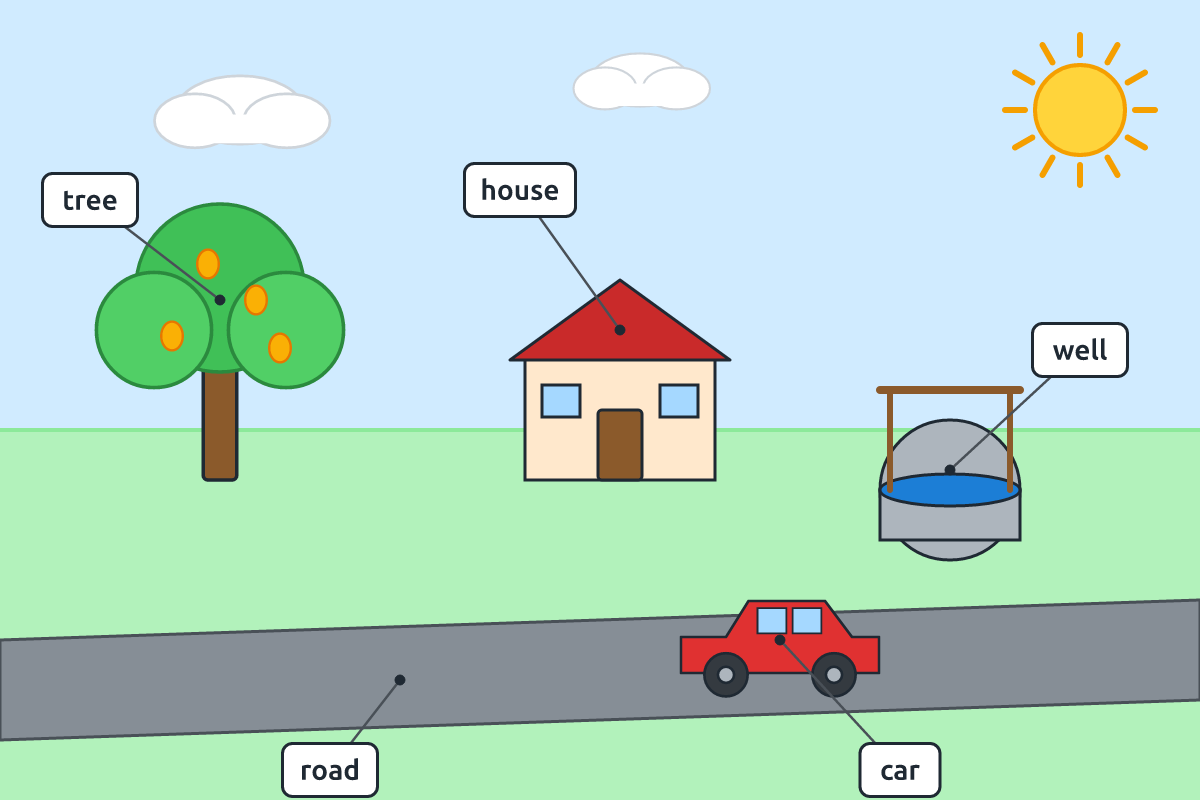
Draw and Label
Draw and label things in your environment
- tree
- house
- road
- well
- car
New words
- label
- A word that names something.
- draw
- To make a picture.
- environment
- Everything around us.
Summary
- We draw objects and label them.
- Labels name things in our environment.
Exercises
Answer in your exercise book first, then check your answers.
1. A word that names something in a picture is a…
- A. Label
- B. Song
- C. Sum
- D. Rule
Show answer
Answer: LabelLabels name things.2. We can label a tree in a drawing.
- A. True
- B. False
Show answer
Answer: TrueLabels name objects.3. Everything around us is the ______.
Show answer
Answer: environmentThat is the environment.4. Name three things to label in your school.
Show answer
Answer: E.g. door, desk, flagpole.These are objects.
Lesson 4
- Strand
- Writing Conventions & Grammar Usage
- Sub-strand
- Using Action Words
- Indicator
- B2.5.4.1.1 – Use the simple present tense to express habitual actions
Introduction
We use the simple present tense for things we do every day.
Simple Present Tense
| I / We / They | He / She / It |
|---|---|
| I wake up early. | Kofi wakes up early. |
| We go to school. | She goes to school. |
| They eat breakfast. | He eats breakfast. |
Tip: Add -s or -es after he, she or it.
New words
- tense
- The time of an action.
- present
- Now or every day.
- habit
- Something you do often.
Summary
- The simple present tense tells what we do every day.
- Add -s or -es with he, she or it.
Exercises
Answer in your exercise book first, then check your answers.
1. She ___ to school every day.
- A. goes
- B. go
- C. going
- D. gone
Show answer
Answer: goesAdd -es with she.2. "We eat breakfast." is simple present tense.
- A. True
- B. False
Show answer
Answer: TrueIt is a daily action.3. Kofi ______ up early. (wake / wakes)
Show answer
Answer: wakesAdd -s with Kofi.4. Write one thing you do every day.
Show answer
Answer: E.g. I brush my teeth.Simple present tense.
Lesson 5
- Strand
- Extensive Reading
- Sub-strand
- Building the Love and Culture of Reading
- Indicator
- B2.6.1.1.1 – Read a variety of age and level appropriate books and texts from print
Introduction
Today we read about a fisherman.
Reading Time
"Uncle Kobby is a fisherman. He goes to sea early every morning in his canoe. He catches fish with a big net. In the afternoon, Auntie Adjoa sells the fish at the market."
Questions
- What does Uncle Kobby use to catch fish? (a big net)
- Who sells the fish? (Auntie Adjoa)
New words
- fisherman
- A man who catches fish.
- canoe
- A long, narrow boat.
- net
- Material with holes used to catch fish.
Summary
- Uncle Kobby catches fish with a net.
- Auntie Adjoa sells the fish at the market.
Exercises
Answer in your exercise book first, then check your answers.
1. What is Uncle Kobby's job?
- A. Fisherman
- B. Teacher
- C. Farmer
- D. Driver
Show answer
Answer: FishermanHe catches fish.2. He goes to sea in a canoe.
- A. True
- B. False
Show answer
Answer: TrueThe passage says so.3. Auntie Adjoa sells the fish at the ______.
Show answer
Answer: marketThe passage says market.4. When does Uncle Kobby go to sea?
Show answer
Answer: Early every morning.The passage tells us.
Homework
- Write three things you do every day using the simple present tense.