Basic 2 · English Language
Greetings, Sight Words, Lists and Adjectives
In this topic you will greet people correctly, read sight words, make lists and use adjectives to describe people.
By the end of these notes you should be able to:
- Use greetings for different times of day
- Read sight words in sentences
- Make a list of objects in school
- Use adjectives to describe yourself and others
What you already know
- Drama and daily actions
Copy everything that has a blue line on its left into your notebook. The other parts are for reading.
Lesson 1
- Strand
- Oral Language
- Sub-strand
- Conversation
- Indicator
- B2.1.6.1.1 – Use appropriate greetings for different times of the day
Introduction
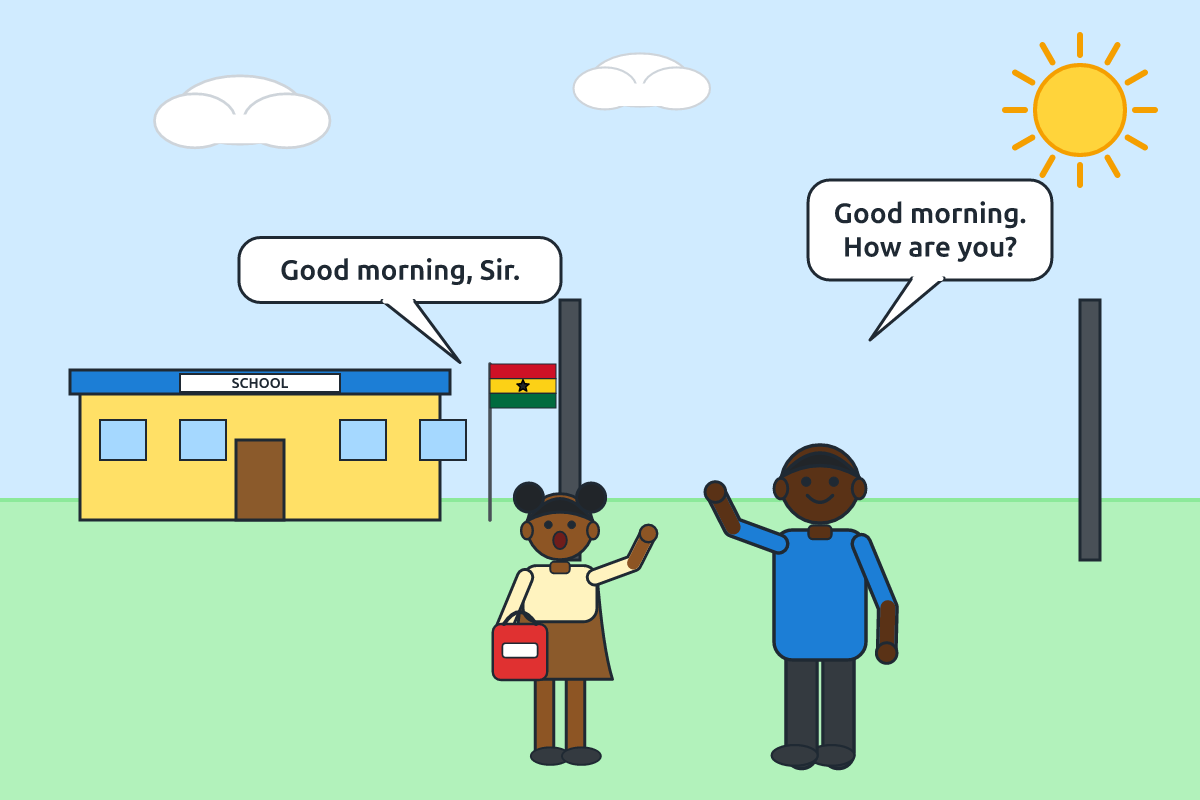
In Ghana, greeting is very important. We greet differently in the morning, afternoon and evening.
Greetings and Responses
| Greeting | Response |
|---|---|
| Good morning, Sir. | Good morning. How are you? |
| Good afternoon, Madam. | Good afternoon. |
| Good evening, Grandpa. | Good evening, my child. |
| How are you? | I am fine, thank you. |
New words
- greet
- To say hello politely.
- respond
- To answer.
- polite
- Having good manners.
Summary
- We use different greetings for morning, afternoon and evening.
- We respond politely.
Exercises
Answer in your exercise book first, then check your answers.
1. What do you say at 3 p.m.?
- A. Good afternoon
- B. Good morning
- C. Good night
- D. Good evening
Show answer
Answer: Good afternoon3 p.m. is afternoon.2. "I am fine, thank you." answers "How are you?"
- A. True
- B. False
Show answer
Answer: TrueThat is a polite response.3. To answer is to ______.
Show answer
Answer: respondThat is responding.4. Write a greeting for your teacher in the morning.
Show answer
Answer: Good morning, Sir/Madam.Morning greeting.
Lesson 2
- Strand
- Reading
- Sub-strand
- Vocabulary
- Indicator
- B2.2.6.1.1 – Read level-appropriate sight words and use many of them in meaningful sentences
Introduction
Sight words help us read quickly.
Sight Words
| about | after | again | always |
|---|---|---|---|
| because | before | every | many |
| very | which | these | those |
Read: "I always greet my teacher before class." "These mangoes are very sweet."
New words
- always
- Every time.
- before
- Earlier than.
- very
- A lot.
Summary
- Sight words appear often in reading.
- We use them in sentences.
Exercises
Answer in your exercise book first, then check your answers.
1. Which sight word means "every time"?
- A. always
- B. before
- C. many
- D. these
Show answer
Answer: alwaysAlways means every time.2. "Very" is a sight word.
- A. True
- B. False
Show answer
Answer: TrueIt appears often.3. I greet my teacher ______ class. (before / these)
Show answer
Answer: beforeBefore means earlier than.4. Write a sentence using "because".
Show answer
Answer: E.g. I am happy because it is Friday.It uses the sight word.
Lesson 3
- Strand
- Writing
- Sub-strand
- Writing Simple Words and Sentences
- Indicator
- B2.4.5.1.1 – Make a list of objects in the school
Introduction
Lists help us remember things.
Making a List
Things in our school
- classroom blocks
- library
- toilets
- playground
- flagpole
New words
- list
- Things written one under another.
- library
- A room with books.
- playground
- A place for playing.
Summary
- A list has one item on each line.
- We can list things in our school.
Exercises
Answer in your exercise book first, then check your answers.
1. Where do we borrow books?
- A. Library
- B. Toilet
- C. Playground
- D. Gate
Show answer
Answer: LibraryLibraries keep books.2. A list has one item on each line.
- A. True
- B. False
Show answer
Answer: TrueThat is a list.3. A place for playing is a ______.
Show answer
Answer: playgroundThat is a playground.4. List three places in your school.
Show answer
Answer: E.g. library, playground, office.Places in school.
Lesson 4
- Strand
- Writing Conventions & Grammar Usage
- Sub-strand
- Using Qualifying Words – Adjectives
- Indicator
- B2.5.5.1.1 – Identify adjectives and use them to describe self and other people
Introduction
Adjectives describe people and things.
Adjectives to Describe People
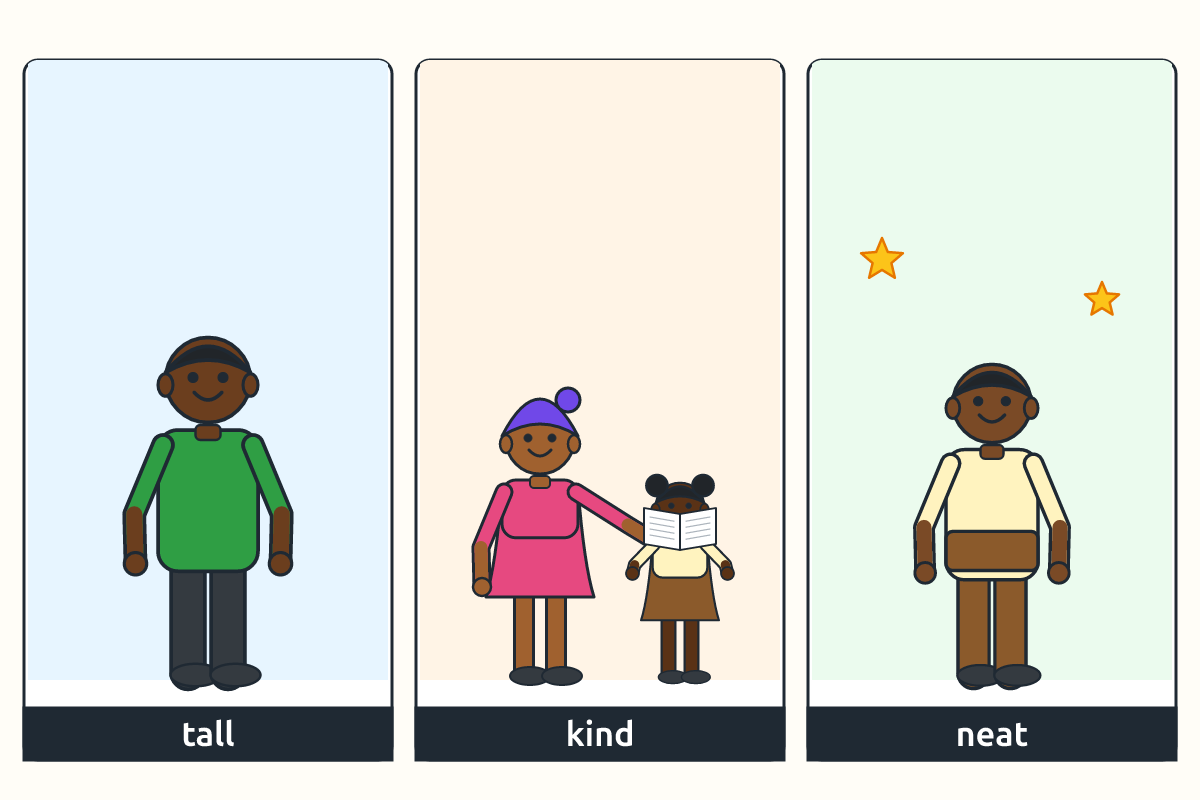
| Adjective | Sentence |
|---|---|
| tall | My father is tall. |
| kind | Our teacher is kind. |
| brave | The soldier is brave. |
| clever | Esi is clever. |
| neat | Kwame is neat. |
New words
- adjective
- A describing word.
- brave
- Not afraid.
- clever
- Quick to learn.
Summary
- Adjectives describe people.
- Tall, kind, brave and clever are adjectives.
Exercises
Answer in your exercise book first, then check your answers.
1. Which is an adjective?
- A. Brave
- B. Run
- C. Ama
- D. Desk
Show answer
Answer: BraveIt describes a person.2. "Clever" means quick to learn.
- A. True
- B. False
Show answer
Answer: TrueThat is its meaning.3. The soldier is not afraid. He is ______.
Show answer
Answer: braveBrave means not afraid.4. Write a sentence with an adjective about your friend.
Show answer
Answer: E.g. My friend is funny.It uses an adjective.
Lesson 5
- Strand
- Extensive Reading
- Sub-strand
- Building the Love and Culture of Reading
- Indicator
- B2.6.1.1.1 – Read a variety of age and level appropriate books and texts from print
Introduction
Today we read about a new pupil.
Reading Time
"A new girl came to our class. Her name is Fati. She is from Tamale. She is shy but kind. We showed her the library and the playground. Now Fati is our friend."
Questions
- Where is Fati from? (Tamale)
- What did the class show her? (the library and the playground)
New words
- new
- Just arrived.
- shy
- Quiet with new people.
- friend
- Someone you like and trust.
Summary
- Fati is a new pupil from Tamale.
- The class helped her and became her friends.
Exercises
Answer in your exercise book first, then check your answers.
1. Where is Fati from?
- A. Tamale
- B. Accra
- C. Ho
- D. Kumasi
Show answer
Answer: TamaleThe passage says Tamale.2. Fati is shy but kind.
- A. True
- B. False
Show answer
Answer: TrueThe passage says so.3. Now Fati is our ______.
Show answer
Answer: friendThe passage says so.4. How did the class help Fati?
Show answer
Answer: They showed her the library and the playground.That made her welcome.
Homework
- Greet three people at home using the right greeting and response.