Basic 2 · English Language
Rhymes, Blending, Spacing and Starting Sentences
In this topic you will explain rhymes, blend syllables, copy words with correct spacing and begin sentences with capital letters.
By the end of these notes you should be able to:
- Explain rhymes and tongue-twisters in your own words
- Blend syllables into words
- Copy upper- and lower-case words with spacing
- Begin every sentence with a capital letter
What you already know
- Songs and capitals
Copy everything that has a blue line on its left into your notebook. The other parts are for reading.
Lesson 1
- Strand
- Oral Language
- Sub-strand
- Rhymes
- Indicator
- B2.1.2.1.1 – Interpret rhymes and tongue-twisters in own words
Introduction
Tongue-twisters are fun and hard to say quickly. Let us say them and explain them.
Rhymes and Tongue-Twisters
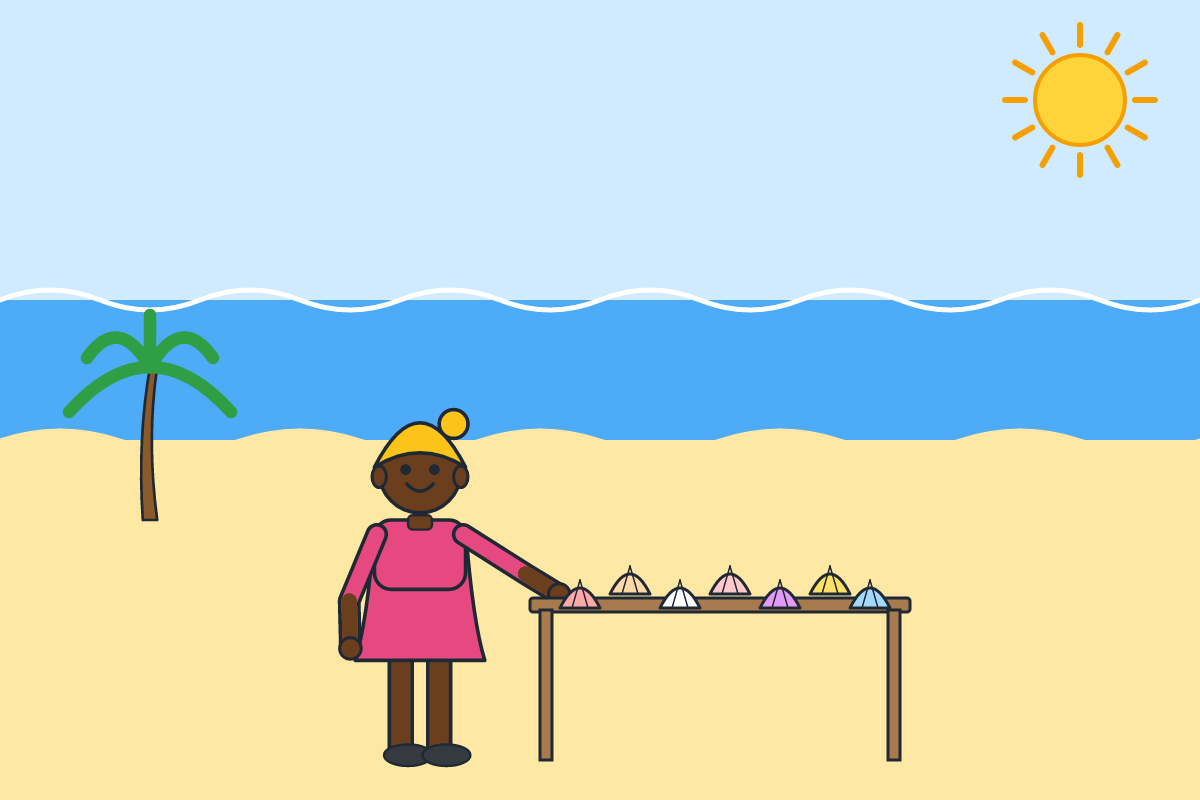
Tongue-twister: "She sells sea shells by the sea shore."
Meaning: A woman sells shells that she finds by the sea.
Rhyme: "Jack and Jill went up the hill to fetch a pail of water."
Meaning: Two children climbed a hill to get water.
New words
- tongue-twister
- A sentence that is hard to say quickly.
- explain
- To make something clear.
- own words
- Your way of saying it.
Summary
- We can explain rhymes in our own words.
- Tongue-twisters help us speak clearly.
Exercises
Answer in your exercise book first, then check your answers.
1. What did Jack and Jill fetch?
- A. Water
- B. Milk
- C. Bread
- D. Shells
Show answer
Answer: WaterThey fetched a pail of water.2. Tongue-twisters are hard to say quickly.
- A. True
- B. False
Show answer
Answer: TrueThat is what makes them fun.3. She sells sea ______ by the sea shore.
Show answer
Answer: shellsThat is the tongue-twister.4. Explain "She sells sea shells by the sea shore" in your own words.
Show answer
Answer: A woman sells shells by the beach.Use your own words.
Lesson 2
- Strand
- Reading
- Sub-strand
- Phonics
- Indicator
- B2.2.2.1.1 – Blend syllables to produce words
Introduction
Let us blend longer words.
More Blending
| Syllables | Word |
|---|---|
| mar + ket | market |
| teach + er | teacher |
| to + ma + to | tomato |
| el + e + phant | elephant |
New words
- blend
- To join sounds or syllables.
- clap
- To hit your hands together.
- longer
- Having more parts.
Summary
- Longer words have more syllables.
- Clap each syllable, then blend.
Exercises
Answer in your exercise book first, then check your answers.
1. mar + ket makes…
- A. market
- B. marker
- C. mark
- D. kettle
Show answer
Answer: marketTwo syllables make market.2. "Tomato" has three syllables.
- A. True
- B. False
Show answer
Answer: Trueto-ma-to.3. teach + er = ______
Show answer
Answer: teacherBlend them.4. Clap and write the syllables in "elephant".
Show answer
Answer: el-e-phant (3)Three claps.
Lesson 3
- Strand
- Writing
- Sub-strand
- Writing Letters – Small and Capital
- Indicator
- B2.4.3.1.1 – Copy words in lower and upper case using correct spacing
Introduction
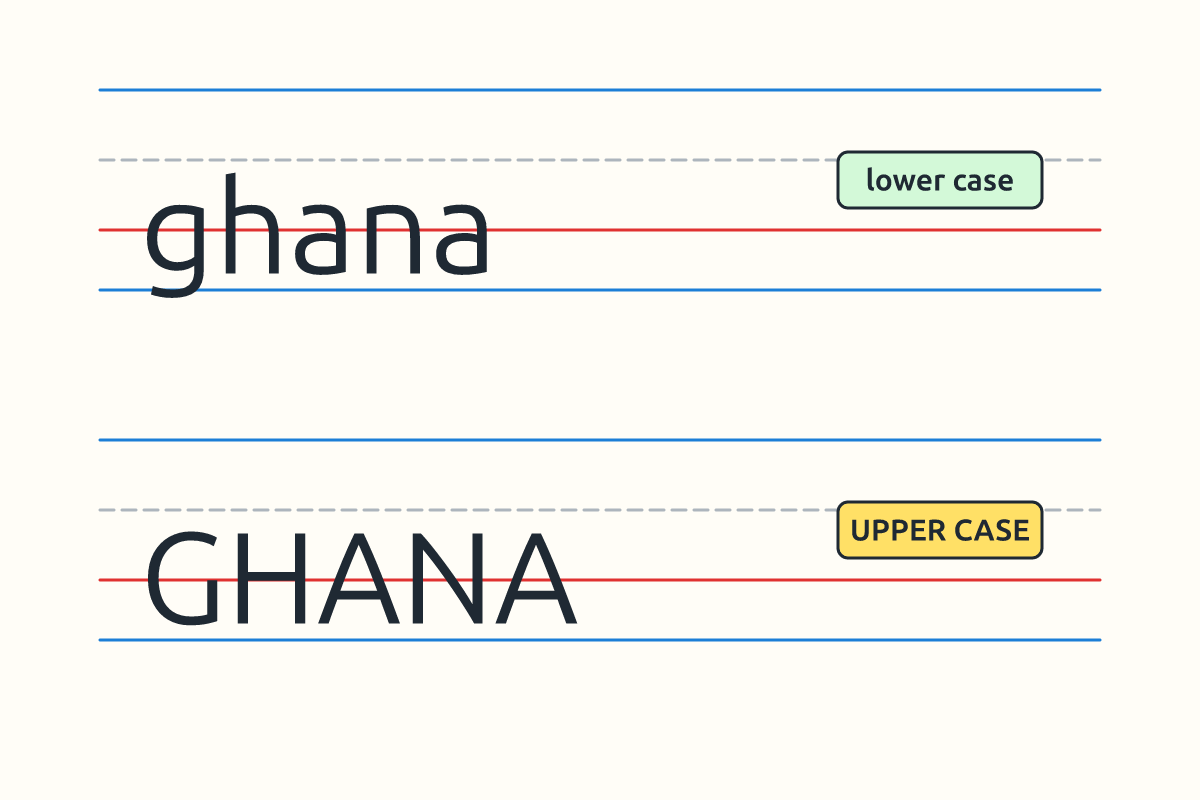
Words can be written in small letters (lower case) or capital letters (upper case).
Upper and Lower Case with Spacing
| Lower case | Upper case |
|---|---|
| ghana | GHANA |
| school | SCHOOL |
| market | MARKET |
Leave equal spaces between words. Do not squeeze letters together.
New words
- lower case
- Small letters.
- upper case
- Capital letters.
- spacing
- The gaps between letters and words.
Summary
- Lower case means small letters; upper case means capitals.
- Leave equal spaces between words.
Exercises
Answer in your exercise book first, then check your answers.
1. "SCHOOL" is written in…
- A. Upper case
- B. Lower case
- C. Joined writing
- D. Numbers
Show answer
Answer: Upper caseAll capitals.2. "market" is in lower case.
- A. True
- B. False
Show answer
Answer: TrueAll small letters.3. Small letters are called ______ case.
Show answer
Answer: lowerThat is lower case.4. Write "goat" in upper case.
Show answer
Answer: GOATAll capitals.
Lesson 4
- Strand
- Writing Conventions & Grammar Usage
- Sub-strand
- Using Capitalization
- Indicator
- B2.5.1.1.2 – Use capital letters to begin the first words of sentences
Introduction
Every sentence begins with a capital letter.
Capitals to Begin Sentences
- The sun is hot.
- My father is a farmer.
- We play ampe.
Common mistake: "my father is a farmer." needs a capital M.
New words
- sentence
- A group of words that makes sense.
- begin
- To start.
- first word
- The word at the start.
Summary
- The first word of a sentence starts with a capital letter.
- Sentences end with a full stop.
Exercises
Answer in your exercise book first, then check your answers.
1. Which sentence is correct?
- A. We play ampe.
- B. we play ampe.
- C. We Play Ampe
- D. we play Ampe.
Show answer
Answer: We play ampe.Capital to begin, full stop to end.2. Every sentence starts with a capital letter.
- A. True
- B. False
Show answer
Answer: TrueThat is the rule.3. ______ sun is hot. (the / The)
Show answer
Answer: TheSentences start with capitals.4. Write a sentence about your family.
Show answer
Answer: E.g. My mother is kind.Capital at the start.
Lesson 5
- Strand
- Extensive Reading
- Sub-strand
- Building the Love and Culture of Reading
- Indicator
- B2.6.1.1.1 – Read a variety of age and level appropriate books and texts from print
Introduction
Today we read about a rainy day.
Reading Time
"It rained all morning. Kwame could not play outside. He read a storybook and drew a picture of a rainbow. In the afternoon, the sun came out and he went to play."
Questions
- Why could Kwame not play outside? (It was raining.)
- What did he draw? (a rainbow)
New words
- rainbow
- A curve of colours in the sky after rain.
- outside
- Not in the house.
- afternoon
- The time after midday.
Summary
- Kwame stayed inside because of the rain.
- He played outside when the sun came out.
Exercises
Answer in your exercise book first, then check your answers.
1. What did Kwame draw?
- A. A rainbow
- B. A car
- C. A goat
- D. A house
Show answer
Answer: A rainbowThe story says a rainbow.2. The sun came out in the afternoon.
- A. True
- B. False
Show answer
Answer: TrueThe story says so.3. It rained all ______.
Show answer
Answer: morningThe story says morning.4. What did Kwame do inside?
Show answer
Answer: He read a storybook and drew a picture.The story tells us.
Homework
- Say a tongue-twister three times quickly to your family.