Basic 2 · English Language
Songs, Blending, Copying and Capitals for Places and Days
In this topic you will explain songs, blend syllables, copy sentences, use capitals for places and days, and enjoy a story.
By the end of these notes you should be able to:
- Explain the meaning of familiar songs
- Blend syllables to make words
- Copy sentences clearly
- Use capital letters for places and days
What you already know
- Songs, books and capital letters (Basic 1)
Copy everything that has a blue line on its left into your notebook. The other parts are for reading.
Lesson 1
- Strand
- Oral Language
- Sub-strand
- Songs
- Indicator
- B2.1.1.1.1 – Interpret familiar songs
Introduction
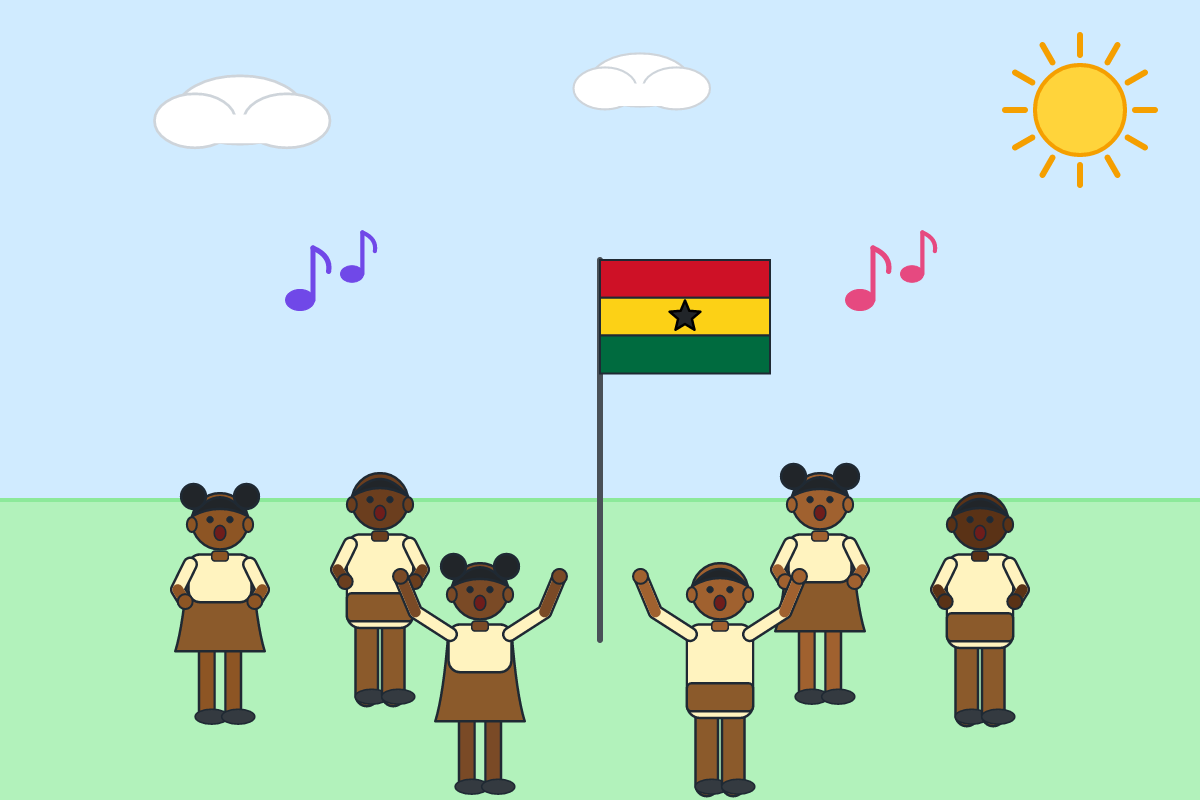
Songs carry messages. When we sing "Ghana, my happy home", we show love for our country.
Explaining Songs
To interpret a song means to explain what it means.
Ask
- What is the song about?
- How does it make you feel?
- What lesson does it teach?
Example: "Clap your hands" teaches us to join in and be happy.
New words
- interpret
- To explain the meaning of something.
- message
- The idea a song or story shares.
- lyrics
- The words of a song.
Summary
- To interpret a song is to explain its meaning.
- Songs carry messages and lessons.
Exercises
Answer in your exercise book first, then check your answers.
1. The words of a song are its…
- A. Lyrics
- B. Drums
- C. Dancers
- D. Notes
Show answer
Answer: LyricsLyrics are the words.2. Songs can teach lessons.
- A. True
- B. False
Show answer
Answer: TrueMany songs carry messages.3. To explain the meaning of a song is to ______ it.
Show answer
Answer: interpretThat is interpreting.4. What is your favourite song about?
Show answer
Answer: Answers will differ.Learners explain a song.
Lesson 2
- Strand
- Reading
- Sub-strand
- Phonics
- Indicator
- B2.2.2.1.1 – Blend syllables to produce words
Introduction
Words are made of parts called syllables. When we join syllables, we make words.
Blending Syllables
| Syllables | Word |
|---|---|
| ba + by | baby |
| pen + cil | pencil |
| ba + na + na | banana |
| but + ter + fly | butterfly |
New words
- syllable
- A part of a word you can clap.
- blend
- To join parts together.
- word
- Sounds that have meaning.
Summary
- Syllables are parts of words.
- We blend syllables to read words.
Exercises
Answer in your exercise book first, then check your answers.
1. pen + cil makes…
- A. pencil
- B. pen
- C. cell
- D. pencils
Show answer
Answer: pencilTwo syllables make pencil.2. "Banana" has three syllables.
- A. True
- B. False
Show answer
Answer: Trueba-na-na.3. ba + by = ______
Show answer
Answer: babyBlend the syllables.4. How many syllables are in "butterfly"?
Show answer
Answer: Three (but-ter-fly)Clap it to check.
Lesson 3
- Strand
- Writing
- Sub-strand
- Penmanship
- Indicator
- B2.4.2.1.1 – Copy sentences clearly
Introduction
Neat copying helps others read your work.
Copying Sentences
- Read the sentence.
- Copy word by word.
- Leave finger spaces.
- Check the capital letter and full stop.
Copy: "We live in Ghana. Our flag is red, gold and green."
New words
- copy
- To write the same as a model.
- neat
- Clean and tidy.
- check
- To look again for mistakes.
Summary
- Copy word by word and leave spaces.
- Check capitals and full stops.
Exercises
Answer in your exercise book first, then check your answers.
1. What do we leave between words?
- A. A space
- B. A comma
- C. A dot
- D. Nothing
Show answer
Answer: A spaceSpaces separate words.2. We should check our copying.
- A. True
- B. False
Show answer
Answer: TrueChecking finds mistakes.3. Clean and tidy writing is ______.
Show answer
Answer: neatThat is neat.4. Copy: "We live in Ghana."
Show answer
Answer: We live in Ghana.Copied correctly.
Lesson 4
- Strand
- Writing Conventions & Grammar Usage
- Sub-strand
- Using Capitalization
- Indicator
- B2.5.1.1.1 – Use capital letter to write names of particular places and days of the week
Introduction
Names of places and days are special. They begin with capital letters.
Capitals for Places and Days
| Places | Days |
|---|---|
| Kumasi | Monday |
| Lake Volta | Wednesday |
| Ghana | Saturday |
Common mistake: "saturday" is wrong. Write "Saturday".
New words
- place
- A town, country, lake or river.
- day
- One of the seven days of the week.
- capital letter
- A big letter like K or M.
Summary
- Names of places start with capital letters.
- Days of the week start with capital letters.
Exercises
Answer in your exercise book first, then check your answers.
1. Which is correct?
- A. Kumasi
- B. kumasi
- C. KumasI
- D. kUmasi
Show answer
Answer: KumasiPlaces start with a capital.2. "Monday" starts with a capital letter.
- A. True
- B. False
Show answer
Answer: TrueDays are names.3. Write "friday" correctly: ______
Show answer
Answer: FridayDays begin with capitals.4. Write the seven days of the week.
Show answer
Answer: Monday, Tuesday, Wednesday, Thursday, Friday, Saturday, SundayEach begins with a capital.
Lesson 5
- Strand
- Extensive Reading
- Sub-strand
- Building the Love and Culture of Reading
- Indicator
- B2.6.1.1.1 – Read a variety of age and level appropriate books and texts from print
Introduction
Reading every day helps you learn new words and ideas.
Reading Time
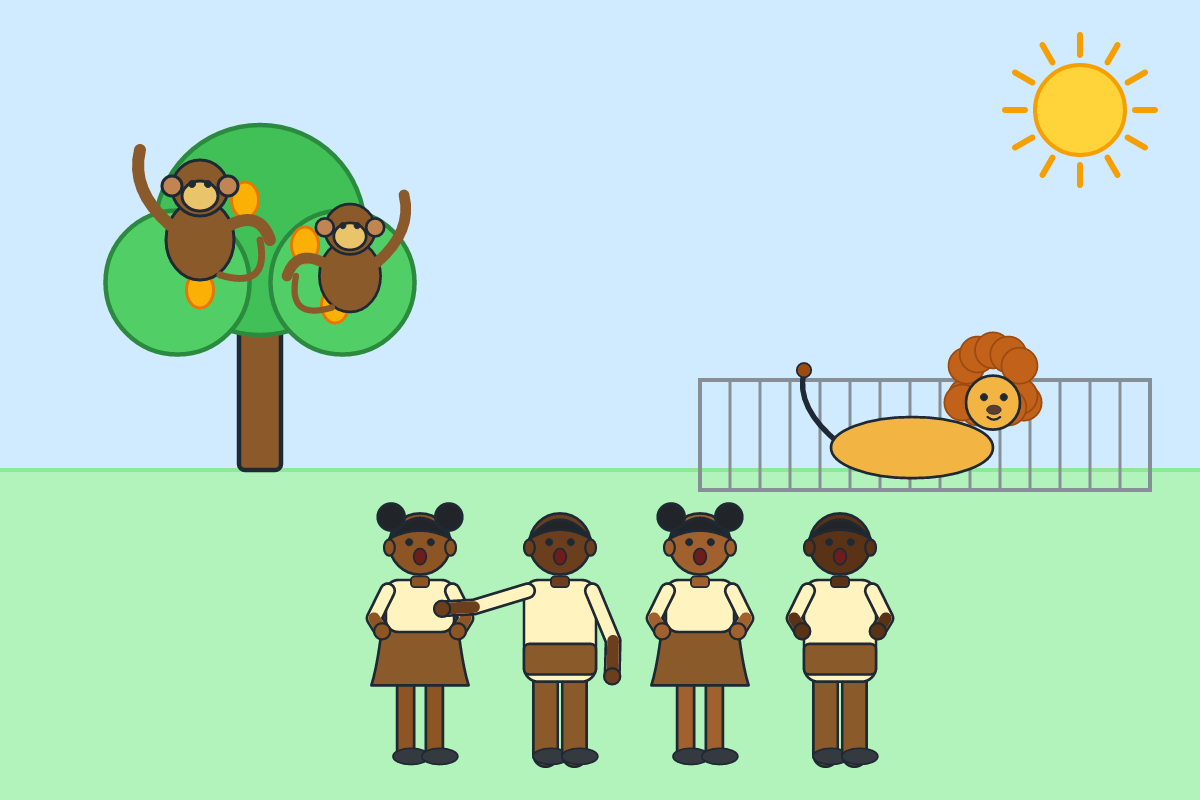
"On Monday, Akua's class went to the zoo in Kumasi. They saw lions, monkeys and a big snake. Akua liked the monkeys best because they were funny."
Questions
- When did the class go to the zoo? (on Monday)
- Where is the zoo? (in Kumasi)
- Which animal did Akua like best? (the monkeys)
New words
- zoo
- A place where wild animals are kept for people to see.
- funny
- Making people laugh.
- best
- Better than all the others.
Summary
- We read a story about a trip to the zoo.
- We answer questions about what we read.
Exercises
Answer in your exercise book first, then check your answers.
1. Which animal did Akua like best?
- A. Monkeys
- B. Lions
- C. Snakes
- D. Goats
Show answer
Answer: MonkeysThe story says monkeys.2. The class went on Monday.
- A. True
- B. False
Show answer
Answer: TrueThe story says so.3. The zoo is in ______.
Show answer
Answer: KumasiThe story says Kumasi.4. Why did Akua like the monkeys?
Show answer
Answer: They were funny.The story gives the reason.
Homework
- Write the names of three places you have visited with capital letters.