Basic 2 · English Language
Commands, Retelling, Narrative Writing and Nouns and Verbs
In this topic you will respond to instructions, retell stories, write about experiences step by step, and find nouns and verbs.
By the end of these notes you should be able to:
- Respond correctly to instructions and requests
- Retell a story in your own words
- Write about an experience using plan, draft and check
- Identify nouns and verbs in sentences
What you already know
- Sentence parts and paragraphs
Copy everything that has a blue line on its left into your notebook. The other parts are for reading.
Lesson 1
- Strand
- Oral Language
- Sub-strand
- Giving and Responding to Commands
- Indicator
- B2.1.9.1.1 – Respond to commands instructions and requests
Introduction
Instructions tell us what to do. Requests ask politely.
Instructions and Requests
| Instruction | Polite request |
|---|---|
| Close the door. | Please, close the door. |
| Bring your book. | Could you bring your book, please? |
| Sit down. | Please, may you sit down? |
New words
- instruction
- Words that tell someone what to do.
- request
- Asking politely for something.
- respond
- To act or answer.
Summary
- Instructions tell; requests ask politely.
- We respond by doing what is asked.
Exercises
Answer in your exercise book first, then check your answers.
1. Which is a polite request?
- A. Could you help me, please?
- B. Help me now!
- C. Go!
- D. Shut up!
Show answer
Answer: Could you help me, please?It is polite.2. "Close the door." is an instruction.
- A. True
- B. False
Show answer
Answer: TrueIt tells what to do.3. Asking politely is a ______.
Show answer
Answer: requestThat is a request.4. Change "Give me water." into a polite request.
Show answer
Answer: Could you give me water, please?Add please and could.
Lesson 2
- Strand
- Reading
- Sub-strand
- Comprehension
- Indicator
- B2.2.7.1.3 – Retell level-appropriate texts in own words
Introduction
Retelling means telling a story again in your own words.
Retelling in Own Words
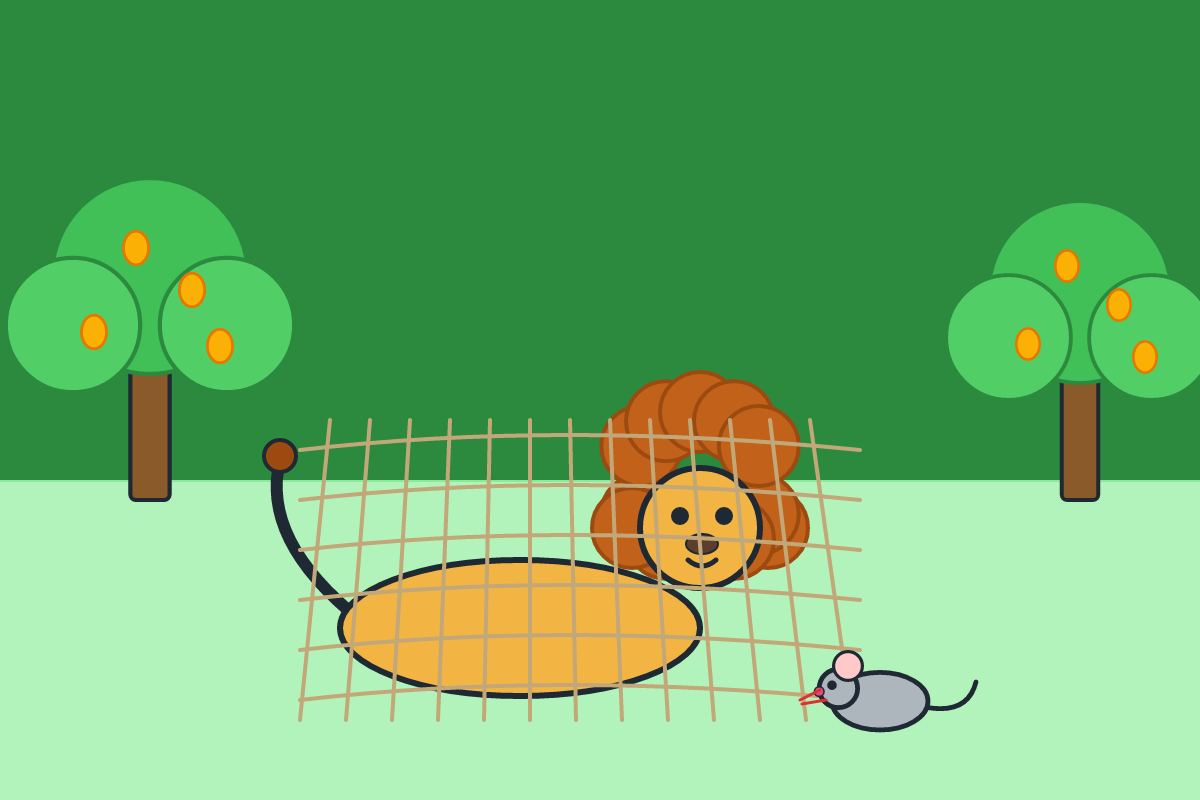
Story: "The lion slept under a tree. A small mouse ran over his face. The lion caught the mouse but let it go. Later, the lion was trapped in a net. The mouse chewed the net and freed him."
Retelling: "A lion let a mouse go. Later, the mouse saved the lion by chewing a net."
New words
- retell
- To tell again in your own words.
- trap
- Something that catches animals.
- free
- To let go.
Summary
- Retelling uses our own words.
- The mouse repaid the lion's kindness.
Exercises
Answer in your exercise book first, then check your answers.
1. Who saved the lion?
- A. The mouse
- B. A hunter
- C. A bird
- D. Another lion
Show answer
Answer: The mouseIt chewed the net.2. The lion ate the mouse.
- A. True
- B. False
Show answer
Answer: FalseHe let it go.3. To let go is to ______.
Show answer
Answer: freeThat is freeing.4. What lesson does the story teach?
Show answer
Answer: Small friends can help; kindness is repaid.The mouse helped the lion.
Lesson 3
- Strand
- Writing
- Sub-strand
- Narrative Writing
- Indicator
- B2.4.10.1.1 – Write about real or imagined experiences or events using the process approach
Introduction
Good writers plan, write, then check.
Writing About an Experience
The process
- Plan: list what happened.
- Draft: write sentences in order.
- Check: correct spelling, capitals and full stops.
- Final copy: write neatly.
Example: "Last Saturday I went to the beach with my family. We built sand castles. I saw a crab. It was a happy day."
New words
- experience
- Something that happened to you.
- draft
- A first try at writing.
- final copy
- The neat, finished writing.
Summary
- We plan, draft, check and write a final copy.
- Write events in order.
Exercises
Answer in your exercise book first, then check your answers.
1. What comes first in the writing process?
- A. Plan
- B. Final copy
- C. Check
- D. Draw
Show answer
Answer: PlanWe plan first.2. A draft is a first try.
- A. True
- B. False
Show answer
Answer: TrueWe improve it later.3. The neat, finished writing is the final ______.
Show answer
Answer: copyThat is the final copy.4. Write the first sentence about a trip you took.
Show answer
Answer: E.g. Last Sunday I visited my grandmother.It starts the story.
Lesson 4
- Strand
- Writing Conventions & Grammar Usage
- Sub-strand
- Using Simple and Compound Sentences
- Indicator
- B2.5.9.1.2 – Identify nouns and verbs in simple sentences
Introduction
Nouns are naming words. Verbs are action words.
Nouns and Verbs
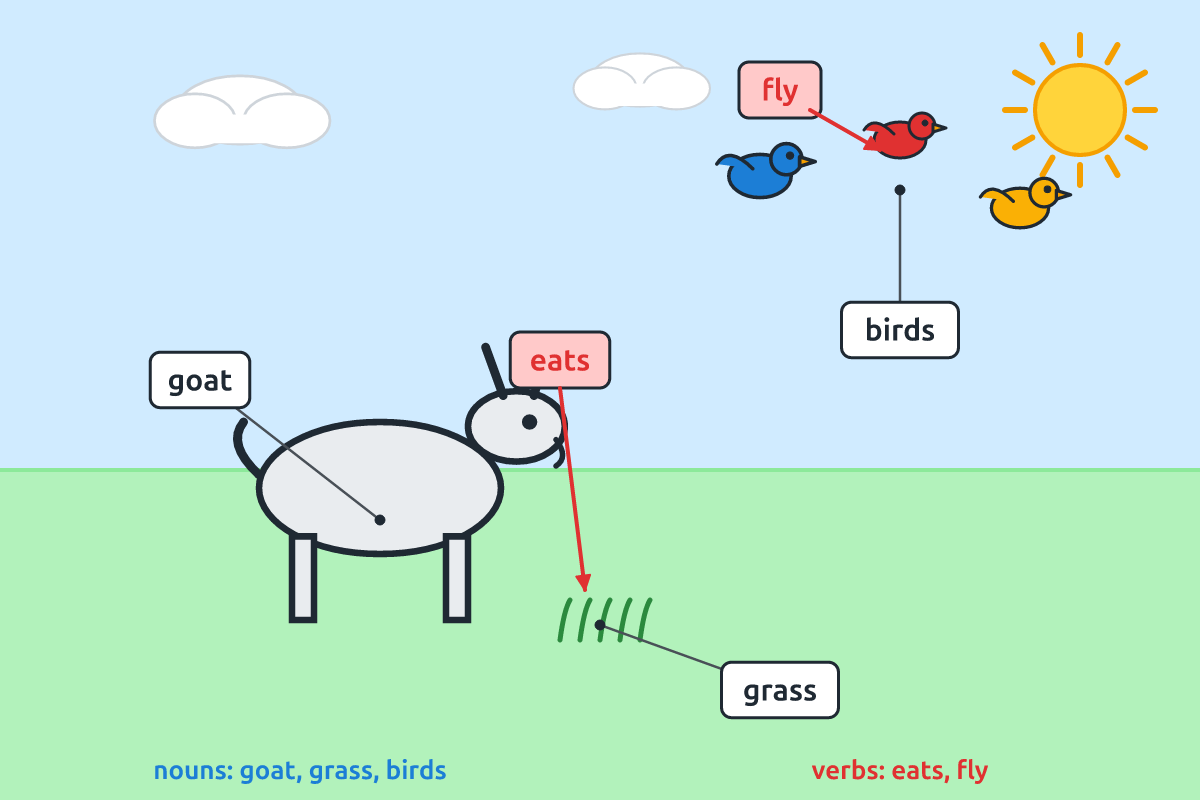
| Sentence | Noun | Verb |
|---|---|---|
| The goat eats grass. | goat, grass | eats |
| Ama sings. | Ama | sings |
| Birds fly. | birds | fly |
New words
- noun
- A naming word.
- verb
- An action word.
- identify
- To find and name.
Summary
- Nouns name people, places and things.
- Verbs show actions.
Exercises
Answer in your exercise book first, then check your answers.
1. In "Birds fly", which word is the verb?
- A. fly
- B. Birds
- C. the
- D. sky
Show answer
Answer: flyFly is the action.2. "Ama" is a noun.
- A. True
- B. False
Show answer
Answer: TrueIt names a person.3. An action word is a ______.
Show answer
Answer: verbThat is a verb.4. Find the noun and verb: "Kofi runs."
Show answer
Answer: Noun: Kofi; verb: runs.Kofi names; runs is the action.
Lesson 5
- Strand
- Extensive Reading
- Sub-strand
- Building the Love and Culture of Reading
- Indicator
- B2.6.1.1.1 – Read a variety of age and level appropriate books and texts from print
Introduction
Today we read about a trip to the beach.
Reading Time
"Last Saturday, Esi's family went to Labadi Beach. Father bought coconuts. Esi and her brother built a big sand castle. A wave came and washed it away. They laughed and built another one."
Questions
- Which beach did they visit? (Labadi Beach)
- What happened to the sand castle? (A wave washed it away.)
New words
- beach
- Sandy land by the sea.
- wave
- Moving water in the sea.
- castle
- A big strong building; here, made of sand.
Summary
- Esi's family visited Labadi Beach.
- A wave washed away their sand castle.
Exercises
Answer in your exercise book first, then check your answers.
1. What did Father buy?
- A. Coconuts
- B. Bread
- C. Ice cream
- D. Fish
Show answer
Answer: CoconutsThe passage says so.2. They built another sand castle.
- A. True
- B. False
Show answer
Answer: TrueThey laughed and built another.3. A ______ washed the castle away.
Show answer
Answer: waveWaves move water.4. How did the children feel when the wave came?
Show answer
Answer: They laughed; they were happy.They were not upset.
Homework
- Write about something you did last weekend using plan, draft and check.