Basic 2 · English Language
Questions, Sentence Structure and Two Paragraphs
In this topic you will ask and answer questions about texts, learn the parts of a sentence and write two paragraphs using leading questions.
By the end of these notes you should be able to:
- Ask and answer factual and "why" questions
- Identify the subject and predicate of a sentence
- Write two paragraphs using leading questions
What you already know
- Predictions and prepositions
Copy everything that has a blue line on its left into your notebook. The other parts are for reading.
Lesson 1
- Strand
- Oral Language
- Sub-strand
- Asking and Answering Questions
- Indicator
- B2.1.8.1.1 – Ask and answer factual and inferential questions about level appropriate texts
Introduction
Some questions are answered from the text. Others make us think.
Factual and Thinking Questions
Text: "Kweku forgot his umbrella. It rained heavily. He got home wet and cold."
| Type | Question | Answer |
|---|---|---|
| factual | What did Kweku forget? | his umbrella |
| thinking (inferential) | Why was he cold? | He was wet from the rain. |
New words
- factual question
- A question answered from the text.
- inferential question
- A question you think about to answer.
- text
- Written words we read.
Summary
- Factual answers are in the text.
- Inferential answers need thinking.
Exercises
Answer in your exercise book first, then check your answers.
1. What did Kweku forget?
- A. His umbrella
- B. His bag
- C. His shoes
- D. His book
Show answer
Answer: His umbrellaIt is in the text.2. "Why was he cold?" is a thinking question.
- A. True
- B. False
Show answer
Answer: TrueWe must think to answer.3. A question answered from the text is a ______ question.
Show answer
Answer: factualThat is factual.4. What should Kweku do next time?
Show answer
Answer: Take his umbrella.This is a thinking answer.
Lesson 2
- Strand
- Reading
- Sub-strand
- Comprehension
- Indicator
- B2.2.7.1.2 – Identify the structure of simple sentences
Introduction
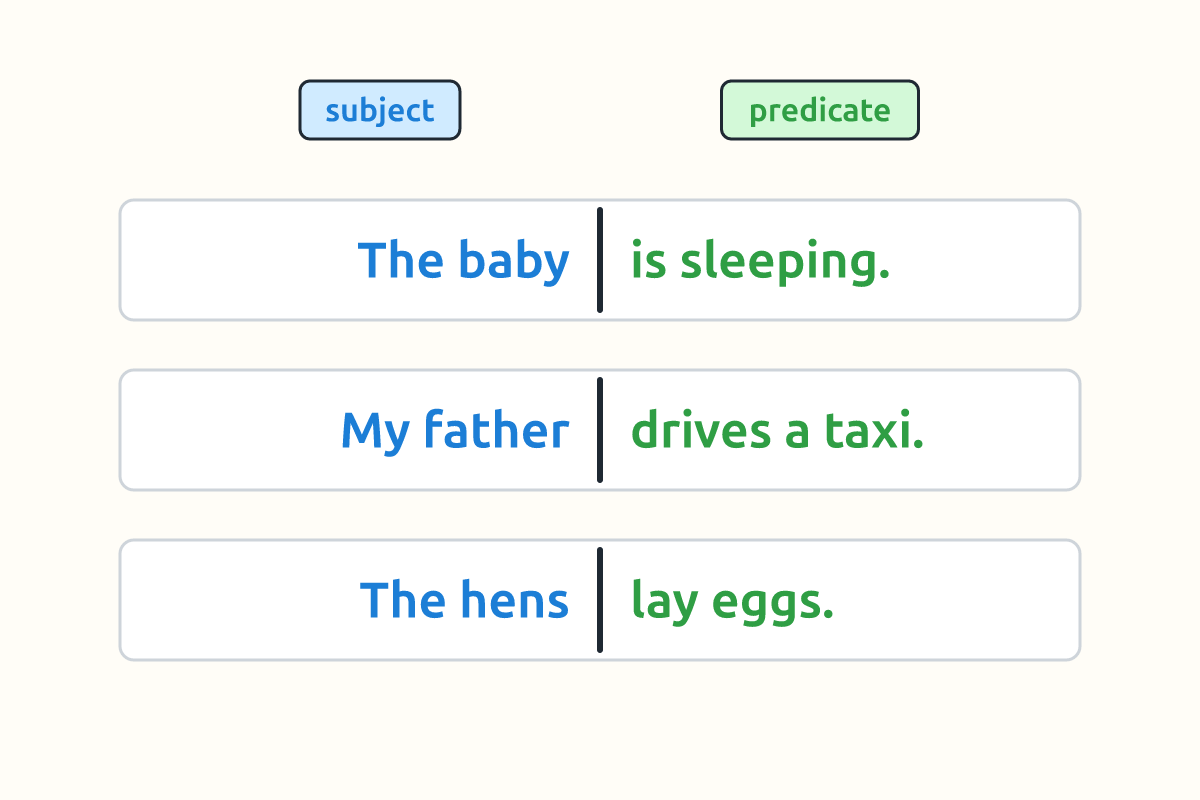
A sentence has two main parts.
Parts of a Sentence
| Subject (who or what) | Predicate (what they do) |
|---|---|
| The baby | is sleeping. |
| My father | drives a taxi. |
| The hens | lay eggs. |
New words
- subject
- Who or what the sentence is about.
- predicate
- What the subject does or is.
- simple sentence
- A sentence with one subject and one predicate.
Summary
- A simple sentence has a subject and a predicate.
- The subject tells who; the predicate tells what they do.
Exercises
Answer in your exercise book first, then check your answers.
1. In "The hens lay eggs", what is the subject?
- A. The hens
- B. lay
- C. eggs
- D. lay eggs
Show answer
Answer: The hensThey are who the sentence is about.2. "drives a taxi" is a predicate.
- A. True
- B. False
Show answer
Answer: TrueIt tells what the father does.3. Who or what a sentence is about is the ______.
Show answer
Answer: subjectThat is the subject.4. Underline the subject: "My sister sings well."
Show answer
Answer: My sisterShe is who the sentence is about.
Lesson 3
- Strand
- Writing
- Sub-strand
- Guided Composition
- Indicator
- B2.4.8.1.1 – Develop two coherent paragraphs on one idea or concepts using leading questions
Introduction
Leading questions help us plan what to write.
Writing Two Paragraphs
| Paragraph | Leading questions |
|---|---|
| 1 | What is your friend's name? How old is he or she? What does your friend look like? |
| 2 | What do you do together? Why do you like your friend? |
Example paragraph 1: "My best friend is Esi. She is eight years old. She is tall and has short hair."
Example paragraph 2: "We play ampe and read together. I like Esi because she is kind and helpful."
New words
- paragraph
- A group of sentences about one idea.
- leading question
- A question that guides your writing.
- idea
- A thought.
Summary
- A paragraph is a group of sentences about one idea.
- Leading questions help us plan two paragraphs.
Exercises
Answer in your exercise book first, then check your answers.
1. A group of sentences about one idea is a…
- A. Paragraph
- B. Word
- C. Letter
- D. Title
Show answer
Answer: ParagraphThat is a paragraph.2. Leading questions help us write.
- A. True
- B. False
Show answer
Answer: TrueThey guide our ideas.3. A thought is an ______.
Show answer
Answer: ideaThat is an idea.4. Write one sentence for paragraph 1 about your best friend.
Show answer
Answer: E.g. My best friend is Yaw.It answers a leading question.
Lesson 4
- Strand
- Writing Conventions & Grammar Usage
- Sub-strand
- Using Simple and Compound Sentences
- Indicator
- B2.5.9.1.1 – Identify the structure of simple sentences
Introduction
Simple sentences have one subject and one predicate.
Simple Sentences
- Ama dances.
- The dog barks loudly.
- We eat jollof on Sundays.
Common mistake: "The dog loudly." is not a sentence. It has no action word.
New words
- action word
- A verb, like dance or bark.
- complete
- Having all its parts.
- simple
- Not complicated.
Summary
- A simple sentence has a subject and a verb.
- A sentence must be complete.
Exercises
Answer in your exercise book first, then check your answers.
1. Which is a complete sentence?
- A. The dog barks.
- B. The dog.
- C. Barks loudly the.
- D. Loudly dog.
Show answer
Answer: The dog barks.It has a subject and a verb.2. "Ama dances." is a simple sentence.
- A. True
- B. False
Show answer
Answer: TrueIt has a subject and a verb.3. An action word is a ______.
Show answer
Answer: verbVerbs show action.4. Write a simple sentence about a bird.
Show answer
Answer: E.g. The bird sings.Subject + verb.
Lesson 5
- Strand
- Extensive Reading
- Sub-strand
- Building the Love and Culture of Reading
- Indicator
- B2.6.1.1.1 – Read a variety of age and level appropriate books and texts from print
Introduction
Today we read about the rain.
Reading Time
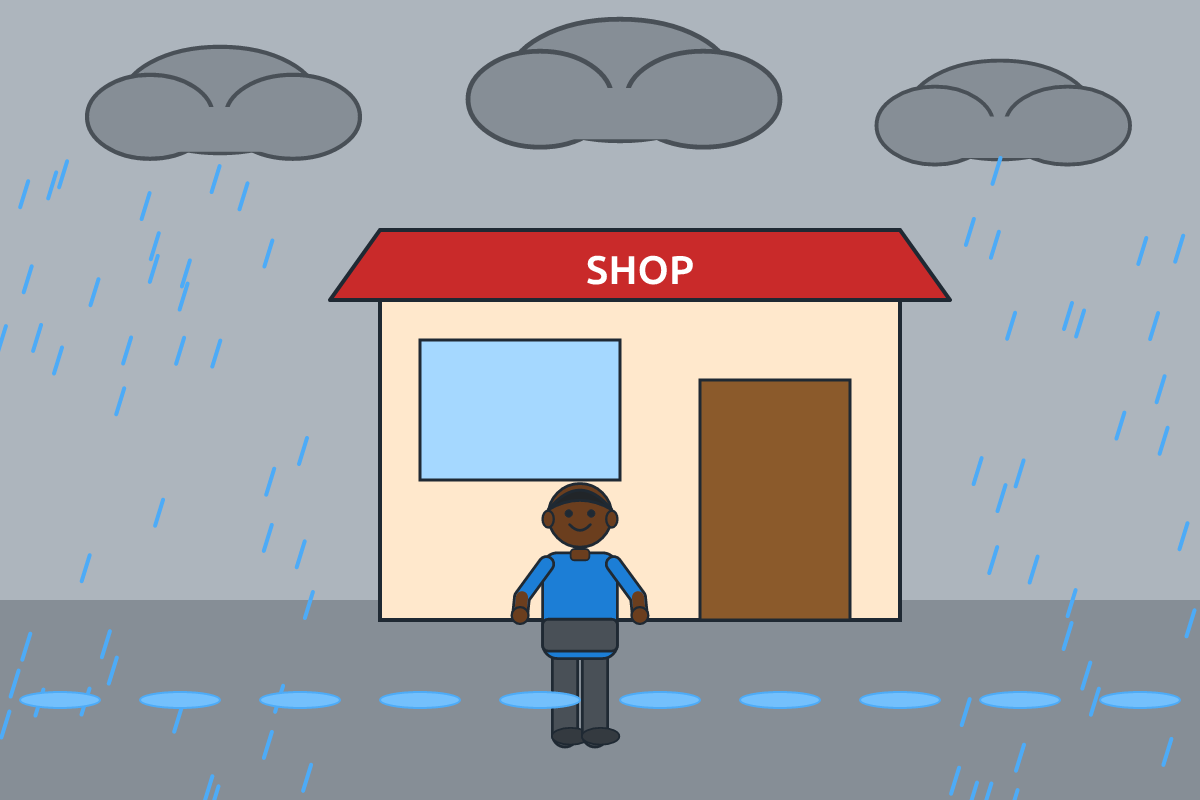
"Kweku left home without his umbrella. Dark clouds covered the sky. Soon it began to rain heavily. Kweku ran under a shop to hide. When the rain stopped, he walked home slowly. His mother gave him a towel and hot tea."
Questions
- Where did Kweku hide? (under a shop)
- What did his mother give him? (a towel and hot tea)
New words
- heavily
- In a strong way.
- hide
- To get out of sight.
- towel
- A cloth for drying.
Summary
- Kweku was caught in the rain.
- His mother gave him a towel and hot tea.
Exercises
Answer in your exercise book first, then check your answers.
1. Where did Kweku hide from the rain?
- A. Under a shop
- B. In a tree
- C. In a car
- D. In the river
Show answer
Answer: Under a shopThe passage says so.2. Kweku had his umbrella.
- A. True
- B. False
Show answer
Answer: FalseHe left without it.3. Dark ______ covered the sky.
Show answer
Answer: cloudsClouds came before the rain.4. Why did his mother give him a towel?
Show answer
Answer: He was wet from the rain.Towels dry us.
Homework
- Write two paragraphs about your favourite food using leading questions.