Basic 6 · Science · Life Cycle of Organism
Observing and Recording the Growth of a Plant
In this topic you will plant maize and okra seeds, observe their life cycle and record their growth in tables and graphs.
By the end of these notes you should be able to:
- Plant and care for maize and okra seeds
- Measure and record plant growth over time
- Present growth data in a table and a line graph
What you already know
- Life cycle of a flowering plant
Copy everything that has a blue line on its left into your notebook. The other parts are for reading.
- Strand
- Cycle
- Sub-strand
- Life Cycle of Organism
- Indicator
- B6.2.2.1.2 – Observe the life cycle of a plant
Introduction
Scientists learn by observing carefully and recording what they see. Now you will become a plant scientist and follow the life cycle of maize and okra.
1. Setting Up the Investigation
- Prepare a garden bed or pots with loose, fertile soil.
- Plant 3 maize seeds and 3 okra seeds about 2–3 cm deep, with spacing between them.
- Label each plant with a stick and its name.
- Water every evening, not too much.
- Keep a record card for each plant.
2. What to Observe and Record
| Day | Height (cm) | Number of leaves | Observations |
|---|---|---|---|
| 1 | 0 | 0 | seeds planted |
| 5 | 2 | 1 | seedling appeared |
| 10 | 8 | 3 | leaves green and healthy |
| 15 | 15 | 5 | maize leaves long with parallel veins |
| 20 | 24 | 7 | okra leaves broad with net veins |
Measure height from the soil to the tip of the tallest leaf (maize) or the top of the stem (okra) with a ruler. Measure on the same days and at the same time each day.
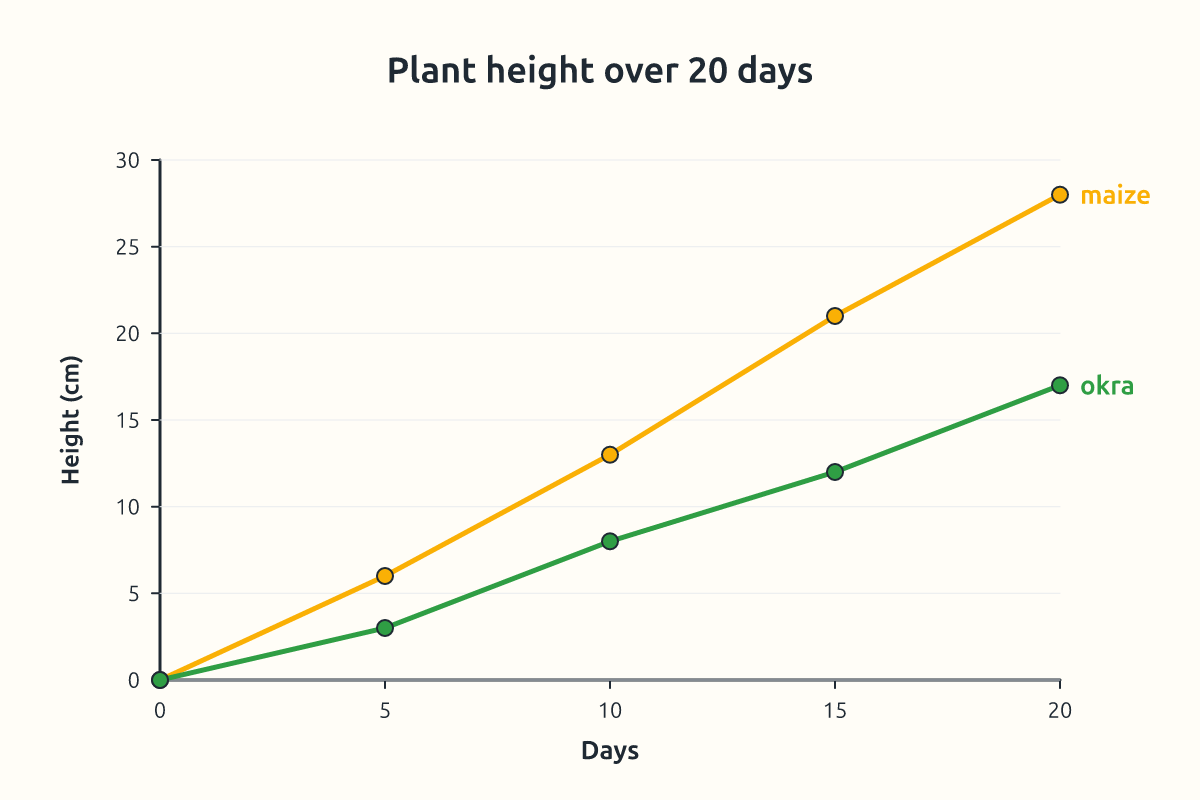
3. Drawing a Line Graph
- Draw the horizontal axis (x-axis) for days and the vertical axis (y-axis) for height.
- Choose a sensible scale and label both axes with units.
- Plot each measurement as a point.
- Join the points with straight lines.
- Give the graph a title.
4. Comparing Maize and Okra
| Feature | Maize | Okra |
|---|---|---|
| germination | hypogeal (grain stays underground) | epigeal (seed leaves come above the soil) |
| leaves | long, narrow, parallel veins | broad, lobed, net veins |
| roots | fibrous | tap root |
| flowers | male tassel at the top, female silks on the cob | yellow flowers on the stem |
| pollination | wind | mainly insects; also self-pollinating |
| approximate time to flower | about 2 months | about 1½–2 months |
Because the whole life cycle takes a few months, continue your observations after this week and record when flowers, fruits and new seeds appear.
Compare your results with other groups. If one group's plants grew faster, discuss possible reasons such as more sunlight or better soil.
New words
- observe
- To watch carefully.
- record
- To write down information.
- data
- Facts and measurements collected.
- line graph
- A graph that shows change over time with points joined by lines.
- axis
- A reference line on a graph.
- variable
- Something that can change in an experiment.
Summary
- Plant seeds, care for them and keep a record card.
- Measure height and count leaves on regular days.
- Present data in tables and line graphs.
- Maize and okra differ in germination, leaves, roots and flowers.
Class activity: Plant Scientists
- Plant maize and okra in the school garden.
- Record height and leaves every five days.
- Draw a line graph and present your findings.
You need: Viable maize, Okra seeds, Soil-filled pots or school garden bed, Watering can, Plant-growth record cards
Exercises
Answer in your exercise book first, then check your answers.
1. Which instrument measures plant height?
- A. Ruler
- B. Thermometer
- C. Rain gauge
- D. Compass
Show answer
Answer: RulerIn centimetres.2. A graph that shows change over time is a…
- A. line graph
- B. pie chart
- C. map
- D. table only
Show answer
Answer: line graphPoints joined by lines.3. Okra germination is…
- A. epigeal
- B. hypogeal
- C. underground only
- D. by spores
Show answer
Answer: epigealSeed leaves come above the soil.4. Measurements should be taken at the same time each day.
- A. True
- B. False
Show answer
Answer: TrueFor fair comparison.5. Maize has broad, net-veined leaves.
- A. True
- B. False
Show answer
Answer: FalseMaize has narrow, parallel-veined leaves.6. Facts and measurements collected are called ______.
Show answer
Answer: dataRecorded in tables.7. Give two differences between maize and okra plants.
Show answer
Answer: Maize: fibrous roots, parallel veins. Okra: tap root, net veins (or germination type, flowers).Any two.8. Why should you plant more than one seed of each type?
Show answer
Answer: Some seeds may not germinate or may die, and several plants give more reliable results.Reliability.
Homework
- Continue recording your plant's growth for four more weeks.