Basic 6 · Science · Earth Science
How Rain Falls from Clouds
In this topic you will explain how clouds form and how rain falls from them, and describe rainfall patterns in Ghana.
By the end of these notes you should be able to:
- Describe how clouds form
- Explain how cloud droplets become raindrops
- Describe rainfall seasons in Ghana and how rainfall is measured
What you already know
- Evaporation and condensation (Basic 5)
Copy everything that has a blue line on its left into your notebook. The other parts are for reading.
- Strand
- Cycle
- Sub-strand
- Earth Science
- Indicator
- B6.2.1.2.1 – Explain how rain falls from clouds
Introduction
Dark clouds gather, the wind blows and then rain pours down. But how does water get into the clouds, and why does it fall?
1. How Clouds Form
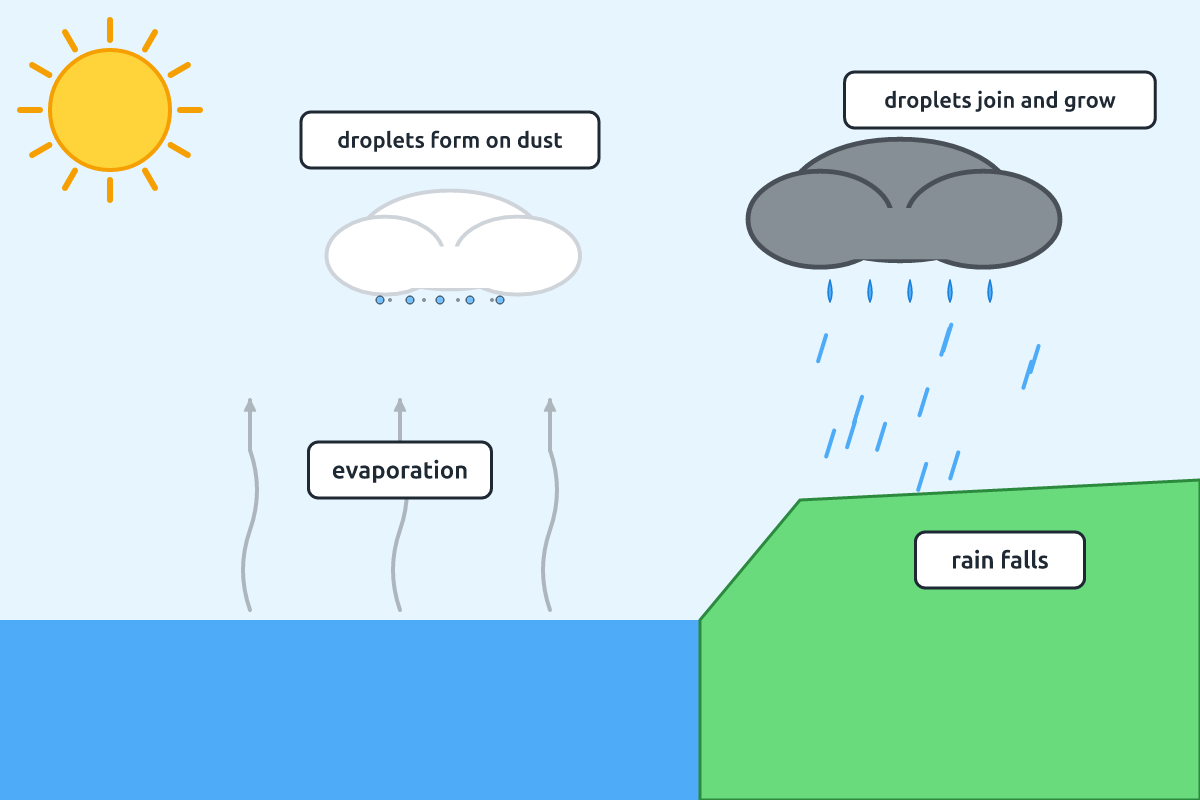
The sun heats water in seas, lakes, rivers and plants, and some of it evaporates into water vapour. Warm, moist air rises. As it rises, it cools. Cool air cannot hold as much water vapour, so the vapour condenses onto tiny particles of dust, smoke or salt in the air, forming tiny water droplets. Millions of these droplets together form a cloud.
2. From Cloud Droplets to Raindrops
Cloud droplets are very small and light, so they float. Inside the cloud, air moves up and down, and the droplets bump into each other and join together (coalesce) to form bigger drops. In very tall, cold clouds, ice crystals also form and grow, then melt into raindrops as they fall. When the drops become too heavy for the rising air to hold up, they fall to the ground as rain.
3. Types of Rain Clouds
| Cloud | Appearance | Weather |
|---|---|---|
| cumulus | white, fluffy, like cotton | fine weather; can grow into rain clouds |
| cumulonimbus | very tall, dark, anvil-shaped top | heavy rain, thunder, lightning, strong winds |
| nimbostratus | thick, grey layer covering the sky | steady, long-lasting rain |
4. Rainfall in Ghana
Southern Ghana usually has two rainy seasons: a major season from about April to July and a minor season from about September to November. Northern Ghana usually has one rainy season, from about May to October. The harmattan, a dry, dusty wind from the Sahara, blows from about December to February.
Rainfall is measured with a rain gauge, a container with a funnel that collects rain. The amount is read in millimetres (mm). The Ghana Meteorological Agency (GMet) measures rainfall and gives weather forecasts that help farmers and fishermen.
Safety: During thunderstorms, stay indoors, keep away from tall trees and do not hold metal objects in the open.
New words
- condensation
- The change of water vapour into liquid water.
- cloud
- A mass of tiny water droplets or ice crystals in the air.
- coalesce
- To join together.
- precipitation
- Water falling from clouds as rain, hail or snow.
- rain gauge
- An instrument for measuring rainfall.
- meteorology
- The study of weather.
Summary
- Rising moist air cools and condenses to form clouds.
- Cloud droplets join together until they are heavy enough to fall.
- Cumulonimbus clouds bring heavy rain and thunderstorms.
- Southern Ghana has two rainy seasons; the north has one.
Class activity: Make a Rain Gauge
- Cut the top off a clear plastic bottle and turn it upside down into the base as a funnel.
- Mark a millimetre scale on the side with a ruler.
- Place it in an open area and record the rainfall for two weeks.
You need: Clear bowl of water, Metal lid, Locally made water-cycle picture chart
Exercises
Answer in your exercise book first, then check your answers.
1. Clouds are made of…
- A. tiny water droplets
- B. smoke only
- C. cotton
- D. sand
Show answer
Answer: tiny water dropletsOr ice crystals.2. Why do raindrops fall?
- A. They become too heavy for rising air to hold
- B. They are pushed by birds
- C. The sun pulls them
- D. Clouds break
Show answer
Answer: They become too heavy for rising air to holdThey grow by joining.3. Which cloud brings thunderstorms?
- A. Cumulonimbus
- B. Cumulus
- C. Cirrus
- D. Fog
Show answer
Answer: CumulonimbusTall and dark.4. Rising air cools as it goes up.
- A. True
- B. False
Show answer
Answer: TrueThat causes condensation.5. Northern Ghana has two rainy seasons.
- A. True
- B. False
Show answer
Answer: FalseIt has one; the south has two.6. Rainfall is measured with a rain ______.
Show answer
Answer: gaugeIn millimetres.7. Explain how a cloud forms.
Show answer
Answer: Water evaporates, the moist air rises and cools, and vapour condenses on dust into tiny droplets that form a cloud.Evaporation → cooling → condensation.8. Why is rainfall information important to farmers?
Show answer
Answer: It helps them know when to plant, how much water crops will get and how to plan harvests.Planning farming.
Homework
- Record the weather each day for a week, noting clouds and rainfall.