Basic 6 · Religious and Moral Education · The Environment
Religious Lessons on Preserving the Environment
In this topic you will explain the religious teachings and moral lessons that encourage people to preserve the environment.
By the end of these notes you should be able to:
- Explain teachings of Christianity, Islam and Traditional Religion on the environment
- Identify moral lessons from these teachings
- Apply the lessons in daily life
What you already know
- Humans and nature
Copy everything that has a blue line on its left into your notebook. The other parts are for reading.
- Strand
- God’s Creation And Attributes
- Sub-strand
- The Environment
- Indicator
- B6.1.2.1.2 – Explain the religious and moral lessons in preserving the environment
Introduction
Long before scientists spoke of climate change, religions taught people to respect the earth. Their teachings remain powerful reasons to protect the environment today.
1. Christian Teachings
- God made humans stewards: "The Lord God took the man and put him in the Garden of Eden to work it and take care of it" (Genesis 2:15).
- The land must rest: the Sabbath year allowed fields to rest every seventh year (Leviticus 25:4).
- The earth belongs to God (Psalm 24:1), so people must use it responsibly.
2. Islamic Teachings
- Humans are khalifah (stewards) and will account to Allah for how they treated the earth (Qur'an 6:165).
- "Do not cause corruption on the earth after it has been set in order" (Qur'an 7:56).
- The Prophet taught that planting a tree from which people or animals eat is a continuing charity.
- Wasting water is discouraged, even when washing for prayer by a flowing river.
3. Traditional Teachings
- The earth (Asase Yaa) is respected; farming is forbidden on certain days.
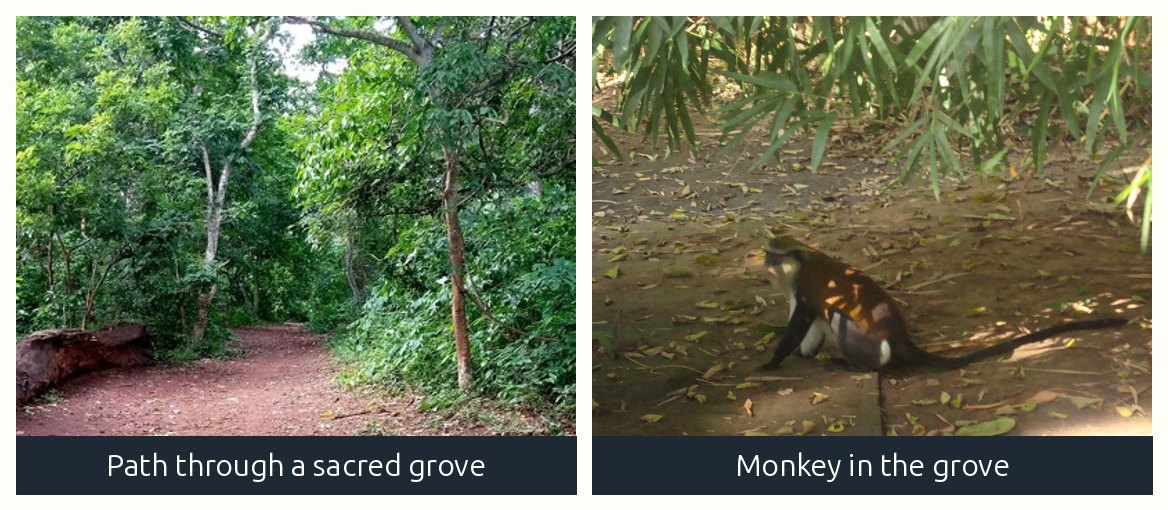
- Sacred groves and rivers are protected by taboos (e.g. Boabeng-Fiema Monkey Sanctuary, sacred groves around shrines).
- Clan totems forbid killing certain animals.
- Libation and festivals honour the land and water.
4. Moral Lessons
| Lesson | Meaning |
|---|---|
| stewardship | we are caretakers, not owners, of the earth |
| accountability | we will answer for how we use the environment |
| moderation | do not waste resources |
| respect for life | protect plants and animals |
| responsibility to future generations | leave the earth in good condition |
These lessons show that caring for the environment is not only a scientific or government matter but also a religious and moral duty. A believer who wastes water, burns the bush carelessly or dumps rubbish in a river is failing in a duty to God and to other people. A believer who plants trees and keeps the surroundings clean is practising their faith.
New words
- steward
- A caretaker who manages something for its owner.
- accountability
- Being responsible for one's actions.
- corruption
- Damage or destruction.
- moderation
- Avoiding excess or waste.
- sacred grove
- A forest protected for religious reasons.
- totem
- An animal or plant that represents a clan.
Summary
- Christianity teaches that humans are stewards of God's earth.
- Islam teaches stewardship, accountability and avoiding waste.
- Traditional Religion protects nature through taboos, totems and sacred groves.
- Key lessons: stewardship, accountability, moderation and respect for life.
Class activity: Teaching Posters
- Each group chooses one religion.
- Make a poster with three teachings on the environment.
- Add a moral lesson and a practical action for each teaching.
You need: Local tree seedling, Broom, Waste basket
Exercises
Answer in your exercise book first, then check your answers.
1. Which verse says God put man in the garden to care for it?
- A. Genesis 2:15
- B. Psalm 23:1
- C. John 1:1
- D. Exodus 20:3
Show answer
Answer: Genesis 2:15Stewardship.2. In Islam, humans as stewards are called…
- A. khalifah
- B. imam
- C. hajji
- D. muezzin
Show answer
Answer: khalifahRepresentatives.3. Boabeng-Fiema protects…
- A. monkeys
- B. elephants
- C. crocodiles
- D. lions
Show answer
Answer: monkeysSacred animals.4. Planting a tree is a continuing charity in Islam.
- A. True
- B. False
Show answer
Answer: TrueProphetic teaching.5. Traditional Religion has no rules protecting nature.
- A. True
- B. False
Show answer
Answer: FalseTaboos and totems protect it.6. A caretaker of something for its owner is a ______.
Show answer
Answer: stewardHumans are stewards.7. State one environmental teaching from each religion.
Show answer
Answer: Christianity: Genesis 2:15; Islam: do not cause corruption (7:56); Traditional: sacred groves.One each.8. Explain the lesson of "accountability" in caring for the environment.
Show answer
Answer: People will answer to God (and society) for how they used or damaged the environment, so they must act responsibly.Moral responsibility.
Homework
- Ask an elder about a taboo in your area that protects nature and explain its purpose.