Basic 6 · Religious and Moral Education · The Environment
Humans and Nature Depend on Each Other
In this topic you will explain the interdependence between humans, plants, animals and the non-living environment.
By the end of these notes you should be able to:
- Explain interdependence in nature
- Describe food chains that include humans
- Explain why balance in nature is important
What you already know
- Human activities and the environment
Copy everything that has a blue line on its left into your notebook. The other parts are for reading.
- Strand
- God’s Creation And Attributes
- Sub-strand
- The Environment
- Indicator
- B6.1.2.1.1 – Explain how humankind and the environment interrelate
Introduction
Bees pollinate crops, birds spread seeds, worms make the soil fertile and trees give us oxygen. Everything in nature is connected, including human beings.
1. Interdependence
Interdependence: The way living and non-living things depend on each other.
| Living thing | Depends on | Gives back |
|---|---|---|
| plants | sun, soil, water, carbon dioxide | food, oxygen, shade, homes for animals |
| bees | flowers for nectar | pollination of crops |
| earthworms | dead leaves | fertile soil |
| humans | plants, animals, water, air | care, planting, protection (or harm) |
2. Food Chains
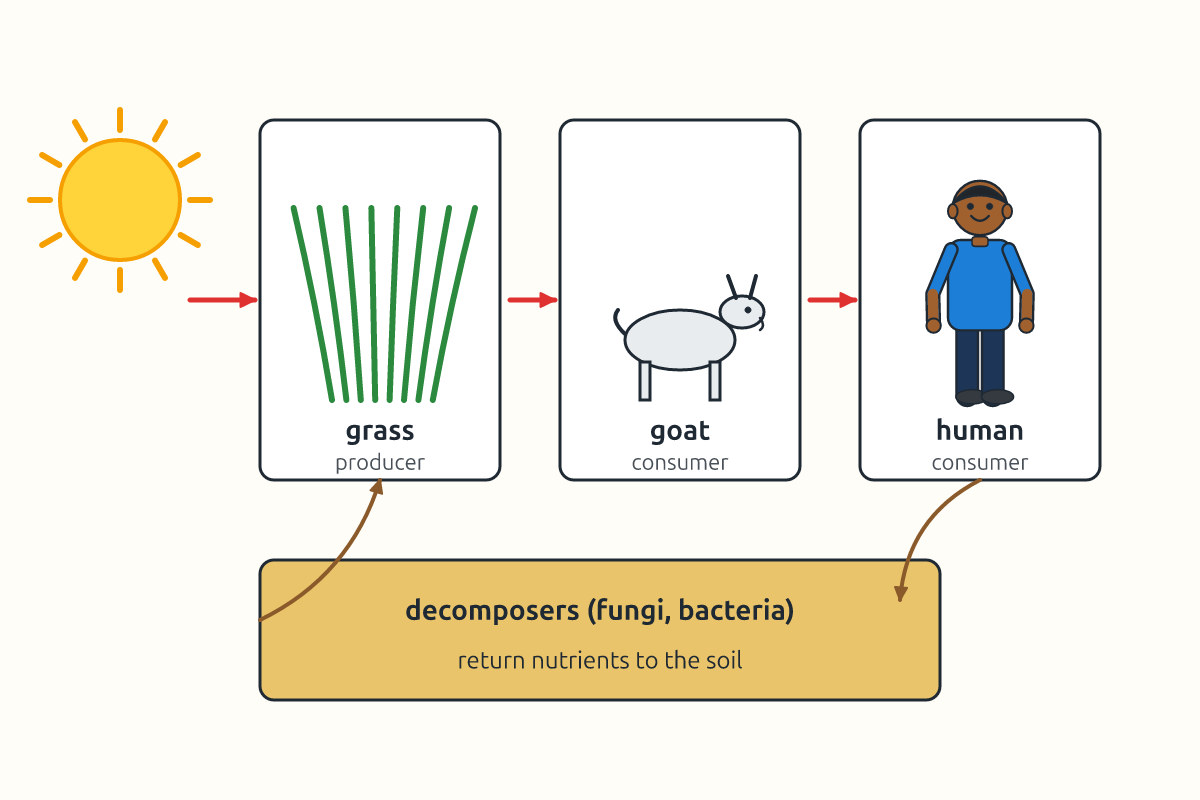
A food chain shows how energy passes from one living thing to another. It always begins with a green plant (producer).
Example: grass → goat → human. Another: maize → grasshopper → bird → hawk.
3. Balance in Nature
When one part of nature is destroyed, others suffer. If farmers use too much pesticide and kill all the bees, crops will not be pollinated and harvests will fall. If people kill too many snakes, the number of rats increases and destroys crops. Keeping balance means protecting all parts of nature.
4. Religious Teaching on Balance
The Qur'an teaches that Allah created everything in due measure and balance (mizan), and humans must not upset it (Qur'an 55:7–9). The Bible describes God caring for all creatures, even sparrows (Matthew 10:29). In Traditional Religion, taboos and totems protect certain animals and plants, helping to keep balance.
Human beings have a special place in this web because they can think, plan and change the environment more than any other creature. This power brings responsibility. A farmer who plants trees around his farm, protects bees and avoids too much pesticide helps keep balance, while a person who burns the bush destroys many links in the web at once.
Protecting the web of life is therefore protecting ourselves, because humans are part of it and cannot survive without it.
New words
- interdependence
- Depending on each other.
- food chain
- The order in which living things feed on one another.
- producer
- A green plant that makes its own food.
- consumer
- An animal that eats other living things.
- decomposer
- An organism that breaks down dead matter.
- balance
- A state where all parts are in proper proportion.
Summary
- Living and non-living things depend on each other.
- Food chains start with plants and pass energy along.
- Destroying one part of nature affects others.
- Religions teach that humans must keep nature in balance.
Class activity: Web of Life
- Each pupil represents a part of nature (sun, grass, goat, human, bee, etc.).
- Pass a ball of string to show who depends on whom.
- Remove one part and see how the web is affected.
You need: Potted maize plant, Local soil in a clear cup, Printed photographs of local people, Animals
Exercises
Answer in your exercise book first, then check your answers.
1. A food chain begins with a…
- A. green plant
- B. lion
- C. human
- D. hawk
Show answer
Answer: green plantProducer.2. Bees help crops by…
- A. pollinating flowers
- B. eating leaves
- C. digging soil
- D. making shade
Show answer
Answer: pollinating flowersPollination.3. Killing too many snakes may cause…
- A. more rats
- B. more rain
- C. fewer crops pests
- D. cleaner water
Show answer
Answer: more ratsBalance is upset.4. Humans depend on plants for oxygen.
- A. True
- B. False
Show answer
Answer: TruePlants give oxygen.5. Destroying one part of nature has no effect on others.
- A. True
- B. False
Show answer
Answer: FalseAll parts are connected.6. An organism that breaks down dead matter is a ______.
Show answer
Answer: decomposere.g. fungi.7. Write a food chain with three links ending in a human.
Show answer
Answer: E.g. grass → cow → human.Producer first.8. Explain why killing all the bees would harm humans.
Show answer
Answer: Bees pollinate crops; without them crops produce less food, causing hunger.Interdependence.
Homework
- Draw a food web from your local environment with at least five living things.