Basic 6 · Physical Education · Rhythmic Skills
Small Stunts: Shifting the Base of Support
In this topic you will perform simple small stunts while shifting the base of support from one body part to another.
By the end of these notes you should be able to:
- Explain base of support and centre of gravity
- Perform stunts that shift weight between body parts
- Link stunts into a short sequence
What you already know
- Small-group balance stunts (Basic 5)
Copy everything that has a blue line on its left into your notebook. The other parts are for reading.
- Strand
- Motor Skill And Movement Patterns
- Sub-strand
- Rhythmic Skills
- Indicator
- B6.1.4.1.5 – Perform simple small stunts while shifting base of support from one body part to the other
Introduction
Gymnasts move smoothly from standing to kneeling, from hands to feet, and from one balance to another. Shifting the base of support with control is the key.
1. Base of Support
The base of support is the part of the body in contact with the ground. A wide base is stable; a narrow base is harder to balance. To stay balanced, keep your centre of gravity above your base. When shifting from one base to another, move smoothly and slowly.
2. Stunts to Practise
| Stunt | Base of support | Shift |
|---|---|---|
| front support (plank) | hands and toes | shift to side support |
| side support | one hand and the side of the feet | shift back to front support |
| crab position | hands and feet, belly up | lift one hand or leg |
| V-sit | buttocks | rock back to a shoulder balance |
| shoulder balance (candle) | shoulders and upper arms | roll down to sitting |
| kneeling balance | one knee and one hand | stretch the other arm and leg out |
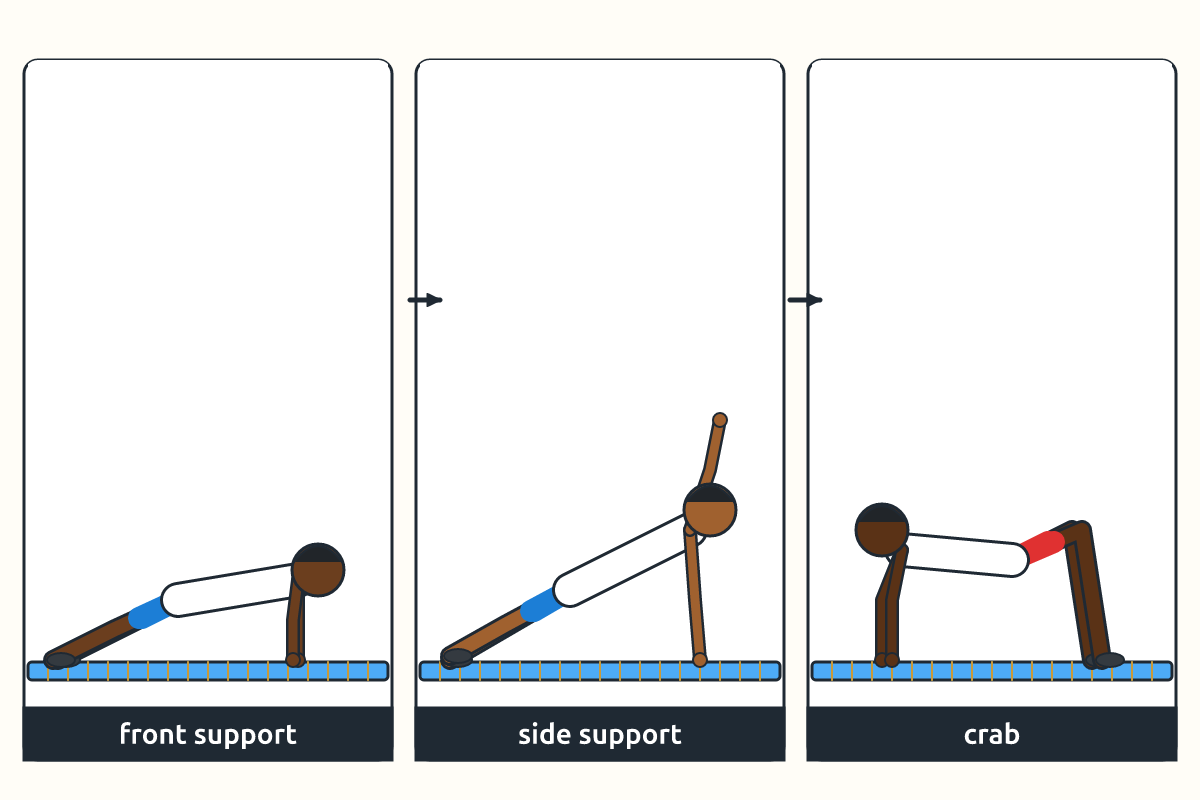
3. Linking a Sequence
- Start in a front support and hold for 3 seconds.
- Turn into a side support and hold.
- Return to front support, then walk feet forward to a squat.
- Roll gently back into a shoulder balance and hold.
- Roll down to a V-sit and finish with a stretch.
A sequence should have a clear start and finish, smooth transitions and good body tension (tight muscles, pointed toes).
Safety: Always use a mat. Warm up first, especially the wrists, neck and shoulders. Never put pressure on the neck in a shoulder balance; support your back with your hands.
New words
- stunt
- A skilful movement or balance.
- base of support
- The body parts touching the ground.
- transition
- A movement linking two positions.
- sequence
- A set of movements in order.
- body tension
- Keeping muscles firm and controlled.
- centre of gravity
- The point where body weight is centred.
Summary
- The base of support is the body part touching the ground.
- Keep the centre of gravity over the base.
- Shift smoothly between bases.
- Link stunts into a sequence with control and safety.
Class activity: My Stunt Sequence
- Create a sequence of four stunts with different bases.
- Practise smooth transitions.
- Perform for your partner, who gives feedback on control and tension.
You need: Long skipping rope, Plastic-bottle cones, Woven landing mat
Exercises
Answer in your exercise book first, then check your answers.
1. The body part touching the ground is the…
- A. base of support
- B. centre of gravity
- C. tension
- D. transition
Show answer
Answer: base of supportIt supports the body.2. Which base is most stable?
- A. wide
- B. narrow
- C. one toe
- D. one finger
Show answer
Answer: wideMore stable.3. A movement linking two positions is a…
- A. transition
- B. tension
- C. mat
- D. candle
Show answer
Answer: transitionSmooth link.4. Stunts should be done on a mat.
- A. True
- B. False
Show answer
Answer: TrueFor safety.5. In a shoulder balance, the weight should be on the neck.
- A. True
- B. False
Show answer
Answer: FalseSupport the back with the hands.6. A set of movements in order is a ______.
Show answer
Answer: sequenceLinked stunts.7. Name three stunts and their bases of support.
Show answer
Answer: Front support (hands and toes), side support (one hand and feet), V-sit (buttocks).Any three.8. Why is body tension important in stunts?
Show answer
Answer: Firm muscles give control and balance and make movements look neat.Control.
Homework
- Practise holding a front support and a side support for 20 seconds each.